
 July 4, 1827 was a special day in New York and certainly one for celebratory events around the state. It was the 51st anniversary of the signing of the Declaration of Independence (July 4, 1776). Moreover, July 4, 1827 was the final emancipation of enslaved people in the state of New York, an anniversary being commemorated statewide next year.
Peleg Weaver, age 22, always enjoyed the merriment of commemorative festivities. With a few friends, Weaver planned some July 4th fireworks on Warren Street in Glens Falls, behind the Abraham Wing residence. Abraham Wing (1721–1795) was a founder of Glens Falls and Queensbury.
On July 4, 1827, Peleg Weaver and others began firing booming salutes from an old colonial cannon. The iron tube was overheating from the rapid salvos.
As Weaver prepared for another blast with the ramrod plunged down the bore of the metal noisemaker, the aged artillery piece unexpectedly exploded. Weaver’s arms were severely mangled and sadly, they had to be amputated.
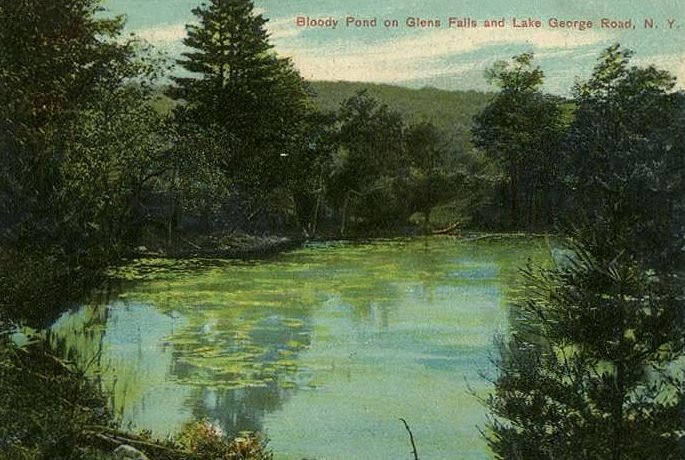
One newspaper account called the 18th-century ordnance “an iron piece taken from Bloody pond [sic] where it had perhaps laid from the time of the French & Indian war [sic].” The cannon was also described, as “nearly honey combed with rust.”
 Bloody Pond, located about two miles south of Lake George, was the site of a skirmish during the Battle of Lake George on September 8, 1755. That combat was one of the few early British victories in the French & Indian War (1755–1763).
Reportedly, prior to the terrible July 4, 1827 artillery explosion, a local board of ordnance condemned the colonial-era weapon.
Though a tragedy, Peleg Weaver overcame many physical obstacles to live a long and fruitful life. He became a Protestant Methodist minister and married. According to census records, Deborah and Peleg Weaver had at least one child, a son named George.
For a time, Peleg Weaver was a cleric serving a parish church located just north of Saratoga Springs. Weaver was occasionally called “the armless preacher.” He also had been a pastor in North Cos Cob in the Greenwich, Connecticut-area.
In 1882, at the age of 75, Peleg Weaver died of tuberculosis.
A few years before his death, Reverand Weaver was asked if he ever wanted to fire another cannon. The patriotic parson replied, “No, but I always like to hear them.”
Read more about the French and Indian War in New York.
A version of this article first appeared on the Lake George Mirror, America’s oldest resort paper, covering Lake George and its surrounding environs. You can subscribe to the Mirror HERE.
Illustrations, from above: Postcard showing Bloody Pond on Glens Falls and Lake George Road, ca. 1912 (American News Company, courtesy Adirondack Experience); and a 2025 Google Earth image showing what is believed to be Bloody Pond, adjacent to what is now Route 9 (shown at left), just a little over two miles from the south end of Lake George.






Recent Comments