
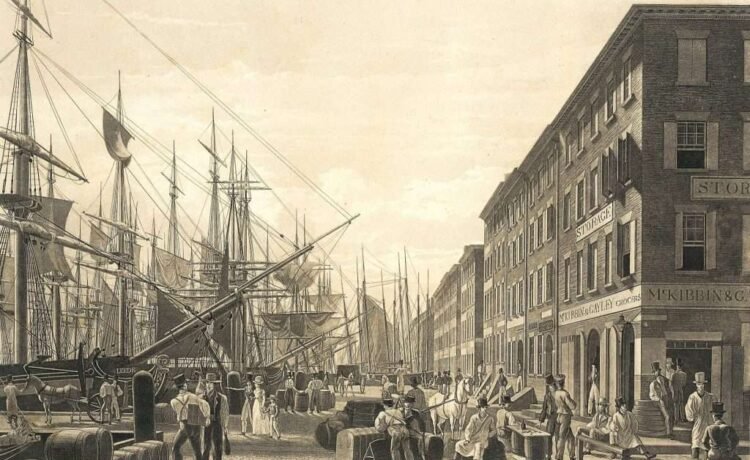
 In August 1829 the passenger ship Emily arrived from Liverpool and anchored in New York Harbor. Like many 19th century ships entering New York’s bustling port, Emily carried migrants intent on making a new life in the city. Passages such as the Emily’s were commonplace but the actions of her master, William Thompson, proved exceptional.
Thompson, likely on the order of shipowner George Miln, flagrantly ignored an 1824 New York State law intended to regulate the flow of migrants into the metropolis.
Under the law, Thompson was responsible for reporting the name, place of origin, age, and occupation of every individual aboard the Emily who planned to disembark into the city.
Thompson’s action resulted in city of New York taking action against Miln, seeking to enforce the punitive aspect of the 1824 law which would fine those ships who failed to make the required report to the Mayor.
With 100 passengers, the city expected a fine payment of $75 per head for a grand total of $15,000. The resulting case would weigh state immigration regulations against federal commercial regulations. More broadly, the case provides insight into America’s fraught efforts to enact immigration policy, yesterday and today.
Historically, states (and their colonial antecedents) bore responsibility for policing in-migration – whether this movement was overland or via the open ocean. During the late 18th and early 19th centuries states were empowered to set laws regulating migration.
It was believed that federal immigration policy would have been an impediment to fluid state needs. For instance, states that wanted to encourage migration to meet free labor needs or rapidly increase the total population (in the case of western territories) would be able to do so.
Simultaneously, states without such needs or in the midst of economic downturns would have pursued more restrictive policies.
 The situation evolved during the antebellum era. During this time immigration to America’s eastern seaboard cities exploded with migrants fleeing famine or instability in Ireland and Germany.
Eastern seaboard states recoiled in response to this influx, with a noticeable increase in anti-Catholic and anti-Irish sentiment. These nativist sentiments were enhanced by the increased competition for scarce jobs that resulted from a volatile economy that would burst in the Panic of 1837.
To defend against these forces, states like New York passed legislation to stem the worst effects of mass migration.
The 1824 law at the center of New York v. Miln required every master or commander of any ship arriving at the port of New York “from any country out of the United States, or from any other of the United States” to report “the name, place of birth, and last legal settlement, age and occupation” of every passenger aboard.
The New York legislature made the larger intentions of the law clear by also requiring surety, “not exceeding three hundred dollars for each passenger not being a citizen of the United States” to protect the state against the costs associated with “the maintenance and support of every such person, and for the maintenance and support of the child or children of any such person which many be born after such importation” if they were to become dependent on the government for subsistence.
The migration-related concerns of states like New York were made even clearer in the state’s argument before the US Supreme Court. David Bayer Ogden arguing for the state asserted that the New York law was “necessary for the prevention of the introduction of paupers, and to prevent the city being charged with the support of the outcast population of foreign nations.”
Conversely, Miln’s attorney warned that the “law of New York… if carried into full effect, will entirely prevent the entrance of all persons from abroad into the city of New York, the great throat of emigration.”
As New York moved to punish George Miln, federal law was in the midst of a renaissance. Thanks to decisions of the John Marshall court, federal law was ascendant with a prevailing sentiment that interpretations of Constitutional principles and federal law were supreme to state action.
Shippers who felt the chilling effect of New York’s state law on the lucrative transit of passengers into major port cities hoped the empowered federal courts would provide relief.
Miln’s argument against the city of New York hinged on an interpretation of the Constitution’s Commerce Clause (Article I, Section 8, Clause 3 of the U.S. Constitution) which empowered Congress to “regulate Commerce with foreign Nations, and among the several States, and with the Indian Tribes.”
Miln’s lawyers endeavored to convince the court that New York’s law was a commercial regulation which would be unconstitutional if such powers were exclusively within the purview of the federal government.
The case was first argued before the court in 1834 but a divided result and John Marshall’s death in 1835 lead to a re-argument in January of 1837.
The Supreme Court decided New York v. Miln on February 16, 1837. A 6-1 vote in favor of New York solidified the right of states to regulate migration via passenger laws.
In doing so, the court recognized the importance of a state using legislation to prevent “from being burdened by an influx of persons brought thither in ships… [and] to prevent them from becoming chargeable as paupers.”
 This language firmly asserted the rights of states to regulate 19th century immigration. In his majority opinion Justice Phillip Barbour (1783-1841) drew on the doctrine of state police powers which authorize states to “advance the safety, happiness and prosperity of its people, and to provide for its general welfare.”
The justice reasoned that New York’s effort to regulate passengers entering its jurisdiction flowed from similar authority to punish criminals for offenses committed on its soil.
Barbour noted that “the right to punish, or to prevent crime, does in no degree depend upon the citizenship of the party who is obnoxious to the law. The alien who shall just have set his foot upon the soil of the state, is just as subject to the operation of the law, as one who is a native citizen.”
Here, Barbour used an analogy that he believed was evident to a 19th century audience. In so doing, the justice espoused a legal principle of legal subjection that might have current relevance.
On April 4, 2026 the Supreme Court heard oral arguments in Trump v. Barbara, constitutional test of President Trump’s Executive Order denying birthright citizenship to children born to those residing unlawfully or temporarily in the United States.
There are considerable differences between NY v. Miln and Trump v. Barbara. Constitutionally, Miln focused on the Commerce Clause whereas the modern case focuses on the citizenship clause of the 14th Amendment.
If oral arguments are any indication in Trump v. Barbara, the case may well hinge in part on following language from the opening sentence of the 14th Amendment, known as the Citizenship Clause: “All persons born or naturalized in the United States, and subject to the jurisdiction thereof, are citizens of the United States.”
Here, Justice Barbour’s language in Miln might be instructive. Upholding a 19th century law restricting migration on the rationale that the laws apply equally to “an alien who shall just have set his foot upon the soil of the state… as one who is a native citizen” could well factor into the current court’s reasoning in Trump v. Barbara.
This part of the Miln case suggested that 19th century laws applied equally to recently arrived immigrants and native citizens. The same argument may well be used to determine the citizenship status of children born to those in America on a temporary or unlawful basis.
In fact careful observers of the court, reading the tea leaves of the oral arguments, speculate that the court is skeptical of the Trump administration’s argument about birthright citizenship with some pointed questions from the justices revolving around the longstanding meaning of “subject to the jurisdiction.”
As with many historical antecedents, the Miln case provides insight into the present. American government, once at the state level and now federally, has long grappled with regulating immigration. Neither the full faucet nor the shut nozzle have proved effective or popular policy.
The debate highlighted by David Bayard Ogden and his legal adversary in their arguments to the court are prescient.
Are we still between claims that immigration restrictions are needed to prevent the nation from being charged with supporting the “outcast populations of foreign nations” and the subsequent accusation that any restriction at all will “entirely prevent the entrance of all persons from abroad?”
Current discourse seems little changed.
What has changed is the locus of immigration regulation. Between the end of the Civil War and the turn of the 20th century, restrictions like those attempted by New York’s passenger law were invalidated. State efforts were replaced by a federal immigration regime and bureaucracy.
The context of the shift was critical. Prior to the Civil War, southern states carefully guarded their legislative power to regulate passengers. This was borne out of the fear that free Black sailors would spread ideas of freedom to the enslaved populations of southern port cities.
To the dismay of foreign governments and northern states, southern states (especially those with port cities) passed passenger laws that required the temporary incarceration of free Black sailors until their ships left port. In an era of tenuous regional compromise over the issue of slavery courts were reluctant to take any passenger regulation authority out of state hands.
The end of the Civil War and the abolition of slavery paved the way for greater federal immigration oversight. New York v. Miln is by no means a household name among Supreme Court cases. However, in light of current questions in Trump v. Barabara about how American law defines the reach of governmental authority over non-citizens, the 1837 case may provide a conceptual precedent about jurisdiction and legal subjection.
In Miln, the Court affirmed that even newly arrived aliens were fully subject to state authority the moment they entered its territory, grounding this power in state police powers to protect public welfare.
This reasoning echoes in modern debates over the Fourteenth Amendment, where the meaning of being “subject to the jurisdiction” of the United States is central to determining birthright citizenship.
While Miln addressed state regulatory authority and Trump v. Barbara concerns federal constitutional interpretation, both focus on whether physical presence alone places individuals, and by extension their children, within the full legal authority of the sovereign.
The historical logic of Miln, emphasizing equal subjection to the law regardless of citizenship status, provides a conceptual backdrop for evaluating contemporary arguments about who qualifies for citizenship under the Constitution.
Read more about Immigration in New York State.
Joe Dwyer is a public school supervisor of social studies and world language in New Jersey. He also teaches Legal History at Rutgers University. This article is an outgrowth of lecture and class discussion in his Legal History I class.
Illustrations from above: Illustration of New York’s busy East River waterfront in the first half of the 19th century (provided by Village Preservation); an 1870 political cartoon by Thomas Nast depicts Catholic bishops as crocodiles threatening America’s public school system; a portrait by G.P.A. Healy completed during Phillip Barbour’s tenure on the United States Supreme Court served as the model for this Kate Flournoy Edwards’s 1911 portrait.






Recent Comments