
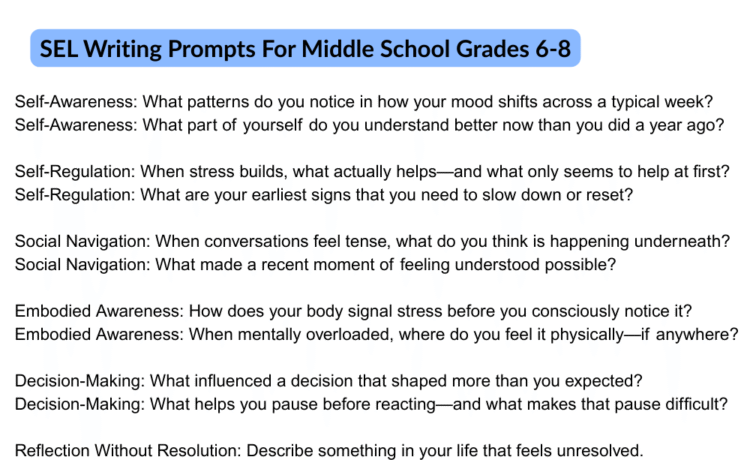
These prompts are drawn from 50 Days of SEL & Metacognitive Writing Prompts for Middle School, a resource that includes a full set of prompts across all six domains along with a student self-reflection rubric and implementation guide.
You can also find Metacognitive Prompts. as well.
Social Navigation
- Describe a time when you had to work with someone whose approach was very different from yours. What did you learn about collaboration?
- Think about a group you belong to. This could be a team, a class, a friend group. What unspoken rules exist in that group, and how did you learn them?
- When you disagree with a friend, how do you decide whether to speak up or let it go?
- What does it look like when someone is being included? What does it look like when someone is being left out without anything obvious happening?
Self-Awareness
- What emotion do you feel most often during a typical school day? Where do you notice it in your body?
- Describe something you’re good at that you had to work hard to learn. What kept you going when it was difficult?
- When you make a mistake, what is the first thing you usually think? Is that thought helpful or unhelpful?
- What is one thing about yourself that has changed in the past year? What is one thing that has stayed the same?
Self-Regulation
- What do you usually do when you feel overwhelmed? Does it help in the moment? Does it help later?
- Think about a time when you wanted to react strongly but chose not to. What helped you pause?
- Describe your ideal environment for focusing. What makes it easier or harder for you to concentrate?
Embodied Awareness
- Where in your body do you first notice stress? How do you know the difference between feeling nervous and feeling excited?
- What does your body feel like after you’ve been looking at a screen for a long time? What does it feel like after you’ve been outside?
- Think about a time when your body told you something before your mind caught up—like a gut feeling. What happened?
Decision-Making
- Describe a decision you made recently that turned out well. What information did you consider before deciding?
- When you have to make a choice and you’re not sure what to do, who or what do you turn to for guidance?
- Think about a time when you made a decision quickly and later wished you had slowed down. What would you do differently?
Reflection Without Resolution
- Write about something in your life that feels uncertain right now. You don’t have to solve it—just describe what the uncertainty feels like.
- Is there a question you’ve been thinking about that doesn’t seem to have a clear answer? What makes it hard to answer?
- Describe a feeling you’ve had recently that you couldn’t quite name. What was the situation, and what did the feeling seem to be telling you?
Information
These prompts are drawn from 50 Days of SEL & Metacognitive Writing Prompts for Middle School, a resource that includes a full set of prompts across all six domains along with a student self-reflection rubric and implementation guide.
Product Summary
50 SEL journal prompts for middle school (grades 6–8) with a built-in, student-friendly self-reflection rubric. This curriculum covers six SEL domains aligned to CASEL competencies. Includes Google Slides and a print-ready PDF.
Description
This resource includes 50 reflective writing prompts designed to help middle school students develop social-emotional skills through structured journaling. Each prompt encourages students to explore their thoughts and emotions without pressure to arrive at a neat conclusion. A dedicated category—Reflection Without Resolution—is included for prompts that support noticing, processing, and sitting with complexity.
Prompts are written to be accessible, age-appropriate, and flexible for a range of classroom contexts, including advisory, morning meetings, and weekly journaling routines.
Trauma-Aware Approach
Trauma is more common in classrooms than is often visible. It can emerge from single events or ongoing circumstances that exceed a student’s ability to process, integrate, and self-regulate. These experiences may affect emotional regulation, participation, self-concept, and relationships at school.
This resource is designed with trauma-aware teaching in mind. While some prompts may be appropriate for small-group sharing, others—and some students—may benefit from keeping their writing private. Prompts are intentionally written to avoid requiring disclosure, but teachers are encouraged to use professional judgment when deciding if, how, or whether sharing should occur.
What’s Included
• 50 SEL writing prompts for grades 6–8
• Post-writing self-reflection rubric (student-facing and non-evaluative)
• Editable Google Slides
• Print-ready PDF
• Implementation guide with pacing suggestions
• CASEL alignment reference
• Free future updates to this prompt set
Six SEL Domains Covered
• Social Navigation – relationships, peer dynamics, communication
• Self-Awareness – identifying emotions, recognizing patterns, personal strengths
• Self-Regulation – managing stress, coping strategies, emotional responses
• Embodied Awareness – mind-body connection, physical signals, grounding
• Decision-Making – weighing options, considering consequences
• Reflection Without Resolution – processing complexity without pressure
How Teachers Use This Resource
Teachers often project one prompt at the start of advisory or class. Students write for 5–6 minutes, adjusting time based on engagement and comfort with the prompt.
At the end of the week, students use the self-reflection rubric to look back across entries, supporting goal-setting, portfolio work, or ongoing journaling routines. The rubric is designed for reflection rather than grading.
Questions?
Message here on TpT or email [email protected]
and we’d be happy to help.
Thanks for taking a look!





Recent Comments