
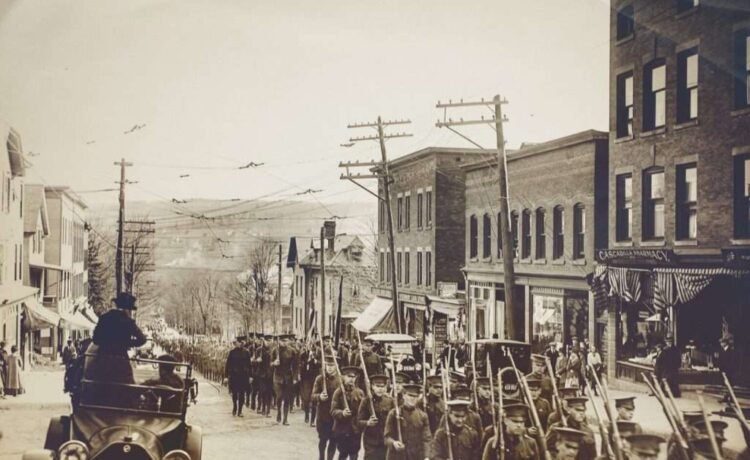
 In March of 1918 several U.S. military units were sent to the Western Front of World War One.
The quota of 120 men from Tompkins County, NY assembled at two o’clock to receive their credentials and instructions. From the courthouse in Ithaca they marched to the Lehigh Valley Railroad Station and left at 10:50 en route to Camp Upton in Yaphank on Long Island. Special cars were attached to the regular train that brought men from Buffalo and Waterloo.
Cornell historian and humorist Hendrik Van Loon, in a sober tone, noted that the small dramatic moments of war rarely appear in the histories, although those “tense moments” and “dramatic situations” that leave a lump in the throat actually happen.
“They suddenly pop up in quiet little nooks, off the beaten track of publicity. They freeze you and thaw you out at the same moment and then life rumbles along in the same foolish fashion and we all go home to eat our dinners and smoke our cigars and read the newspapers,” Van Loon observed.
The Ithaca Daily Journal carried letters home, some shared by families, some sent directly to the newspaper. Robert Hascal has left us something of a running account of his experience, and that of other “Tompkins County Boys.”
On February 27, 1918, Hascal wrote:
“Just at this writing we are leaving Sayre [in Pennsylvania]. Lew Rittenhouse is playing a mandolin and many of the boys are singing… Those who are not singing or playing jokes are eating sandwiches. Matt Herson brought along enough to feed a regiment and passed them around.
“We have been given breakfast cards but don’t know yet when we shall get a chance to cash in on them. The paper this is written on was passed out by a YMCA man in field uniform.
“Arriving here at 1 o’clock this afternoon it took the Tompkins County draftees only a few minutes to realize that no time was going to be lost in making them soldiers. Right after their first mess, which consisted of beef stew, coffee, bread and bread pudding, the boys were measured for uniforms, which are expected to reach them in about a week.
“Then they were ordered to take a bath and to report to a certain corporal, the penalty for failing to do so being an order to take another bath. After a night and most of a day on the trains the bath was really a treat…
“We have been assigned to the 302d Ammunition train… Some of the mistakes we already have made amused even ourselves. Many of the boys were so nervous that they forgot to remove their hats at mess and were properly “called” for it. Others, including myself, were ‘balled out’ for smoking in the bunk room.
 “We were put to work emptying ashes, sweeping the barracks and carrying water. No one seemed to think we had been without sleep for about 36 hours. Nevertheless not a man complained and we are all enjoying the life…
“Tomorrow we expect our first ‘shot in the arm,’ and some of the fellows who arrived a week ago are trying to scare us into thinking it is worse than the inquisition…
“We have not had a chance to go around the camp any, but hope to get out tomorrow. The officers have been very considerate and the men are all happy and contented.”
On March 2 he wrote:
“Walter Hunt and myself were this morning ordered to ‘fall out’ of line, empty our bed sacks, turn in our mess kits and prepare to move. We did so in a hurry.
“A sergeant said that the fact that we emptied our bed sacks meant that we were going on a long trip… but we were merely sent to the 302d Field Signal Battalion, Company C, about two miles from our pals in the ammunition train. Right off the bat they outfitted us.
“Later Hunt is to work in Company A as a wireless operator, and I am to tap a key behind the lines ‘somewhere.’
“Attired in our new uniforms and feeling every bit like a couple of major generals, we went down to G Company ammunition trains tonight to see the boys who are still there. Six went to the 302d Engineers this morning. They have not received their uniforms and few of them knew us when we walked in.
“I went up to the table where the non-coms [non-commissioned officers] sit and asked the first sergeant to change my address. He grabbed me, put me on a bench and introduced me to the company as ‘Tompkins County’s first soldier.’
“The boys sang ‘The Star Spangled Banner’ and of course I had to stand there at attention all the time they were singing…
“If there is anyone in Ithaca who has a real, honest desire to make a soldier happy, just send him some cookies, cake or candy. Sweaters are fine, but you can’t eat them. Socks of course are necessary, but unpalatable. We get no sweets and sure do miss them.”
On the 16th:
“82 Tompkins County boys, now nearing the end of their preliminary training here, are scattered all over the camp. I went down to the ammunition train with Walter Hunt yesterday and the only boys left in the casual barracks were Matt Herson and one other…
“Found about 25 Tompkins County boys engaged in the ‘pleasant’ occupation of acting as chambermaids for about 200 horses and mules. They were making the best of it, but to tell the truth they were a pretty disgusted lot…
“A half hour later when we were walking up the main street of the camp, we heard a shout of ‘hello fellows.’ It was Tom Horton of Ithaca… perched on the top of a load of fertilizer. We had to look twice to recognize him…. Received boxes of ‘eats’ last week from five friends — some had been a long time on the road…
“The signal corps is not so bad, but it’s no cinch. There’s no such thing as a cinch in the army.”
On April 1:
“Coming to camp at the tail end of the big winter, the boys escaped the swamp digging, the plague of the lives of the boys who came down in the fall.
“The whole camp was a wilderness (Oh yes, right on Long Island and parts of it still surround us.) Stumps left after the trees were cut had to be dug up. In the dead of winter this was a real job, if you believe the men who did it and we do believe them.
“Within our second day we were here we got our first needle and within three weeks two more needles [inoculations]. These kept us feeling depressed and in some instances actually sick in bed. Now, however, we are getting into shape…
“The terrific grind they put us up against was more than we bargained for and many of the boys had all they could do at first to keep going. Penalties were many.
“We are not permitted to say anything about troop movements, so there is no use of Ithaca people writing and asking when we are going.
“When our letters home stop all of a sudden, you will know that we have gone… We have for the most part mastered what is known as the school of the soldier, and the school of the squad, something every soldier has to learn…
“Many of the Ithaca boys, I regret to announce, know all about taking care of horses and miserable low-down army mules (the meanest beasts on earth, Tom Horton says). Mike Dooley, be it said right out loud, is right at home with a rifle.”
On May 9th:
“I am assigned to a cable laying outfit and am mounted on a plunging, miserable charger that daily does his best to end my services in the war. He frequently succeeds in throwing me off, but soon I’ll be able to stick to the saddle without trouble.
“Among other things I have to do is operate a buzzer and Morse flashlight. The roar of the big guns seems to keep up pretty steady.”
 Then the letters came from Europe. On July 5th:
“We have moved a long way and are now located in an entirely different section of ‘Bonny France,’ as the boys call it… I am an operator at the second line of defense.
“It is the only real snap I’ve had in Uncle Sam’s army, although the fact that we are under fire a lot of the time takes some of the pleasure out of it.
“Just imagine yourself sound asleep dreaming of home, apple pie and two clean sheets. Then imagine hearing the boom-boom of the Hun guns and the clatter of a Klaxon horn. No matter how you feel about it, the only thing to do is to jump up and clamber into your gas mask ‘tout de suite’ [immediately] as the French say.
“The fact that about half of the 50 natives in this village are pro-Hun keeps us on the alert to prevent them from slipping a pill into our water or punching a needle though our masks…
“In the office here are three Frenchmen. They are a sociable, friendly and clean lot of men, and we like them. We are rapidly getting wise to their lingo.
“At present there are no signs of peace. I am banking on being back with you within a year from the time I left there.”
On August 2nd:
“The men who at camp looked like the best soldiers have not in every instance turned out to be such here.
 “I know of one regiment where a platoon of men could not be managed at all at camp. They overstayed the passes home, they refused to drill, they did not salute, they spent half of their time in the guard house, but when they got over here they made good.
“This platoon can lick its weight in wild cats any old time, day or night, and the only thing they complain about how their officers won’t send them over to end the war at once.
“They shoot craps and play ball under shell fire; nothing gets their goat; in fact they are the kind of men needed to win.”
And here, the letters stop.
Read more about New Yorkers and World War One.
Illustrations, from above: A World War One-era military parade makes its way up Eddy Street in Ithaca (Tompkins County History Center); 308th Infantry Battalion on review at Camp Upton in Yaphank; 302nd Field Signal Battalion in Baccarat France sharing their dessert with French children (photo by Cpl K Polk, July 20, 1918); and 302nd Field Signal Battalion marching toward Vauxcere near Bazoches, Aisne, France (photo by Cpl K Polk, Sept. 9, 1918).




Recent Comments