
 Scientists from the New York State Museum, in collaboration with researchers from Princeton University and the Northeast Ecological Recovery Society, have confirmed the first documented case of a wild gray wolf south of the St. Lawrence River in decades.
The confirmation is based on analysis of a canid shot by a hunter outside Cooperstown in Cherry Valley, Otsego County in December 2021. The New York State Department of Environmental Conservation (DEC) announced its confirmation the animal was a wolf in 2022.
Through hunting, gray wolves were eliminated from the northeastern United States by the late 19th century. The findings, detailed in a peer-reviewed study led by Dr. Jeremy Kirchman, the State Museum Curator of Birds and Mammals, present evidence of occasional long-distance movement of wolves from eastern Canada into New York State.
Dr. Kirchman said, “The Cherry Valley wolf specimen is an exceptionally important piece of physical evidence of occasional dispersals by wild wolves into the northeastern U.S. from core breeding areas in eastern Canada. The specimen will remain preserved in the Museum’s mammalogy collection in perpetuity, where it will be available for future study.”
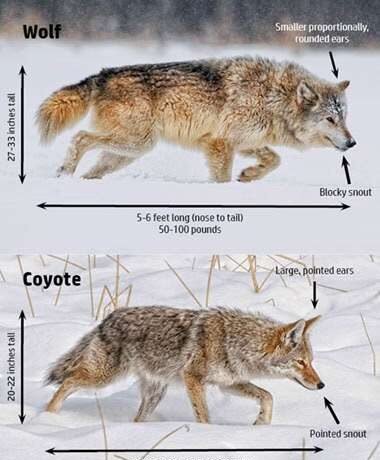
The discovery prompted the New York State Department of Conservation (DEC) to increase educational efforts aimed at helping hunters distinguish between coyotes, which are legal to hunt in New York, and wolves, which are protected under state and federal law.
In October 2022, genetic testing first confirmed that the canid killed by the hunter was a wolf. However, identification remains challenging due to the complex history of hybridization between wolves and coyotes in eastern North America, hence the second confirmation.
DEC has documented a few wolves and wolf hybrids over the last 20 years in New York. Legislation to aid in the protection of New York wolves has not progressed beyond the committee level.
The bills, S.7927A and A.08295, would require mandatory check-in and tagging of all wild canids (coyotes and potential wolves) killed by hunters or trappers; mandate DNA analysis for any canid weighing over 50 pounds to determine if it was a protected wolf; authorize DEC to impose a temporary moratorium on canid hunting in areas where a wolf was confirmed; and modify hunting and trapping educational materials to include information on distinguishing wolves from coyotes.
The State Museum’s Analysis
To definitively identify the Cherry Valley wolf, the Museum’s research team conducted extensive morphological, genetic, and stable-isotope analyses.
DNA comparisons across the genomes of 435 sampled wolves, coyotes, and dogs firmly grouped the specimen with Gray Wolves, showing an exceptionally high probability of Great Lakes Gray Wolf ancestry.
Skull measurements and body mass placed the individual well above the size range observed in eastern coyotes, even those with high levels of wolf ancestry.
When DNA results first confirmed the animal was a wolf and not a coyote, the DEC confiscated the taxidermy mount and skull and transferred them to the State Museum. The hunter cooperated fully with officials and was not fined.
“I’m happy to have published this comprehensive examination of the wolf’s diet, morphology, and genetics with a team that includes my long-time NYSM colleague Dr. Robert Feranec, wolf advocate and citizen scientist Joe Butera, and Dr. Bridgett vonHoldt, a leading expert on canine genetics at Princeton University,” Dr. Kirchman added.
The Cherry Valley wolf is currently on display as part of the State Museum’s Canine Contrasts exhibit, where visitors can learn about the complex relationship between wolves, coyotes, and their hybrid descendants in eastern North America.
Established in 1836, the New York State Museum is the oldest and largest public museum in the United States. Home to leading scientists, historians, archeologists, and anthropologists, its collections represent the State’s rich cultural and natural heritage from the past and present, including a staggering 20+ million artifacts spanning 1.1 billion years ago to today.
The Museum is located at 222 Madison Avenue in Albany, and open Tuesday through Sunday from 9:30 am to 5 pm. It is closed on the Fourth of July, Thanksgiving, Christmas, and New Year’s Day. Admission is free.
Read more about wolves and coyotes in New York State.
Illustration: A DEC Wolf Coyote comparison.





Recent Comments