
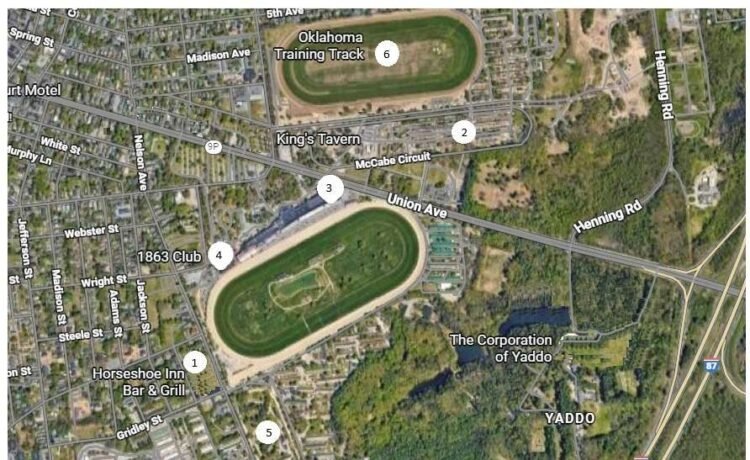
 A cursory view of free online aerial imagery displays various race tracks in Saratoga Springs. There are nine locations that appear in the imagery, and each has its own horse racing record.
The overview image displays the nine separate locations, with the track numbering system in chronological order of construction, which represents the geography as we know it now, with illustrations below of what had been.
1 – The Fair Grounds Track
 This location may have been the first horse racing grounds in Saratoga Springs, which hosted local gatherings and the New York State Fair in the late 1840s, before the permanent facility was dedicated at Syracuse.
The 1866 Beers Atlas map shows this track location at the South-West corner of the Nelson Avenue at Crescent Street intersection. No remnant of this track survives, as the property was converted to a neighborhood.
2 – Horse Haven
This location was the driving track north of Union Avenue where John Morrissey and partners staged the initial four-day contest, beginning August 3, 1863. This thoroughbred meet at Saratoga Springs during the Civil War was something of a proving trial, with two races each day.
 The Saratoga Association for the Improvement of the Breed of Horses (which did not actually incorporate until 1865), relocated after this first successful season as this track was too small for that type of competition. The track and its surrounding barns were retained to support operations on the south side of Union Avenue.
Charles Reed and Albert Spencer were John Morrissey’s partners in management of the Saratoga Association, and succeeded him following his demise. Charlie Reed had a booming voice, and he enjoyed fine attire; he was noted for a square belltop hat from his own special block and plaid-checked waistcoat, lavish jewelry and spats.
His wife, Ann Jane Reed, was a cigar smoking native of Ireland, also well known in Saratoga Springs, and said to have coined the term “Horse Haven,” for the sylvan tree-lined equine facility and stables opposite the main track.
The Reeds operated a thoroughbred breeding farm on the shores of Saratoga Lake near Snake Hill, and maintained an impressive summer home on Union Avenue, where they staged Saratoga’s first yearling auctions.
 3 – Saratoga Race Track (1864-1901)
The success of the informal inaugural season of 1863 demanded a new competition ground, where the revised location of the Saratoga Association began competition in 1864 on an 8 furlong (one mile) circuit, which many horsemen doubted was actually that long.
This track had an unusual chute that crossed the infield on a diagonal, which allowed races carded at less than a mile to be started in front of the grandstand. The present-day H. Langford Warren grandstand and clubhouse, along with a betting ring, were added 1892.
 4 – Saratoga Race Track (1902-present day)
A consortium led by William C. Whitney and Richard T. Wilson purchased the Saratoga Association and their race course in 1900. The track was enlarged to 9 furlongs, to match the Sheepshead Bay Race Course on Coney Island, Brooklyn by repositioning the track on additional property purchased.
The 1892 Warren grandstand, clubhouse and betting ring were physically moved to the new orientation and enlarged, which is mostly what we see today at Saratoga Race Course, except for the betting ring that was removed in 1964, in favor of a 550’ extension of the eastern grandstand.
 5 – Clare Court
This private training center was originally constructed by August Belmont, which he referred to as “The Surcingle,” and occupied a 106-acre Nelson Avenue farm south of Saratoga Race Track, with direct access.
Belmont had a half-mile oval built for the exercise of his horses, and a tunnel underneath the track, so that he could come and go from his summer house on the infield without disturbing his thoroughbreds at work.
 In 1936, the Saratoga Association, which was having difficulties providing ample stable space to meet the ever-increasing activities, purchased the area from William R. Coe as a part of its expansion program.
In 1940, the area was renamed Clare Court by John Galligan, Assistant Superintendent of the track, in memory of the late track superintendent Tom Clare, who had passed away that January.
 6 – Oklahoma Training Track
The Oklahoma Training Track was an improvement to the Saratoga Race Course in 1901 when this acreage was purchased by William C. Whitney from Eugene F. O’Connor of Brooklyn, former state senator and major Saratoga Springs real estate holder.
Whitney had become President of the Saratoga Racing Association just the year before, and had a long-range vision in his development of the racing plant, much to the benefit of a grateful posterity, who continue decades and generations of enjoyment.
Prior to Whitney’s purchase, the property on East Avenue was used by the Saratoga Gun Club for trap shooting, with many backstretch workers taking part in busting clay targets for relaxation when the seemingly never-ending tasks at the track were complete.
When this training track was new at the beginning of the twentieth century, people felt it was a long hike from the main track, “like walking all the way to Oklahoma” they grumbled, and the name stuck.
7 – Godolphin Training Track
This facility was originally constructed by Edward F. Simms, owner of Xalapa Stable, as a private training center. Simms brought George Horine, racetrack engineer and builder, to the Spa in the early spring of 1921 to lay out the facility.
The private track, stables and impressive summer home were purchased by John Hay “Jock” Whitney, and following the death of his mother, Mrs. Payne Whitney, he merged it with the holdings of his sister, Joan Whitney Payson, as the Greentree Stable.
The Whitney estate sold the property to Godolphin, which is the global thoroughbred breeding and racing operation owned by Mohammed bin Rashid Al Maktoum, Vice President and Prime Minister of the United Arab Emirates and Ruler of Dubai.
 8 – Saratoga Casino-Hotel (Saratoga Harness Track)
The Saratoga Harness Racing Association, headed by W. Ellis Gilmour, was granted a charter of incorporation in early 1941. The new track was planned by Albany architect Marcus T. Reynolds, who also designed the Gideon Putnam Hotel at the Spa.
The new venture was known as Saratoga Raceway, as the phenomena of trotters and pacers racing under the arc lights captured the nation. The Saratoga Raceway has evolved into the Saratoga Casino-Hotel as it presently operates as a year-round sports and wagering facility.
9 – Former Harness Training Track
The outline of this track is still discernable in aerial images, but the use has been curtailed since the construction of the racino and hotel, which required a large portion of the former circuit.
 Illustrations, from above: Aerial imagery showing the nine various past and present race tracks in Saratoga Springs; Former Saratoga Springs Fair Grounds Track at the SW corner of the Nelson Avenue and Crescent Street intersection as shown on the 1866 Beers Atlas map; 1898 Brunner Map showing the Horse Haven track, in relation to the 1864 improvement to the south; 1879-80 Krik’s Guide to the Turf map of Saratoga Race Course showing the unique chute across the infield, where races could be started in front of the grandstand. The steeplechase course is shown with dotted line (these annually published issues were produced by turf writer and Jockey Club official Henry G. Crickmore, or “Old Krik” in racing circles); Charles Leavitt’s general plan for the reconfigured Saratoga Race Course scheduled to open in the summer of 1902, with the phantom line showing the location of the original track (The New York Sunday Telegraph, March 9, 1902); 1954 Sanborn Fire Insurance map showing Clare Court near the intersection of Nelson Avenue at Gridley just south of the main track’s 7-furlong chute; August Belmont’s tunnel, a grade separated crossing in and out of Clare Court, beneath the exercise track above; the sign for the Oklahoma Training Track where early morning work-outs are held; horses line-up to start at the Saratoga harness track (courtesy Saratoga Harness Horseperson’s Association); and a race finish at Saratoga Race Course in front of the Victorian judge’s stand which has been replicated to the memory of Marylou Whitney at the Oklahoma Training Track as a viewing stand (Saratoga Illustrated: The Visitor’s Guide, 1902).
Read more about New York State horse racing history.





Recent Comments