
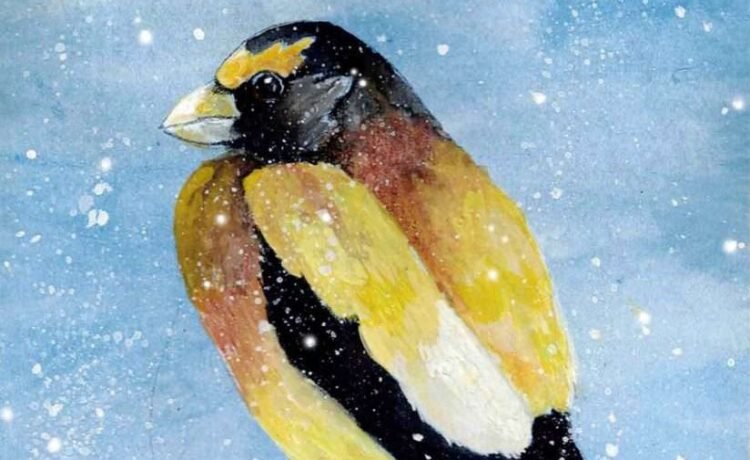
 On a fine gray afternoon in late October, I came across an impressive cone midden beneath a towering red spruce. While it was surely the work of an industrious squirrel – perhaps a family, given the size of the mound – I looked up to see a red crossbill in the crown, using its hyper-specialized beak and tongue to remove seeds after prying the spruce cone scales apart.
That was my first winter finch of the season, and if the 2025-2026 Winter Finch Forecast is as accurate as its predecessors, it’s unlikely to be my last.
Winter finch species are often in the Fringillidae (“true finch”) family, and are known for their “nomadic and erratic” irruptions, meaning they sometimes disperse south in winter, seeking more abundant food crops.
In addition to red crossbills, researcher Matt Young of the Finch Research Network (FiRN) includes pine grosbeaks, evening grosbeaks, purple finches, redpolls, white-winged crossbills, and pine siskins among these northern travelers.
While scientists once attributed their irruptions in the Northeast solely to crop failures in their normal wintering ranges to the far north, Young says that view has been updated: it’s not just crop failure that can drive a species south, but breeding success as well. And in most instances, the two conditions are interrelated.
“You can have successive years of high reproductive success, which leads to higher population levels, which leads to a food crash,” Young said. “When a lean
crop year follows on the heels of a year in which reproductive success is high, a part of the population can’t be supported and are forced to come down.”
Thirty-five years ago, Ontario resident Ron Pittaway, a forester and lifelong birder, realized that he could predict the likelihood of irruptions for nine winter finch species and their likely presence in certain geographic areas.
It required three data sources: crop reports from natural resource managers in Canada and U.S. border states; a survey of Pittaway’s network of foresters and citizen scientists assessing food crops for 15 key tree species (ranking them as poor, fair, good, excellent, or bumper); and late summer movements of indicator species like the red-breasted nuthatch, an early warning of crop failures in the north.
After circulating the “Winter Finch Forecast” privately for several years, Pittaway published his first report on the internet in 1999, where it quickly gained a large and enthusiastic audience. In 2020, he handed it off to FiRN, which has been publishing it in the last half of September ever since.
“If it wasn’t for his original forecasts, we wouldn’t have these legions of fans out there that just can’t wait to read this every year,” Young said of Pittaway, who passed away in August 2023.
Although species-specific irruptions tend to occur independently, because each species consumes only certain cone seeds, conditions sometimes converge to create “flight years,” when several winter finch species leave their normal ranges. When nearly every species irrupts in the same year – as happened in 1997-98, 2012-13, and most recently 2020-21 – you have what researchers call a “superflight” year.
So what does the current forecast predict?
“With mostly very poor crops in the boreal forest from central Quebec westward to Manitoba, this has the potential of being the biggest flight year since 2020-2021,” Tyler Hoar wrote in the 2025-26 Winter Finch Forecast. “In these very poor crop areas in the eastern boreal, significant food source species such as white spruce, tamarack, and white birch have a total absence of any new crop over large areas.”
That forecast – now built on input from almost a hundred correspondents across North America and several thousand miles of driving on Hoar’s part – has birders in New England and upstate New York buzzing with anticipation.
The 2025 Christmas Bird Count is likely to reflect the irruptive pattern, providing a unique opportunity to observe winter finches in shrubs, tree stands, and at feeders.
“This is a year that the birders out there are going to be able to see multiple species within reasonable driving distances throughout the winter,” Young said. “There’s going to be a nice potpourri of finches for people to enjoy through the holiday season and beyond this year.”
Read more about birds in New York State.
Jack Beaudoin is a frequent contributor to Northern Woodlands and a Maine Master Naturalist. Illustration by Adelaide Murphy Tyrol. The Outside Story is assigned and edited by Northern Woodlands magazine and sponsored by the Wellborn Ecology Fund of New Hampshire Charitable Foundation: nhcf.org.






Recent Comments