
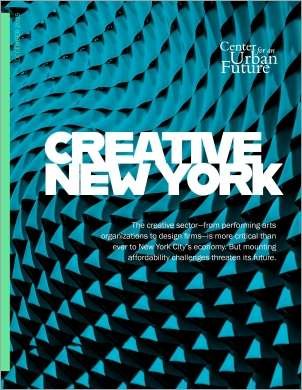
 There are few things considered more critical to New York City’s economy than the creative sector, the mix of industries that range from performing and visual arts to ad agencies and design firms.
But a new Creative New York report by The Center for an Urban Future (CUF) shows that the city’s creative sector is facing serious new threats, in large part due to an affordability crisis that is hitting artists and creative workers especially hard.
Although it’s been decades since New York was remotely affordable for artists, CUF’s report shows that since the pandemic, the city has seen an 18.8% decline in dancers, an 8% drop in actors, and a 2.8% decrease in musicians.
Overall, the city’s resident artist population has declined by 4.4% since 2019—after increasing by 34.7% from 2004 to 2019. But their research also shows that it’s no longer just artists whose numbers are dwindling; there have also been declines in fashion designers (28.9%), film and video editors (18.5%), graphic designers (13.8%), and art directors (6%).
At the same time, creative industries that had been among the city’s fastest-growing sectors in the decade before the pandemic are now lagging well behind.
From the first quarter of 2020 to the first quarter of 2025, employment is down in film and TV (-19.1%), advertising (-15.7%), applied design (-14.3%), publishing (-11.7%), architecture (-9.4%), performing arts (-6.4%), music production (-3%), and visual arts (-1.3%). During the same period, overall city employment is up 4.6%.
CUP’s report, the third edition of Creative New York, argues that city policymakers will need to take steps to reverse these trends. The arts and creative industries employ more than 326,000 people across the five boroughs and provide New York with what is arguably its greatest competitive advantage.
“Indeed, the city’s unmatched creative edge may be the single most important asset that helps New York counteract the many negatives of living here, including the city’s astronomical cost of living,” the organization told supporters.
The report — made possible with support from Rockefeller Brothers Fund, Howard Gilman Foundation, Ford Foundation, and Mellon Foundation — outlines several challenges facing working artists, nonprofit cultural organizations, and creative businesses.
The widening gap between income and housing costs is the top concern: Creative workers in New York now earn about 23% less than the national average after adjusting for the city’s high cost of living. Meanwhile, artists of color earn about 37% less than white artists, underscoring how existing inequities make the affordability crisis even more acute.
At the same time, nonprofit and commercial arts venues alike face rising expenses on every front — from labor and materials to insurance and utilities.
While costs are up, many performing arts venues have seen notable declines in revenues from ticket sales, driven by major audience shifts since the pandemic — with people opting for in-home streaming over in-person attendance.
On top of all this, the Trump regime aims to make steep federal funding cuts to the arts.
You can read the 55-page Creative New York report here.
This is the third edition of the Creative New York report. Prior editions include: Creative New York – 2015 and Creative New York – 2005.
The Center for an Urban Future (CUF) is a think tank focused on building a stronger and more equitable economy in New York City, and expanding economic opportunity for all New Yorkers.
CUF receives general operating support from The Clark Foundation and the Altman Foundation, and ongoing support from Fisher Brothers Foundation for CUF’s Middle Class Jobs Project, and from several other philanthropic funders.
Read more about New York City.





Recent Comments