
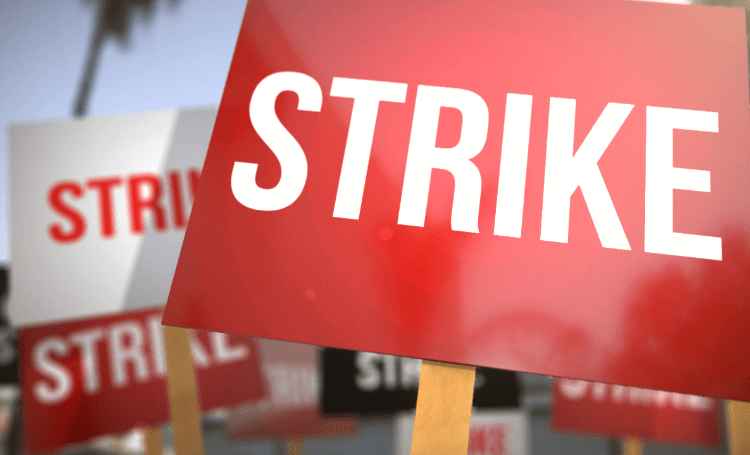
 Today the state of Minnesota is engaged in the first General Strike in nearly 80 years. There have been thousands of strikes in American history, but only about a dozen General Strikes. One of the first strikes took place in the city of New York in 1677. Afterward a dozen cart-men (one-horse cart operators) were criminally prosecuted “for not obeying the Command and Doing their Dutyes as becomes them in their Places” and fined.
About 80 strikes in the U.S. have involved over 100,000 workers. Here are 13 strikes every New Yorker should know about:
 1872: The New York City Eight Hour Day Strike
In 1835 America’s first citywide general strike occurred in Philadelphia, and with the support from workers across the Northeast ended the 12 hour workday in favor of the 10 hour workday for many workers.
Nearly 40 years later in 1872 workers in the city of New York began a city-wide strike for the eight hour day. More than 100,000 workers participated, mostly across the building and manufacturing trades.
The strike culminated in a 20,000-person march demanding the 40-hour work week, which it was initially successful in winning for many workers. However, following police crackdowns on picketing and a union busting campaign by large employers, the effort ended in defeat, with many of the initial gains reversed by employers.
The National Labor Union (1866-1873, NLU), the first national labor federation in the United States and a major force in organizing the Eight Hour Day Movement, dissolved the following year.
The NLU is best remembered for the critical role played by Kate Mullany, a Troy collar worker who led a successful six-day strike with over 300 women in 1864, winning themselves a 25-percent increase in wages.
1877: The Great Railroad Strike
The Great Railroad Strike of 1877, the first national strike of an entire industry, occurred near the end of the Long Depression of 1873-1878 that pushed wages to near starvation levels. In New York State there were major disruptions in Albany, Buffalo, and Corning in Steuben County, as workers protested wage cuts.
 The strike lasted 52 days until it was put down – often violently – by private militias, the National Guard and federal troops. Afterward, a rising movement of more militant workers, including armed anarchists, formed to resist the kind of violence against workers seen during the 1877 strike.
Also, the Knights of Labor (1869-1917), the largest and most influential U.S. labor organization in the 19th century, emerged as a powerful force for workers. Strikes organized by Knights of Labor unions became routine events by the 1880s.
There were 37,000 strikes between 1881 and 1905. By far the largest number were in the building trades, followed by coal miners, but strikes reached nearly every occupation.
1886: The Great Upheaval for the Eight Hour Day
The only national General Strike in American history was called for May 1, 1886 to support the Eight Hour Day Movement, some 300-500,000 people left their jobs. Throughout 1886 however, more than 2,000 strikes involving over 600,000 workers spread throughout the country, including to New York State.
Known as the “Great Upheaval,” these were largely railroad and street railroad workers, along with coal miners, all with demands focused on the eight hour day.  Among them was the Southwest Railroad Strike, which involved more than 200,000 railroad workers in five states taking action against the Union Pacific and Missouri Pacific railroads, owned by New York robber baron Jay Gould.
New York City was, next to Chicago, the major center for the May 1st General Strike, led by the Federation of Organized Trades and Labor Unions (1881-1886) headed by New York’s Samuel Gompers. About 10-20,000 workers took to the streets of the City, joining more than 300-500,000 strikers nationwide.
After a summer of labor activism, popular writer and economist Henry George ran a losing campaign for mayor of New York City, running under the short-lived United Labor Party line with a campaign focused on labor issues and municipal corruption.
The 1886 strikes are now best known as the impetus of the Haymarket Massacre and the establishment of May Day, the International Workers’ Day, but they led to the collapse of the Knights of Labor and the formation of the American Federation of Labor (the AFL, 1886-1955).
 1899: The NYC Newsboys’ Strike
During the Spanish-American War in 1898 publishers Joseph Pulitzer (New York World) and William Randolph Hearst (New York Journal) raised the wholesale price for newsboys and newsgirls – “newsies,” child newspaper sellers – from 50 cents to 60 cents per 100 papers. When war demand ended, other papers lowered their prices, but Pulitzer and Hearst refused to do so.
A strike led by thousands of newsies across New York City began on July 20, 1899 and concluded on August 2nd. The strike ended when the publishers agreed to buy back all unsold papers at full price, though they would not lower the wholesale price. This result eliminated the financial risk for the newsies, who previously lost their own money on any papers that failed to sell.
 1909: The Uprising of the 20,000
The Uprising of the 20,000, also known as the New York shirtwaist strike of 1909, was a pivotal labor strike by thousands of immigrant garment workers, mostly young Jewish women led by Clara Lemlich (1886-1982) in New York City.
It was the largest strike by female workers in American history at the time and helped transform the garment industry into one of the country’s best-organized trades.
It successfully improved wages and hours in the shirtwaist industry, though it took the tragic 1911 Triangle Shirtwaist Factory Fire, in which 146 mostly young women were killed, to spark broader safety reforms.
Like many workers of her time, Lemlich was blacklisted from the industry for organizing and became a communist and consumer activist. As a nursing home resident in her final years she helped to organize the staff.
 1912-1913: Little Falls Textile Strike
The Little Falls Textile Strike involved about 1,300 workers at two textile mills in Little Falls in Herkimer County, NY, and was triggered by pay cuts following a new state law that reduced the workweek for women and children from 60 to 54 hours.
The strike became a focal point for the Industrial Workers of the World (IWW) and the Socialist Party of America and saw the participation of such well-known names as Big Bill Hayward, Helen Keller, and Eugene Debs. In Schenectady, Mayor George Lunn, a member of the Socialist Party of America, recruited people to support the strikers, which resulted in significant wage increases for immigrant mill workers.
 1919: Great Strike Wave of 1919
In United States labor history the Seattle General Strike of 1919 stands as a landmark with some 65,000 workers shutting down the city for five days. It was just one of a succession of extensive labor that year which unfolded across various American industries, involving more than four million American workers, all calling for higher wages and shorter hours.
Major events included the New York Harbor Strike by some 15,000 longshoremen and City Garment Workers’ Strike, which brought about 35,000 garment workers off their jobs to demand a 44-hour week and higher wages. In July, a violent confrontation occurred at the Globe Malleable Iron Works in Syracuse were management used Black strikebreakers against striking white workers, part of what became known as Red Summer.
The wave of strikes in 1919 helped launch the First Red Scare as mass arrests and deportations of suspected liberal radical across New York State were fueled by anarchist bombings and fears of Bolshevik influence. (Read more about that here.)
 1934: The Uprising of ’34
The United States textile workers’ strike of 1934, was the largest textile strike in the labor history of the United States, involving nearly a half million textile workers from New England, the Mid-Atlantic states and the U.S. Southern states, and lasting twenty-two days.
Tens of thousands of workers across New York joined the walkout, especially at the mills in the Mohawk Valley, the Hudson Valley, and the New York City’s Garment District. The United Textile Workers of America (UTW) held a convention in New York City on August 13, 1934, where delegates voted overwhelmingly to strike.
In part to avoid police repression “flying squadrons” of strikers moved between mills to bolster walkouts and organize workers. Utica was notably impacted, with major textile strikes in March and September.
A survey of textile mills in and around Utica by The New York Times on September 4th, found that about 2,500 of 6,000 workers were on strike. The largest number about 1,500, were employees of the New York Mills Corporation, about 800 from the Utica Knitting Company, and 200 from the Standard Silk Mill at Chadwicks in the town of New Hartford.
1946: The Rochester General Strike of 1946
The Rochester General Strike of 1946 was one of the many strikes of the Great Post-War Strike Wave of 1945-46 involving over 5 million workers following World War II when people demanded higher wages and better conditions after wartime wage freezes and rising costs of living.
 Sparked by the firing of 500 unionizing municipal workers, AFL and the Congress of Industrial Organizations (CIO) unions led city-wide shutdowns of factories, transit, and businesses to support the right of public workers’ right to organize. The action by 50,000 strikers led to mass arrests and significant public support, bringing city services to a halt. Ultimately the city was forced to negotiate and reinstate workers amidst a broader post-World War Two wave of strikes for better working conditions.
Early strikes in this wave included the those by elevator operators and dock workers in New York City and the New York City Tugboat Strike, a 10-day stoppage by nearly 3,500 tugboat workers, paralyzed New York Harbor.
In 1947, Congress responded to the strike wave by enacting, over President Harry S. Truman’s veto, the Taft–Hartley Act, restricting the powers and activities of labor unions, and requiring union leaders to sign anti-communist oaths. The act is largely still in force as of 2026. These strikes contributed to the rise of the Second Red Scare (McCarthyism) to suppress liberals.
 1967-1968: NYC Teachers’ Strikes
The 1967 New York City teachers strike was a 14-day walkout led by the United Federation of Teachers (UFT) that began on September 11, 1967. This strike is often overshadowed by the more massive 1968 strikes, but it served as a critical precursor that established union militancy and tested new state labor laws.
The 36-day strike 1968 NYC Teachers’ Strike highlighted racial tensions during an experiment in community control of schools in Ocean Hill-Brownsville, Brooklyn. It remains one of the most contentious episodes in the city’s educational history.
1968: Great Garbage Strike
The 1968 New York City Great Garbage Strike was a nine-day “illegal work stoppage” by sanitation workers in February. Represented by the Teamsters, they demanded demanded higher wages, double-time for Sundays, and better pensions. The president of the sanitation workers’ union John Delury was jailed.
Mayor John Lindsay asked other unions public employee unions to provide scabs to pick up the garbage; they refused in solidarity. As the strike wore on nearly 100,000 tons of solid waste accumulated on city streets. Lindsay ultimately settled the strike in a contract victory for the union.
 2023: Film and Television Strikes
In 2023, SAG-AFTRA (Screen Actors Guild–American Federation of Television and Radio Artists) and the Writers Guild of America went on strike against the Alliance of Motion Picture and Television Producers and others.
These strikes was led by changes in the film and television industry caused by streaming and its effect on residuals, as well as other new technologies like AI and digital recreation. The longest U.S. actors’ strike in history and marked the first actors strike since the 1980 actors strike and the first time that actors and writers walked out simultaneously since 1960.
The strike ended in December when the union voted to approve a new deal with 78% supporting, though only 38% turned out, and resulted significant job losses, halted many productions, and hurt related businesses (catering, crew), with film permits dropping sharply and local film and television employment plunging.
 2026: NYC Nurses Strike
New York City is currently experiencing the largest nurses strike in City history. Roughly 15,000 nurses went on strike at multiple campuses operated by three private hospital systems on January 12th: NewYork-Presbyterian, Mount Sinai, and Montefiore.
“For months, nurses have been bargaining for fair contracts, but management has refused to settle fair contracts that include enforceable safe staffing ratios, guaranteed healthcare benefits for frontline nurses, and protections from workplace violence,” according to The New York State Nursing Association.
New York Almanack works to present accurate history that informs the present state of affairs, but we can’t do it without your help. Please support this work.
Read more about labor history in New York State.
Illustrations, from above: Strike Picket Signs (UFCW Local 400); The Eight-hour Movement Procession of workingmen on a strike in the Bowery, June 10th, 1872 (Frank Leslie’s Illustrated Newspaper); Sixth Maryland Regiment firing strikers in Baltimore during the Great Strike of 1877; Labor Day Parade congregating at Union Square, 1882 (Frank Leslie’s Illustrated Newspaper); Newsboys and newsgirl getting afternoon papers in New York City, 1910 (National Archives); Uprising of the 20,000 Labor Organizer Clara Lemlich in 1910; Parade of strikers during the 1912–1913 Little Falls textile strike, published in the International Socialist Review; Actors On Strike On 45Th Street In New York City, 1919; “Strikers herded into concentration camps” Daily Worker September 22, 1934; Number of workers involved in US strikes each year according to the US Bureau of Labor Statistics, showing the 1919 strike wave (in purple) and the 1945-46 wave; Brooklyn parents and teachers demonstrated for their children’s right to a quality education in 1968; WGA and SAG-AFTRA members marching together in June 2023; and the NYC Nurses Strike, 2026 (NYS Nurses Association).






Recent Comments