
 An outspoken critic of the National Socialist (Nazi) Party, Jewish photojournalist Gisèle [Gisela] Freund fled her native Germany in 1933 with Adolf Hitler’s rise to power. Having settled in Paris, she obtained her PhD at the Sorbonne in 1936 and would become the most talented chronicler of the vibrant and multi-national bohemian community of artists and writers that made its home in Paris during the 1930s.
By 1939, Freund had photographed many of the greatest writers and artists of the twentieth century, amongst them Henri Matisse, Samuel Beckett, T. S. Eliot, Virginia Woolf, Jean Cocteau, André Breton, Colette, André Malraux, Paul Valéry, Tennessee Williams, Peggy Guggenheim, Simone de Beauvoir, and Jean-Paul Sartre.
 In 1938 she took a photograph of James Joyce in company of Sylvia Beach and Adrienne Monnier in the bookshop Shakespeare & Company at Rue de l’Odéon. It is an iconic shot of literary Paris between the wars, and a powerful reminder of the role played by women in the emerging cosmopolitan modernist movement.
Beach & Monnier had played a pivotal role in the publication of James Joyce’s Ulysses, a novel that would set new literary standards after lengthy obscenity trials in New York City’s courts, reshaping the concept and practice of American censorship.
Book Friends
In 1935 Freund met the publisher and bookseller Adrienne Monnier who, a year later, published her ground-breaking dissertation La photographie en France au dix-neuvième siècle (French photography in the nineteenth century) in which the author deals with relevance and social impact of photography.
Born on April 26, 1892, Adrienne was brought up in Paris, and the family encouraged her love for literature and theater. Having finished school in 1909, she moved to London to improve her English and remain close to former classmate Suzanne Bonnière who would become her partner in bed and business.
A drienne spent some time in the capital working as an au pair, before finding a job teaching French at an Eastbourne school on the Sussex coast for six months. She later wrote about her English experiences in Souvenirs de Londres (Memories of London, 1957).
She returned to Paris a year later and secured a position with the popular weekly magazine Les annales politiques et littéraires. Being actively involved in the editorial process pushed her dream to start a bookshop and publishing house in the avant-garde world of the “Quartier Latin.” When in November 1913 her father was injured in a train crash while at work, he handed his financial compensation to her to make a start in the book trade.
Two years later, in the middle of the First World War, she opened a bookshop in partnership with Suzanne Borrière named La Maison des Amis des Livres (House of the Friends of Books) at 7 Rue de l’Odéon in the city’s 6th arrondissement on the Left Bank. Adrienne Monnier was among the first French women to found her own bookstore. It soon became an informal hangout for young and aspiring French authors.
Shakespeare & Company
Nancy Woodbridge Beach was the daughter of a Presbyterian minister in Baltimore. In 1901 the family moved to Paris when her father was appointed minister at the American Church. This stay in Paris filled her with a passion for French culture. The family returned to America six years later when her father took up a post at Princeton. By 1916 she was back in Paris as a student of French literature and decided to make the city her permanent home.
 In 1917/8 Sylvia Beach met Adrienne Monnier who, after the death of Suzanne Borrière in 1919, would become her lifelong partner. Inspired by Monnier’s entrepreneurial initiative, Sylvia’s prime ambition was to set up a French bookstore in New York City.
Held back by the forbidding cost of such a project, Adrienne persuaded her to start an Anglo-American bookshop in Paris instead, as the number of English-speaking residents in the city was growing fast (in 1920 there were 8,000 permanent American residents in Paris; three years later, that number had risen to 32,000).
On November 19, 1919, Sylvia opened Shakespeare & Company at 12 Rue de l’Odéon, close to her partner’s bookshop.
The establishment transformed an Anglophone cultural convergence into an expat community. It became a gathering place for French, British, and American writers during the interwar period, a mutual support hub of literary encounters and cultural exchanges where authors and poets such as Nathalie Sarraute, André Gide, Jacques Prévert, Ernest Hemingway, F. Scott Fitzgerald and Ezra Pound met one another regularly.
John Dos Passos was a constant visitor to the bookshop at the time he was writing Manhattan Transfer. Composers George Antheil and Aaron Copeland often dropped in for a chat with fellow expatriates. Several regulars had their mail sent to Shakespeare & Company (for some writers it was their only reliable address), and Beach used a pigeonhole box to sort their mail alphabetically.
The street, poetically referred to by Monnier as “Odéonia,” became the centre of intellectual and literary Paris for some considerable time. It was the Rue de l’Odéon that sheltered French and American authors starting out during the twenties.
Silver Ship
Sylvia’s bookshop functioned as a lending library as well. Foreign books were expensive in interwar France. Because of added import costs, English-language materials were almost unattainable for most readers. By making these available through a lending library, Beach reached a wide circle of Parisian readers. Hemingway, struggling to eke out a living in Paris, was one of her clients. Early subscribers included Gertrude Stein and Ezra Pound.
 The Monnier & Beach partnership in the service of modern literature came to fruition with the launch in June 1925 of the periodical Le navire d’argent (after the silver ship that appears in the Parisian coat of arms) with Jean Prévost as literary editor. Although struggling to survive financially, the journal (“French in language, but international in spirit”) helped launch the careers of several writers.
The first issue featured a French-language translation (by Monnier & Beach) of T. S. Eliot’s poem “The Love Song of J. Alfred Prufrock.” The October issue included an early drafted part of Joyce’s Finnegans Wake.
The March 1926 issue concentrated on American literature, paying attention to the work of Walt Whitman, William Carlos Williams, and E.E. Cummings. The name of Ernest Hemingway was first introduced to French audiences in the pages of Le navire. American literature made an impact in Paris.
The journal lasted twelve issues and was discontinued because of accumulating debts. To cover her losses, Monnier auctioned her personal collection of four hundred books, many of those inscribed to her by their authors. A decade later she launched a successor periodical, the Gazette des Amis des Livres, which ran from January 1938 until May 1940.
Beach & Joyce
On a hot Sunday afternoon in July 1920, Sylvia Beach attended a dinner party at the home of the well-established French poet André Spire. The event was organized in honor of James Joyce who had just arrived in Paris having been persuaded by Ezra Pound to settle in the “Capital of Modernism.” The day after the gathering, wearing his iconic black felt hat, Joyce walked into Beach’s bookstore, an author haunted by legal problems surrounding the publication of Ulysses.
Since 1918, the Chicago modernist magazine The Little Review had been publishing fragments of the novel. In April 1920, after the publication of the “Nausicaa” segment (Episode 13 in the sequence) which depicts a character masturbating, the New York Society for the Suppression of Vice (NYSSV) leveled obscenity charges against the periodical before the New York Court of Special Sessions.
The case was upheld and the magazine’s editors Margaret Caroline Anderson and Jane Heap were fined. The novel was banned in the United States, leading to mass confiscations and burnings by the U.S. Postal Service.
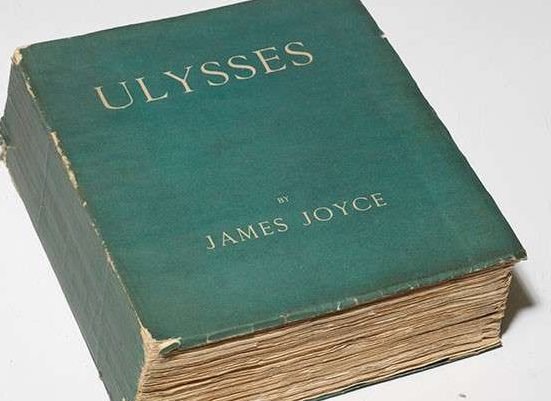
When Joyce’s main patron Harriet Shaw Weaver (publisher of the journal The Egotist to which Ezra Pound was literary editor) failed to find people who were prepared the risk to get involved, Beach offered the novelist the services of Shakespeare & Company. In 1922, she became the first publisher of Ulysses. As his advisor and friend, Beach helped Joyce personally and financially throughout the 1920s.
Sylvia had her opponents. Gertrude Stein thought that she was lowering the tone of the Left Bank by publishing indecent material and she avoided both Beach and Joyce at all cultural events.
 The novel was nevertheless well-received in avant-garde circles and news of its availability traveled fast. Copies of Ulysses were smuggled into America and Britain, although on occasion customs officers would confiscate and destroy Beach’s parcels. In 1924 she brought out a fourth edition of Ulysses, printed with revisions and corrections to the original text.
Published by Adrienne Monnier, a French edition of the novel appeared in 1929: Ulysses was prepared by a team that included August Morel (a young writer from the Celtic province of Brittany), Stuart Gilbert and Valéry Larbaud with Joyce himself helping from the wings. Monnier did for Ulysses in French what Beach had done for the book in English.
It was not until 1933 that Joyce was able to find a New York publisher, Random House, willing to challenge the ban by first printing the novel and then, intentionally, having a copy seized by Customs to provoke a legal case before the federal District Court for the Southern District of New York (United States v. One Book Called Ulysses).
On December 6, 1933, Judge John M. Woolsey (1877–1945) ruled that the novel was not obscene, noting that the book may be “emetic” (nauseating) in parts, but the story was not “aphrodisiac” (arousing).
The ban was lifted after rejection of the 1934 Appeal against the ruling, allowing Random House to legally publish the first American edition of Ulysses that same year.
Sadly, the momentous occasion led to an estrangement between Beach and Joyce. In the end, she relinquished her rights to the book without receiving a penny. After all the efforts she had made on behalf of the novel, Sylvia Beach was pushed aside.
Shakespeare & Company struggled during the 1930s as the global economic crisis hit hard and many Americans returned home to the United States. It finally succumbed to the German occupation of Paris after 1940.
Adrienne Monnier committed suicide in 1955 to escape the double pains of rheumatism and Ménières disease (a disorder of the inner ear that can lead to vertigo and hearing loss), having donated 5,000 books to the American Library in Paris in 1951.
Sylvia Beach lived on to set up a permanent home for her archive of Joyce materials at the State University of New York, Buffalo. She died in her beloved Paris in October 1962.
Read more about literature and New York State.
Illustrations, from above: James Joyce, Ulysses, published by Shakespeare & Co., 1922 (first edition); Gisèle Freund, photograph of James Joyce with Sylvia Beach and Adrienne Monnier, 1938; Adrienne Monnier in her ‘Maison des Amis des Livres’, 1935; Sylvia Beach (left) with Adrienne Monnier; the Parisian Coat of Arms (with silver ship); and Sylvia Beach in front of her bookshop, Shakespeare and Company, Paris, May 1, 1941.






Recent Comments