
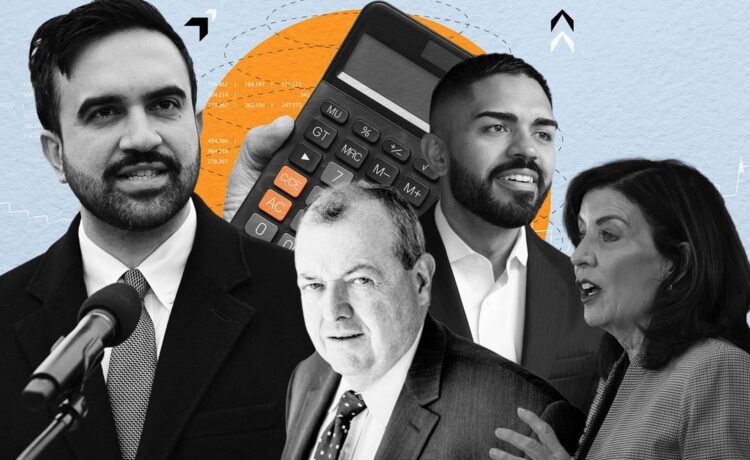
To plug a more than $5 billion budget gap, Mayor Zohran Mamdani sees two options: Either raise taxes on corporations and New York’s wealthiest or increase property taxes by 9.5 percent while tapping into the city’s reserves.
Gov. Kathy Hochul has rejected the former, which requires state action, and the latter, which Mamdani unveiled Tuesday as part of his administration’s preliminary budget, swiftly drew criticism from landlord groups.
“This proposal, coupled with Mamdani’s pledge to freeze rents for four years, virtually guarantees the physical destruction of tens of thousands of units of housing,” Kenny Burgos, CEO of the New York Apartment Association, said in a statement.
Jim Whelan, president of the Real Estate Board of New York, said “tax hikes of any kind, including increases to an already egregiously regressive property tax system, to raise revenue or plug budget holes is a non-starter.”
Ann Korchak, board president of Small Property Owners of New York, said that owners of small rental properties “are sick and tired of being treated like ATM machines every time the city needs to balance the budget.”
When presenting his $127 billion preliminary budget, the mayor said that his administration will do everything in its power to avoid the second path, calling raising property taxes the “tool of very last resort.”
“The second path is painful,” Mamdani said on Tuesday. “We will continue to work with Albany to avoid it.”
Hochul didn’t include the mayor’s proposal to increase taxes on corporations or those earning more than $1 million in her own executive budget, and hasn’t shown any appetite for taking up either cause. On Tuesday, she told reporters that she also doesn’t support raising property taxes.
The city’s property tax rates ranged from 10.8 to 19.8 percent in fiscal year 2026. The administration estimates that a 9.5 percent increase across the city’s four property classes will increase revenues by $3.7 billion in the next fiscal year.
The prospect of property tax hikes comes after Hochul and Mamdani announced on Monday that the state would allocate another $1.5 billion to the city over the next two years, $510 million of which is recurring funding stemming from costs that had shifted from the state to the city in previous years.
But that still left the city with an estimated $5.4 billion deficit for fiscal years 2026 and 2027.
The mayor’s preliminary budget dips into the city’s rainy day fund, taking $980 million in fiscal year 2026 and $229 million from the city’s Retiree Health Benefit Trust in fiscal year 2027. Taking into account $1.2 billion in general reserves used to bring down the deficit, along with the $980 million in rainy day funds targeted by the mayor’s budget, the city expects to log $6.3 billion in reserves for fiscal 2026, down from a reserve originally pegged at $8.5 billion. For 2027, again accounting for general reserves ($1.1 billion, leaving only $100 million for in-year funds) and a planned raid of the retiree trust, that number is expected to drop to $6.1 billion.
Using reserves is a one-time fix that leaves the city with a smaller cushion in the event of recession or other crises. The mayor indicated that the rainy day fund and retiree trust would be replenished by fiscal year 2028, though doing so could be complicated by future economic pressures.
“Assuming the city will replenish the funds in FY28, when the budget shows a $6.7 billion gap, is at best extremely tenuous and at worst a gamble,” Andrew Rein, president of the Citizens Budget Commission, said in a statement.
Even as he laid out the possibility of raising property taxes, Mamdani reiterated that his administration plans to send Albany a proposal to reform the city’s property tax system in the next few weeks. Sherif Soliman, director of the mayor’s Office of Management and Budget, said the proposed bill would build on the recommendations laid out in the 2021 report by the city’s Advisory Commission on Property Tax Reform. He noted the commission’s recommendation to eliminate assessed value growth caps and use sales-based market value to assess condos and co-ops.
The mayor also reiterated that the plan is not final.
City Council leadership believes there are additional areas of savings and revenue “that deserve careful scrutiny” before increasing property taxes.
“At a time when New Yorkers are already grappling with an affordability crisis, dipping into rainy day reserves and proposing significant property tax increases should not be on the table whatsoever,” Speaker Julie Menin and Council member Linda Lee, chair of the Committee on Finance, said in a joint statement.
Comptroller Mark Levine also said the city needs to search for other sources of savings, indicating that the mayor’s plan might not be enough to bridge the budget gap because it assumes “an aggressive revenue projection,” and presumes that the city will not move forward with the planned expansion of CityFHEPS rental assistance.
“Drawing down reserves during a period of economic growth would leave us vulnerable to economic turbulence next year,” he said.
Read more

The Daily Dirt: Voucher wars

Mamdani’s HPD head: “We don’t take over properties”

Mamdani’s housing czar on rent freeze, bad landlords and striking balance between pro-development and pro-tenant agendas






Recent Comments