
Although fewer than 1% of infections led to paralysis, the sheer scale of polio outbreaks meant that large numbers of children still ended up in iron lungs. They might remain encased from the neck down for days, months or even years. The patients Zogran cared for were still contagious, and she and her fellow nurses were told that the only protection available to them was rigorous handwashing. “We washed our hands every time we touched that patient or more, and I can remember going home at night and my hands were so sore and so chapped,” she said.
While it was primarily children who were affected by polio, no one was safe. Future US president Franklin D Roosevelt, then a rising political star, contracted the virus in 1921 at the age of 39. It left him paralysed from the waist down for the rest of his life. In office, he made combatting polio his own personal crusade, and in 1938, he founded the March of Dimes, a polio charity that would turn the traditional model of fundraising on its head. Rather than seeking big donations from the few, it asked for tiny ones from the very many, and raised hundreds of millions of dollars.
By the late 1940s, scientists had shown that polio entered the bloodstream through the gut. At the same time, two researchers emerged to compete in the race for a vaccine, each taking a sharply different path. Dr Albert Sabin, a paediatrics professor at Cincinnati Medical School, had already spent two decades studying the polio virus, and believed in moving slowly and carefully, according to David M Oshinsky, author of Polio: An American Story. “He saw himself as a scientist’s scientist… who worked in the lab, never left, and made discoveries one by one, using building blocks,” he told a 2014 BBC documentary.
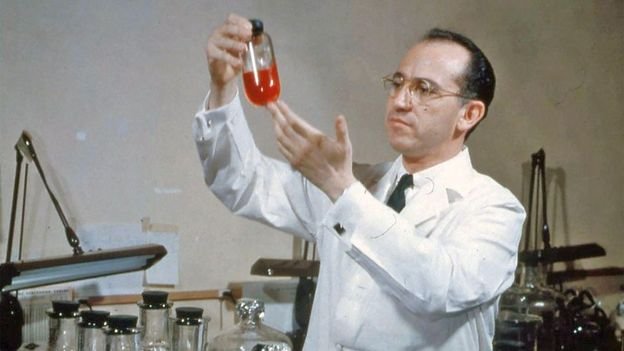
Salk, meanwhile, was a fast-moving researcher at the medical school in Pittsburgh, who had already produced a successful flu vaccine for troops during World War Two. Crucially, he had the support of the March of Dimes, which was impatient for progress. Dr Paul Offit of the Vaccine Education Centre in Philadelphia told the BBC how Salk worked with the speed and focus of a pharmaceutical company, a style that challenged traditional ideas of how scientists behaved. He said: “Salk and Sabin had fundamental differences about what would be the best vaccine. Salk thought it would be a virus that would be completely killed. Sabin thought it would be a virus that would be weakened.”


Recent Comments