
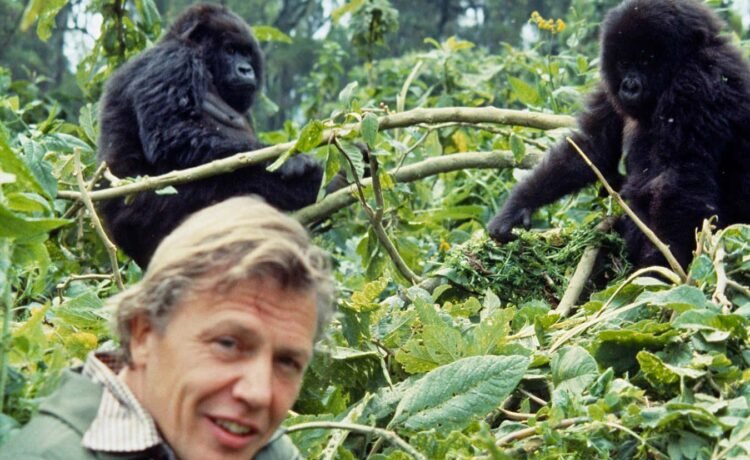

David Attenborough with mountain gorillas, on location in Rwanda during filming for Life on Earth
John Sparks
HOW could we talk about David Attenborough’s best documentaries without featuring the photo perhaps most associated with the broadcaster, whose 100th birthday is on 8 May?
Life on Earth, the groundbreaking 1979 series containing that iconic gorilla sequence, pictured above, introduced a wider audience to the calm narration and stunning nature shots for which Attenborough is known today. His many documentaries would go on to move from the ocean depths to the lives of plants, and from the distant past to the fight against climate change.
Read on to discover which made the biggest impact on our staff, and which they deem worth watching today.

David Attenborough by the Grand Canyon, on location for Life on Earth
John Sparks/naturepl.com
Life on Earth is special to me for so many reasons. There is that famous encounter with gorillas. It was also the first ambitious nature series of its kind – without its success, we might never have had the many great series that followed it. Then there’s the brilliant way Attenborough tells the story of deep time as he descends the Grand Canyon, and then back up again. There’s probably as much science here as in the rest of his programmes put together – I don’t think I’ve seen a better TV series on the evolution of life. OK, from today’s perspective it is a bit lectury at times, but who would you rather be lectured by?
Last but not least, for me, it has personal meaning, as I’m sure it does for many other people who saw it in their youth and were influenced by it. That wonky opening music by Edward Williams is just so evocative.
Michael Le Page, reporter

David Attenborough with film crew on Ellesmere Island, Canada, filming The Private Life of Plants
NEIL NIGHTINGALE / naturepl.com
Plants live on another plane of existence. Every morning, drooping wood anemones lift their heads and nod at the sun, while brambles grapple across the forest floor with slow aggression. Exploding pods launch seeds in a millisecond; on mountain tops, bristlecone pines gnarl into stumps over thousands of years.
Time-lapse and high-speed photography weren’t new when The Private Life of Plants was filmed, but this was the first series to use them at scale. They allowed Attenborough to explore the agency and the intelligence of flora like never before.
When I rewatch the series today, the lurid colour grade, bespoke plant-themed typeface and rudimentary CGI bring me as much joy as the plants’ private lives. I would also recommend the behind-the-scenes for the plants episode of Life, which lays bare the painstaking ingenuity of the film-makers who capture these other worlds.
Thomas Lewton, features editor

The Pacific Ocean, seen from the International Space Station
NASA
As the first in-depth look at what is happening beneath the rarely explored waves, The Blue Planet astounded me when I first watched it. New species were discovered and extraordinary footage showed blue whales from the air, alien-looking creatures in the ocean depths and, most surprisingly, herring sperm as far as the eye could see.
I am still haunted 25 years later by watching a pod of orcas spend 6 hours hunting a grey whale calf to eat only its lower jaw and tongue. Attenborough’s narration is calm, clear and concise, unafraid to let the images and music hold our attention.
It may not have the glossy HD footage or drone shots of more recent series, but it changed the shape of nature documentaries.
It also blew my mind and sparked a life-long interest in the oceans. Without it, I wouldn’t have ended up at New Scientist!
Eleanor Parsons, magazine editor

David Attenborough at the launch of the third series of Planet Earth in 2023
Ian West/PA Images/Alamy
Those nighttime images of a massive pride of lions swarming over a fleeing young elephant have stayed with me ever since the first series was shown in 2006. The film-makers set out to create a spectacular, high-definition series, and boy did they achieve it.
The many notable moments in Planet Earth include a starving polar bear trying to catch walruses, eagles preying on cranes as they fly over the Himalayas, dolphins beaching themselves to hunt fish and bears climbing mountains to feast on moths. This is simply incredible television. Watch it now if you haven’t seen it. Watch it again if you have.
The second series, first shown in 2016, also made a notable departure. While Attenborough’s previous series all showed wildlife in pristine wildernesses, the last episode here, and in the third series (2023), is about animals living alongside people, from leopards and monkeys to falcons and otters.
I do think Attenborough has been right to aim to evoke wonder rather than despair in most of his programmes, but now there’s no denying we live on a much-changed planet.
Michael Le Page, reporter

Polar bears in Frozen Planet
BBC
Wondrous and strange is the life that thrives at the very ends of Earth. Frozen Planet cast a loving eye over the inhabitants of the Arctic and Antarctica, hostile lands whose charms are apparent from the earliest moments of this excellent series. The narrative bounces back and forth from one pole to the other, treating us to scheming penguins, swimming snails, polar bears and a bison charging down wolves.
Among it all, the then 84-year-old David Attenborough, bundled up in a fetching array of parkas, makes the odd appearance as our all-terrain guide to these alien environments.
Casting a pall over proceedings, of course, were the advancing effects of climate change. The series’ seventh episode, “On Thin Ice”, was an explicit call for the world to do more to protect these magnificent ecosystems and those living in them, including humans.
The magic of Frozen Planet wasn’t just that it told us how global warming imperils the poles, it’s that it made us truly care about what we might be losing.
Bethan Ackerley, subeditor

A turtle swims over a coral reef in A Life on Our Planet
Netflix / David Attenborough: A Life On Our Planet
Like an ice core or tree ring, David Attenborough’s long and extraordinary life has come to be used as a yardstick for change. Socially, technologically and environmentally, the world of his youth was a far cry from the one we see today – and in this powerful film, Attenborough charts how we have degraded Earth’s ecosystems over his lifetime.
Released during the first year of the covid-19 pandemic, A Life on Our Planet was a timely warning from a man who has seen more of Earth’s wonders – like this turtle, pictured swimming over a coral reef – than perhaps anyone else alive. Its marriage of the personal and the political makes it a different beast from most Attenborough films. Climate change, biodiversity loss and rampant pollution all feature, as Attenborough sets out what a child born in 2020 may witness over their lifetime. It makes for bleak viewing, but, as is a hallmark of more recent Attenborough works, it also supplies plenty of solutions to the environmental crises we’re living through – if we’d only apply them.
Bethan Ackerley, subeditor

Rapetosaurus, a long-necked sauropod from Madagascar, in Prehistoric Planet
Apple TV
Prehistoric Planet is far from the first programme to try to bring long-extinct animals back to life on the small screen, but it is the best so far. Of course, the programme-makers had to use their imagination to some extent, but the series has been praised by palaeontologists for its accuracy and naturalism.
The three series feature many of the most iconic animals of the past, but shows them in new ways – we see Tyrannosaurus rex swimming and mating, for instance. There are lots of smaller, lesser-known animals, too. For me, the real stars are not the dinosaurs but the pterosaurs, brought back to life in stunning detail.
The third series jumps forward in time to the recent glacial periods, featuring animals such as mammoths, sabre-toothed cats and many more. The content is just as brilliant, but Tom Hiddleston replaces David Attenborough as the narrator. It’s just not the same without him.
Michael Le Page, reporter

A pigeon, one of the stars of Wild London, on a London Underground train
BBC/Passion Planet Ltd/Simon De Glanville
This very late entry to the David Attenborough canon became an instant classic in my household, since it was shown on New Year’s Day. We’ve rewatched the extraordinary exploits of London’s wildlife many times.
Yes, this one-off urban showcase has the foxes and pigeons you would expect, but not as you would expect to see them: vixens viciously squaring off on the streets of Tottenham and pigeons intelligently commuting on the tube from Hammersmith are standout moments.
But the bigger surprises come from how much the city’s nature has changed in recent decades. Peregrine falcons now soar over the centre, ring-necked parakeets have conquered the parks, Aesculapian snakes dangle from the trees along the Regent’s Canal and, since covid lockdowns, large numbers of fallow deer have taken to roaming parts of Romford.
The programme tours a London that is familiar to locals but rarely seen on screen: the community gardens, cemeteries and suburban parks that make the city an outstanding place to live, even for the nature-lovers who sometimes wonder if a megacity is the right place for them.
Perhaps their lingering doubt will be extinguished by Attenborough’s own assertion that he wouldn’t want to live anywhere else.
Penny Sarchet, managing editor
Topics:






Recent Comments