
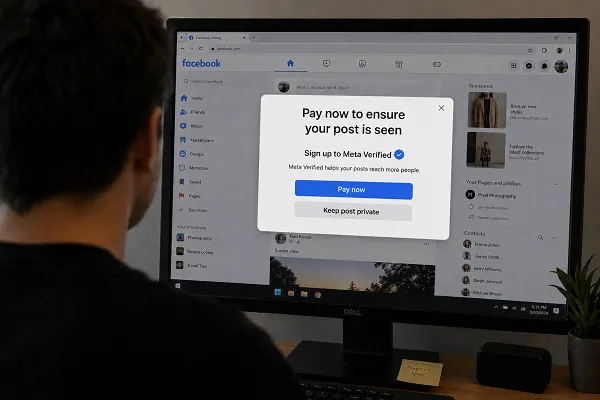
After Meta announced a range of new add-on subscription packages, questions were raised as to the viability of free social media moving forward, and whether, at some stage, everyone will have to pay to access the apps.
The concept that, eventually, all platforms will have to charge something for access gets floated every now and then. Some people see paid social media subscriptions as the only way to negate spammers and scammers, and stop them from creating millions of new profiles for free.
In 2023, just months after buying Twitter, X owner Elon Musk suggested that his app may soon be forced to charge all users, even if just a small amount, for this exact reason.
According to Musk, the development of AI, at that stage, made it impossible to keep out bot armies, because it’s “trivial to spin up 100k human-like bots for less than a penny per account.”
“Paid verification increases bot cost by ~10,000% & makes it much easier to identify bots by phone & CC clustering,” Musk said.
Expanding on this, Musk further predicted that paid social media will eventually be “the only social media that matters.”
Historically, Meta CEO Mark Zuckerberg has remained committed to keeping his company’s apps available for free. He told Congress in 2018 that “there will always be a version of Facebook that is free.”
And that makes sense. Meta generates around 98% of its annual income from ads, and that’s only possible because of the company’s massive reach, with over 3 billion active users.
If Meta forced everybody to pay, a lot of people would at least consider life without Facebook and Instagram. And with so many other options available, it would likely be a massive misstep, or at the least, a massive risk, if Zuckerberg chose this path.
There’s also, historically, limited precedent for paid social as an option.
Various platforms now offer paid subscription offerings, but most have seen very limited take-up.
Around 4.5% of YouTube’s user base pays for YouTube Premium and fewer than 1% of X users pay for X Premium. Meanwhile Snapchat+, which has been a relative success for the platform, has only been taken up by around 2.6% of the platform’s total monthly audience.
Meta hasn’t shared any official data on Meta Verified take-up, but looking at Meta’s quarterly performance updates, it seems that, potentially, around 35 million Facebook and IG users may have signed up to Meta Verified thus far. Which is a lot, but that also only equates to 0.98% of Meta’s massive audience.
LinkedIn Premium likely holds the crown for the highest levels of take-up. Like Meta, LinkedIn also doesn’t publish official data on this, but external estimates suggest that around 18% of the platform’s member base pay for its add-on features.
But overall, data suggests that not a lot of people are keen to pay for social media apps, which further underlines the risk that any platform would be taking in forcing people to pay.
So could X or Meta decide to make everyone pay $1 per month to use their apps? Sure.
Would they? Probably not.
What’s more likely is more subscriptions for AI features, since every platform wants to build its business models for monetizing expensive AI features, which costs billions, even trillions, of dollars to develop and maintain.
Reports last year suggested that xAI was burning through $1 billion per month in development and maintenance costs. In addition to the hundreds of billions that Meta is sinking into AI datacenters, it’s also paying additional billions of dollars per year in ongoing maintenance and operation. Every time someone asks an AI chatbot to generate an image of a dog in a hat, that costs development resources. And as more people use AI for more things, those costs will continue to rise.
Based on current outlay, even if Meta was bringing in $100 billion per year from AI subscriptions, it would take it more than a decade just to break even on its AI expenditure.
Meta’s non-ads income for 2025 was $4.8 billion in total, which includes data sales, AI glasses and VR hardware. Quite the gap to make up.
So yes, Meta and X and other apps will be looking to pass on at least some of the costs from their AI add-on elements, and that will likely see more of them adding subscription options for AI tools.
But charging for access? No, except for in Europe, where the platforms have to offer this as an option in order to avoid using people’s personal data for ad targeting.






Recent Comments