
 “A self-made man is the description which best fits Karl Peterson, a manufacturer of Jamestown. He has a natural gift for mechanics and is of an inventive turn of mind, quick to grasp the possibilities in any circumstance which may arise, and equally quick to develop the new idea presented to him,” wrote John P. Downs and Frederick Y. Hedley in their 1921 History of Chautauqua County.
Karl Peterson’s father was the operator and owner of a summer resort in Sweden, where Karl was born in Malmö in 1866. For about a dozen years during the summer busy seasons he spent his time helping his father run the place.
One of his duties was to superintend the workings of the resort’s steam engine and his greasing and repairing, packing it away for the winter, and putting it together again each spring, gave him his first experiences in mechanics.
While in Sweden he also learned the manufacture of snuff, and at 20 years-old in 1886 he emigrated to the United States and arrived in Jamestown, in Chautauqua County where he joined went into business with James Holmes making snuff.
 In his spare time Peterson perfected a wood carving machine he invented and patented, eventually selling the rights. He gave up snuff making and worked in an experimental department of the Art Metal Construction Company (1888–1971), a local steel office furniture company, spending some of his time making voting machines.
After three years Peterson joined C.W. Morgan’s bicycle handle bar factory, where he became superintendent of the works.
In 1902, he formed a partnership with J.P. Danielson, to manufacture small tools, such as pliers, wrenches, etc., eventually taking six men into the business.
They rented a small floor space in the Whitney building on Steele Street, where they added special machinery as they went, eventually buying the lot at the corner of Foote Avenue and Harrison Street, and erecting a two-story building.
In 1907, after a falling out among the partners, the Crescent Tool Company was organized and incorporated and took over the fomer company facilities. The following men men were named as the company’s first officers: Karl Peterson, president, Amel Nelson, vice-president and Jamestown native Charles F. Falldine, secretary and treasurer.
The following year the company introducing the first successful American adjustable wrench, which became a staple of early industry, aviation, and automotive mechanics.
 Peterson bought the prototype design from fellow Swedish immigrant Gunnard Oberg for $500 and production challenges were solved in part by Emil Johnson, the Crescent plant’s superintendent.
It wasn’t the first adjustable wrench – they date to the early 1800s – but it was the first screw-worm design patented in the United States (though not until 1915). Peterson is famously said to have whittled the prototypes from wood.
From time to time additions were made to the original plant (half of the machinery used in the business was said to be of their own invention) and the business grew to require 300 men to turn out the constantly arriving orders.
The Crescent wrench was an instant success. It became a household name and was famously carried by Charles Lindbergh on his 1927 solo trans-Atlantic flight, polar explorer Richard E. Byrd and astronauts on Gemini missions.
The company was kick-started by Detroit and the Ford Model T, when an adjustable wrench and a pair of slip-joint pliers was supplied with every car sold.
In the 1930s, the company created Crestoloy, a special stronger and lighter alloy steel for the US army Air Corps. The company dedicated 100% of its manufacturing efforts to the World War Two effort, providing tools for the Seabees and military aviation.
By 1931 the company was so famous it was successfully suing competitors for using the “Crescent wrench” name. Other major historical competitors included Diamond and Craftsman.
Karl Peterson died on June 30, 1933 and his son Marvin assumed leadership of the company.
 The Peterson family sold the business in 1960 and it became a subsidiary of the Crescent Niagara Corporation, which was itself bought out by Cooper Industries (established in Texas in 1833).
Most of the production lines were moved to less Labor friendly North Carolina in 1977 and the original Jamestown factory was closed in 1984.
In 2010 the tool divisions of Cooper Industries and Danaher Corporation merged into Apex Tool Group.
In 2017 Apex added several other historically important brands to their portfolio, including Wiss (snips and scissors, Newark, NJ, 1848); Nicholson (files, 1864 Providence, RI); Lufkin (tape measures, founded in Cleveland in 1869); and H.K. Porter (bolt and cable cutters, Boston, 1880).
Today Crescent brand adjustable wrenches are manufactured in both Sumter, South Carolina (where more specialized versions are made) and in China (where most consumer versions are made).
Read about more about Chautauqua County.
This article was sourced in part from John P. Downs and Frederick Y. Hedley’s History of Chautauqua County (1921); John Warren contributed.
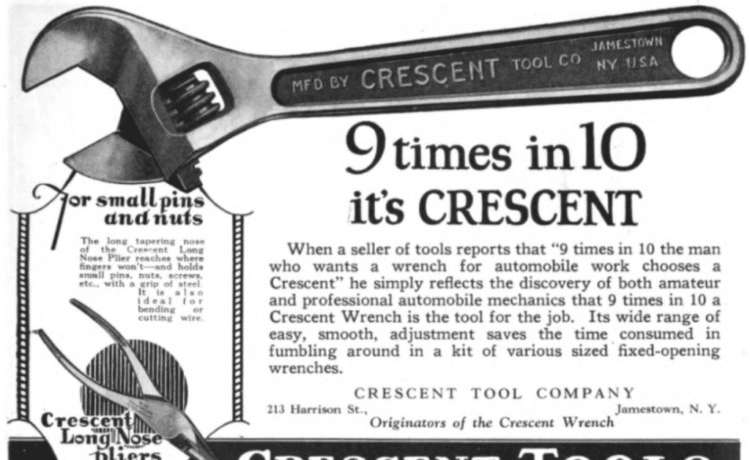
Illustrations, from above: “9 times out of 10 it’s Crescent’ advertisement in The Journal of the Society of Automotive Engineers (January 1926); Crescent Company wrench patent drawing (1915); Crescent Company pliers advertisement in Popular Mechanics, 1928; and the former Crescent Company factory in Jamestown NY, ca. 2021.






Recent Comments