
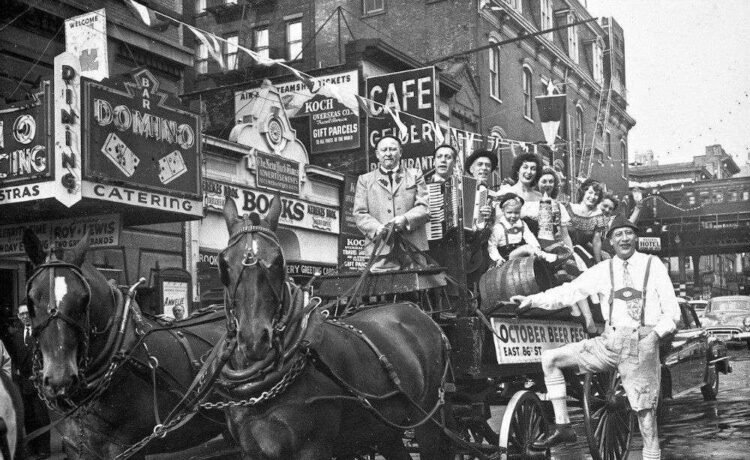
 New York’s vibrant immigrant history created a diversity of ethnic enclaves in the city. When over time demographics changed or newcomers assimilated deeper into metropolitan culture, the identity of such areas diminished. Little Poland, Little Syria, Little Africa, Little Vienna, and the French Quarter (Little Paris) were once lively parts of Lower Manhattan but have long since disappeared (Little Italy and Chinatown being notable exceptions).
They contributed to the city’s rich tapestry of food. Many dishes that are considered today as quintessentially American have an immigrant origin.
Sauerkraut played a foundational role in Manhattan’s socio-cultural history and New York’s agricultural development. Early settlers in New Netherland packed barrels of fermented cabbage for the long Atlantic crossing as high vitamin content offered protection against scurvy. Massive German immigration made it a dietary staple.
Sauerkraut & Scurvy
Sauerkraut, a German word meaning “sour cabbage,” is the product of a preservation process that is believed to have originated in China. Workers on the Great Wall fermented sliced cabbage in rice wine to survive freezing winters.
During the Mongol conquest, Genghis Khan’s armies not only plundered China but also adopted its fermentation methods, carrying those into Eastern Europe, reaching the Germanic regions and Low Countries in the sixteenth century.
 With the expansion of long-haul maritime journeys in that era, Dutch sailors suffered high mortality rates caused by scurvy (the “disease of sailors”). Unable to preserve food, crew members developed vitamin C deficiencies with symptoms of bruising, bleeding gums, and internal hemorrhaging.
The vernacular word for the affliction was scheurbuik (torn belly). Dutch-born physician Johannes Echthius (1515–1576) who spent most of his medical career practicing in Cologne, latinized the word in 1541 to “scorbutus,” which became the medical term for scurvy.
In the seventeenth century, the expanding Dutch Republic sought medical solutions for this fatal scourge. Practicing in Leiden, the center of medical excellence at the time, Paul Barbette wrote Praxis Barbettiana (1669) in which he outlined the importance of diet and hygiene in combating shipboard illnesses.
Fewer casualties occurred when ships carried citrus fruits to feed the crew. Having learned that Dutch seafarers avoided scurvy by consuming fermented cabbage (zuurkool), English explorer Captain James Cook ordered his suspicious crew to eat “foreign” cabbage during his Pacific voyages. It’s said that by intentionally serving the dish to officers only, the ship’s sailors soon demanded their plateful.
 Scottish surgeon James Lind has been credited with providing a cure for scurvy in 1747, but earlier pioneering research in the Netherlands was carried out by a Polish-born physician named Johannes Bachstrom. Working in Leiden, he published Observationes circa scorbutum (Observations on Scurvy) in 1734, suggesting that a lack of fresh fruit and vegetables was the sole cause of scurvy.
Food preservation was a matter of survival for soldiers in the Continental Army too. Rations were small, unpalatable, and lacking nutrients. Meat was salted and flour made into hard biscuits to prevent molding. Scurvy was a continuous threat.
In a 1777 requisition to Congress, General George Washington called for significant supplies of sauerkraut to keep his troops fighting fit during the harsh winter months of the Revolutionary War.
Sauerkraut was far more than a medical remedy. The Dutch developed a taste for zuurkool, treating it as a delicacy. Settlers brought a taste for fermented cabbage to New Amsterdam. Manhattan’s bouweries (farms in old Dutch) were the colony’s food suppliers.
Cabbage was a vital crop cultivated on large patches along the Hudson River. It profoundly influenced New York’s agrarian landscape and established a culinary legacy that includes the passion for coleslaw (koolsla, the cabbage salad now known as coleslaw).
In the early 1800s, long after the British take-over of the colony, descendants of the first settlers (known as Knickerbockers) formed the exclusive “Krout Club” to defy the city’s vogue for French cuisine at the time.
They celebrated their heritage by feasting on traditional fare like zuurkool stamppot en rookworst (sauerkraut mashed with potatoes and smoked sausage). The club flourished in the first decades of the nineteenth century (the final feast took place in 1843).
The mass arrival of German-speaking immigrants further strengthened Manhattan’s connection with sauerkraut.
Rise of Germantown
Until the early nineteenth century, Yorkville was a hamlet in an area of farmland surrounded by country houses. Members of Manhattan’s social elite like Peter Schermerhorn or Jacob Astor owned summer estates on the banks of the East River.
In 1770, shipping magnate Jacob Walton and his wife Mary Cruger, daughter of New York’s 41st Mayor, settled in a newly built riverside residence named Belview Mansion at Horn’s Hook. Because of its strategic position, British cannon fire blew the property to bits during the Revolution.
 Using its foundations in 1799, Scottish merchant Archibald Gracie (1755-1829) built a federal-style wooden house on the site. John Quincy Adams and Louis Philippe, King of France, were among many famous guests who sat on its porch watching the river flow.
The “pastoral” landscape changed rapidly after 1834 when the New York & Harlem Railroad opened a station at 86th Street, triggering urban expansion.
Gracie Mansion survived the transformation. Ever since Fiorello La Guardia’s occupancy of the house in 1942, it has been the Mayor of New York City’s official residence.
From 1837 onward, the East Side became home to thousands of Irish immigrants who worked on the Croton Aqueduct. Its construction was carried out by disenfranchised laborers who lived in a slum area that would later morph into Yorkville.
Although not in use until 1842, the aqueduct created a crucial network for Manhattan’s residents and industry. It supplied clean water, eradicated waterborne epidemics, and eased fears of fire in the metropolis.
The introduction of the Second and Third Avenue elevated transit lines (“El”) accelerated the urbanization process. Improved means of transport led to an expansion of Yorkville’s manufacturing base.
 German immigrant workers soon outnumbered the Irish as many of them found jobs in breweries that spread over several blocks from 90th to 94th Street.
In 1866, George Ehret founded the Hell Gate Brewery in a massive brick clock-tower structure on East 93rd Street (named after the tidal strait in the East River). He had arrived in 1857 during the first wave of mass immigration from the German states.
Founded a year later, the adjacent brewery ran by Jacob Ruppert was just as impressive (his father is believed to have had been the first German malt dealer in the city of New York). Most of their German employees lived on or near to the premises – “Germantown” was born.
Sauerkraut Boulevard
Little Germany (Kleindeutschland) and Germantown were two distinct enclaves in different eras of settlement. The first developed during the 1850s in Manhattan’s Lower East Side. Centered around Tompkins Square Park, it was a close community that for some considerable time kept its culture and customs.
On June 14, 1904, an aging paddle-steamer named General Slocum left the Recreation Pier at the foot of East 3rd Street. She carried 1,331 passengers, mostly women and children belonging to St Mark’s Lutheran Church, on their way to an annual picnic on Long Island.
As the ship passed through Hell Gate a fire alarm rang. Emergency equipment turned out to be in a state of neglect as firehoses did not function and life vests were useless. Passengers jumping in the East River drowned in the treacherous waters.
In the end, 1,021 passengers died in the disaster. The traumatic event precipitated migration away from the district towards uptown Yorkville.
By then, New York City was the world’s third largest German-speaking city after Berlin and Vienna. Yorkville stretched from Third Avenue to the East River, between 79th and 96th Streets.
 It became a hub of German life in the 1900s, renowned for its butcheries, bakeries, beer gardens, dance halls, and singing clubs. The district smelled of sauerbraten and schnitzel; its soundscape rang with German dialects, brass band music, and tunes of Wagnerian opera.
Sometimes referred to as “German Broadway,” East 86th Street was Yorkville’s main commercial and cultural artery. It was nicknamed “Sauerkraut Boulevard.”
Locals upheld established traditions such as eating pork and sauerkraut on New Year’s Day (pork for “rooting” forward; cabbage for the blessings of health and wealth). The consumption of home-made sauerkraut gave rise to a unique profession.
The krauthobler or cabbage shredder was an itinerant tradesman who went door-to-door in local tenements with a razor-sharp mandoline slicer to cut cabbages into uniform thin shreds ready for home-made sauerkraut or coleslaw.
The city’s passion for sauerkraut was of prime value to the State’s economy. Operating out of Phelps, a village in Upstate New York’s Finger Lakes region, the Empire State Pickling Company was founded in 1905.
Two years later it introduced the Silver Floss brand of canned and jarred sauerkraut. At its peak in the early 1930s, Silver Floss ran six fermentation factories in this cabbage-rich region. Phelps was lauded as the “Sauerkraut Capital of the World.”
Battle of Yorkville
In the 1930s, several anti-fascist protests took place in Yorkville. The neighborhood welcomed German refugees but there were serious tensions too. The German American Bund was a pro-Nazi group led by Munich-born Fritz Julius Kuhn. It held frequent rallies and parades in Yorkville which terrified local Jews, many of whom had relatives in Europe and were aware of the fascist threat.
Former judge and member of Congress Nathan David Perlman (1887-1952) decided to intervene. When the Bund announced plans to stage a march celebrating Adolf Hitler’s forty-ninth birthday, he reached out to Meyer Lansky, a Jewish mobster.
The latter recruited several criminal “enforcers” of the Murder Incorporate group, including Harry “Pep” Strauss, a prolific contract killer, Jacob Drucker whose favorite murder weapon was an ice pick, and others.
 On April 20, 1938, an army of Bund supporters wearing brown shirts goose-stepped from Carl Schurz Park to Yorkville’s Casino at 210 East 86th Street.
Posing as American Legion members, fifteen mobsters joined an audience that had gathered in the Casino’s ballroom, facing a stage decorated with Hitler pictures and swastikas, whilst waiting for the Bund’s leader to burst into his “Sieg Heil” drill and start a speech in praise of the Führer.
At that moment, although heavily outnumbered, the infiltrators attacked and created mayhem. The violent incident did not stop the Bund from attracting big crowds. On February 20, 1939, more than 20,000 people attended a Nazi rally at Madison Square Garden.
Months later, Kuhn was accused of embezzling money from the Bund and, eventually, convicted of grand larceny and forgery. With the arrest of several other officials, the Bund fell apart. When the United States entered World War II in December 1941, the government outlawed the organization.
End of an Era
As residents of Kleindeutschland started moving uptown to Yorkville in the early twentieth century, East European immigrants followed the exodus with Czechs clustering around East 72nd Street (Bohemian Broadway) and Hungarians settling at East 79th Street (Goulash Boulevard).
Manhattan’s first Little Hungary had been situated between Houston and East 10th Streets. Nicknamed “Goulash Row,” it had the Little Hungary restaurant as a hot spot.
Founded in 1888 by Max Schwartz at 255-263 East Houston Street, city guides referred to the offbeat eatery as a “widely known bohemian resort,” where customers enjoyed goulash and fine wines from the Tokaj region in the “midst of casks and barrels.”
 Uptown New Yorkers flocked to the district to see downtown “foreign” life, enjoy the “atmosphere of Budapest,” and hear Romani bands perform fiery renditions of Franz Liszt’s “Hungarian Rhapsodies.”
Theodore Roosevelt was a friend of Max Schwartz and often dined at the restaurant during his time as New York City Police Commissioner. In February 1905, shortly after his first presidential election, he attended a dinner in his honor hosted by the Hungarian Republican Club.
When East European residents started moving uptown to Yorkville, Little Hungary stayed at its original location. It did not survive Prohibition, closing soon after its introduction in 1920.
Following anti-German sentiment in the First World War, Yorkville started to show signs of decline. It faced intense government scrutiny and populist harassment.
To avoid persecution, locals began hiding overt displays of heritage, renaming businesses, and abandoning traditions. Restaurants changed their menus, serving “Liberty Cabbage” instead of sauerkraut.
The final demise of Sauerkraut Broadway happened in the mid-1950s with the removal of the elevated Third Avenue train tracks. Property prices shot up, real estate dealers moved in, and the area lost its identity and character. Gentrification dissolved the historical German, Czech, and Hungarian enclaves.
A few old-world establishments resisted urban change and stayed in business. Founded in 1902 by Bavarian immigrants at 1670 First Avenue, Glaser’s Bakery was famed amongst clients for its black-and-white cookies (a New York classic), fudgy brownies, and traditional German pastries. Boasting a vintage “Old New York” interior of wood and glass display cases, tin ceilings, and mosaic floor tiles, the bake shop finally stopped trading in 2018.
 The stores have vanished and memories are fading, but the ghost of Sauerkraut Boulevard lives on, its legacy linked to fast food. The pairing of “dachshund” pork bangers with fermented cabbage originated in Central Europe.
Immigrant vendors made traditional German “Wursts” (sausages) popular across New York City by selling them out of carts in milk rolls topped up with sauerkraut.
The “classic” hot dog had arrived. Sauerkraut remains a defining staple of street food and Jewish delicatessen (recall the Reuben sandwich) in the metropolis.
Read more about German-American History.
Illustrations, from above: October Beer Fest, East 86st Street in the German enclave of Manhattan; Cabbage yard of Ward Moulton Cannery in Clay, NY; Johannes Bachstrom, Observationes circa Scorbutum (Observations on Scurvy), Leiden 1734; Late nineteenth century photograph of Gracie Mansion; Calendar poster for George Ehret’s Hell Gate Brewery, founded in 1866; Little Germany in Manhattan in the late 19th century; German American Bund parade in East 86th Street, 1938 (Library of Congress); 1890 U.S. Census map titled “Density of Distribution of the Natives of the Germanic Nations”; and a New York hot dog stand, ca. 1900.






Recent Comments