
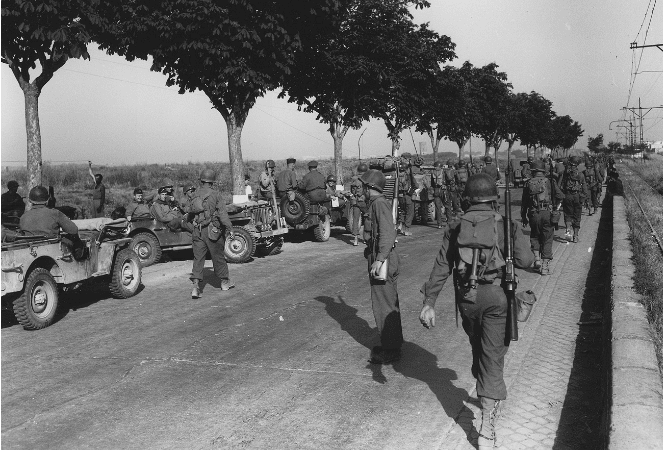
 When Leon “Frog” DeCelle left his small hometown of Mechanicville, in Saratoga County, NY, on December 10, 1942, for induction into the US Army, he set out on a journey that eventually took him to some of the toughest fighting in Italy during World War Two, including the Gothic Line and the Po Valley campaigns.
Upon his return home in the winter of 1945, he started a yearly reunion with a life-long friend.
Leon was born November 4, 1915, in Corinth, NY, in the foothills of the Adirondacks. He was the ninth child of Albert and Mary DeCelle.
In the mid 1920’s the family moved to Mechanicville where the DeCelle name would be synonymous with local baseball as the DeCelle boys – older brothers Alfred and Edward – were very good ballplayers – and Leon was the bat boy.
Leaving with Leon on that cold December day was George Luther, who was also heading into the Army. I am sure they had a lot to talk about but also sure they shared hope that they would see each other and their families again.
Leon’s basic training was at Fort Jackson in South Carolina, followed by Ranger training and assignment to the Ranger detachment of the 100th Infantry Division, known as the “Century Division.”
Leon was transferred to the 91st “Powder River” Division as a replacement in Company I, 3rd Battalion of the 363rd Regiment. At this time, the 363rd took significant casualties during the Rome-Arno Campaign (January 22 – September 9, 1944) in the battles of Channi and Bagni.
Leon arrived in Italy on July 15, 1944, and was sent up to the front.
 The Gothic Line was series of fortifications, machine gun nests and minefields extending across northern Italy’s Apennine Mountain Range from the Tyrrhenian Sea on the west coast to the east coast on the Adriatic Sea.
The Line prevented the Allies from accessing the Po Valley and eventually advancing into southern Germany. The line would fluctuate and move at each Allied advance, making for tough defenses and difficult fighting.
On September 12, 1944, the 363rd started out to capture the Il Giogo Pass by taking Monticelli to the west of the pass and Monte Altuzzo to the east. On September 13, Company I stormed the 2,390-foot crest of Monticelli to within 400 feet only to be turned back by machine-gun fire and barb wire.
The regiment returned to base with 25 wounded, including the company commander, Captain Willie Kriel. Their base at I’ Uomo Morto was in direct sight of the defensive heights of Monticelli and received many attacks from the Germans for the next few days.
Multiple attempts were made over the next week to reach the top of the two mountains. On September 17, at 2 pm, the 3rd battalion advanced behind a rolling artillery barrage with Company I following Company K up the hill.
Just before 3 pm, Captain William B. Fulton of Company K radioed that he was on the top of Monticelli with 10 men.
Lieutenant Joseph Wessendorff of Company I heard the same message and rallied six platoons to the top by dusk to help hold Monticelli.
 Leon, physically unscathed, was among that group. The Germans had to withdraw, leaving the pass open for Allied troops to eventually move forward into the Po Valley.
Two of many heroic actions stood out.
Sergeant Joseph D. Higdon, Company A, was wounded by advancing Germans. He rose from his fox hole firing his light machine gun to drive back the enemy. The Germans retreated but not before mortally wounding him. He died 30 yards from his fox hole trying to return to his buddies.
Another example was described by Private First Class Ben Kelley, Company I machine gunner, who described a night attack on their forward position.
Low on ammunition and with only two grenades, the Americans started to toss mud balls. The moonlit night caused the Germans to think they were grenades and retreated.
Kelley’s squad would then toss a live grenade to keep them guessing. Eventually the Germans gave up the attack.
For their heroics during the Italian campaign, Lieutenant General Mark Clark, American commander of the Fifth Army, wrote a congratulations letter to the Fifth and Eighth Armies praising them for their courage and victories.
Later, Clark’s replacement, Lieutenant General Lucian Truscott Jr. awarded the Distinguished Unit Citation to Leon’s battalion. Leon and Frank Michon, of Green Island, NY in Albany County, received the Distinguished Unit Badge for taking part in the conquest of Monticelli Ridge.
Leon would continue the fight in Italy, seeing fierce combat. He would be a part of the Po Valley Campaign, at Armigo and Cologna, in April 1945.
 At the end of the war in Europe, his regiment was moved to Treviso in northeastern Italy for occupation duty. He sailed home on August 14, 1945, from Naples on the SS Pachaug Victory and discharged from the Army on November 20,1945 at Fort Dix in New Jersey.
During the Italian campaign, I Company’s 3rd Battalion had a peak muster roll of 492 soldiers. They would serve 127 days on the front line and 121 days in reserve.
The company’s casualties were listed as 17 missing in action, 57 killed in action, three deaths from wounds, 48 serious wounds, 94 lightly wounded and 17 injured for a total of 236. That represented a 50% casualty rate.
Battalion soldiers were awarded 10 Distinguished Service Crosses, 147 Silver Stars, 13 of which went to Company I soldiers, including four posthumously. A Medal of Honor was awarded to Sergeant Oscar Johnson of B Company, 1st Battalion, for his bravery during the battle for the Il Giogo Pass.
Leon and George Luther, who set out for the Army on the same day in 1942, both arrived back in Mechanicville on the same day in December of 1945. George attained the rank of sergeant while serving in the Pacific. They would go on to celebrate this day each year by meeting at a local bar or VFW post for a beer.
Leon married Elizabeth Burton and have three children: Dawn, Doreen and Dan. He passed away on St. Patrick Day 1979. Betty would join him on February 9, 2014.
While I knew my Uncle Leon (aka Uncle Frog) was in the war, I never knew details about his service. My cousin Doreen shared a box of his war records with me so that I could preserve them electronically.
 “He never talked about the war,” she said. “When the topic arose, he would simply say, ‘I’m a vet, I served my country.’”
To ensure that statement stands for all time, his granddaughter, Janine Iamunno, enrolled his name in the World War II memorial in Washington D.C.
If you drive down Main Street in Mechanicville and look at the Hometown Heroes banners hanging from telephone poles, in front of the old school you will find Leon and George Luther’s banners next to each other – just like they were when they left home in 1942.
Don Carola Is a local history buff and Revolutionary War reenactor. He is a retired manager for the NYS Office of Information Technology. Don lives in the Town of Halfmoon and is married with two daughters.
Read more about New York’s World War Two History.
This essay is presented by the Saratoga County History Center.
Illustrations, from above: American infantrymen advancing along Highway 6 toward Rome (National Archives); a map of Northern Italy, 1944 showing the Allied advance to the Gothic Line (June 5 to Aug 25) and gains (Aug 29-Dec 31), a larger version is available here; the top of Il Giogo Pass in the Gothic Line, looking north; the Bessemer Victory, a sister ship to Pachaug Victory; and a Mechanicville “Hometown Heroes” banner highlighting Leon DeCelle’s World War Two service.





Recent Comments