
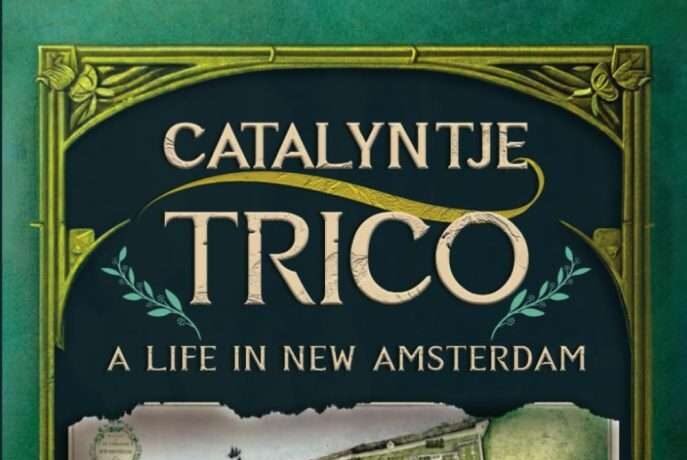
 Catalyntje Jeronimous Trico was born in about 1605 in Pres or Prijs, Hainault, in what was then the Spanish Netherlands, now Nord, Valenciennes, France to Jeronimus Jean Tricot and Michele Sauvagie.
Although her birth record has never been found (records in her parish only begin nearly a century after her birth), she is known through her sister Margareta (Triko) de la Fontaine dit Wicart’s will, which left half of her estate to Catalina.
The Trico family was from a French speaking portion of the or Spanish Netherlands (now in France). At the time of Catalina’s birth, the Trico family lived under Spanish rule in a time of change which included war and the religious persecution of the Spanish Inquisition.
 Following her birth Catalina and other family members traveled to Amsterdam. There, at the age of 18, she married Joris Jansen Rapalje, and four days later they boarded the Eendrecht (Unity), the first ship to carry settlers to the the Dutch colony of New Netherland. On board were only a handful of other women.
After landing at Fort Orange (now Albany) her husband worked for the Dutch West India Company. On June 9, 1625, Catalyntje gave birth to a daughter Sarah, said to have been the first European born in the colony. Besides Sarah, Joris and Catalyntje would have 10 more children.
In 1626, the settlers at Fort Orange were ordered to move south to populate New Amsterdam (now Manhattan), which Peter Minuit had just acquired from representatives of the Lenape.
The Rapaljes acquired a lot and built two houses, among the first dwellings in the settlement. Joris was an innkeeper and Catalyntje served as his bookkeeper (Joris was illiterate as shown by the fact that he always signed with a mark). In 1637, Joris purchased land at what is now the Brooklyn Navy Yard.
Joris died in 1662, leaving Catalyntje a widow. A man who met her when she was 74 years-old said that she lived alone in her own home near her large family, and tended her small garden. She was “worldly minded… living with her whole heart, as well as body, among her progeny.”
Catalina lived so long that she became one of the last people alive who could remember some important historical events and was called upon to file a deposition, which she did on February 14, 1685:
“The Deposicon of Catelina Trico aged fouer score yeares or thereabouts taken before the right honoble Collo. Thomas Dongan Lent. and Governour under his Rlyll. hignss James Duke of Yorke and Albany etc. of N York and its Dependencyes in America, who saith and Declares in the prsens of God as followeth
 “That she Caine to this Province either in the yeare one thousand six hundred and twenty three or twenty fouer to the best of her remembrance, and that fouer Women Came along with her in the same Shipp, in which ship the Governor Arian Jorissen Came also over, which fouer Women were married at Sea and that they and their husbands stayed about three Weekes at this place and then they with eight seamen more went in a vessell by ordr. of the Dutch Governor. to Dellaware River and there settled. This I Certifie under my hand & ye seale of this province. THO. DONGAN.”
On Oct 17, 1688, she filed another deposition:
“Catelyn Trico aged about 83 years born in Pris doth Testify and declare that in ye year 1623 she came into this Country wth a Ship called ye Unity wherein was Commander Arien Jorise belonging to ye West India Company being ye first Ship yt came here for ye sd Company; as soon as they came to Mannatans now called N: York they sent Two families & six men to harford River & Two families & 8 men to Delaware River and 8 men they left att N: Yorke to take Possession and ye Rest of ye Passengers went wth ye Ship up as farr as Albany which they then called fort Orangie.
“When as ye Ship came as far as Sopus which is ½ way to Albanie; they lightned ye Ship wth some boats yt were left there by ye Dutch that had been there ye year before a tradeing wth ye Indians upont there oune accompts & gone back again to Holland & so brought ye vessel up; there were about 18 families aboard who settled themselves att Albany & made a small fort; and as soon as they had built themselves some hutts of Bark:
“ye Mahikanders or River Indians, ye Maquase: Oneydes: Onnondages Cayougas. & Sinnekes, wth ye Mahawawa or Ottawawaes Indians came & made Covenants of friendship wth ye sd Arien Jorise there Commander Bringing him great Presents of Bever or oyr Peltry & desyred that they might come & have a Constant free Trade with them wch was concluded upon & ye sd nations came dayly with great multidus of Bever & traded them wth ye Christians, there sd Commanr Arien Jorise staid with them all winter and sent his sonne home with ye ship; ye sd Deponent lived in Albany three years all which time ye sd Indians were all as quiet as Lambs & came & Traded with all ye freedom Imaginable, in ye year 1626 ye Deponent came from Albany & settled at N: Yorke where she lived afterwards for many years and then came to Long Island where she now lives.
“The sd Catelyn Trico made oath of ye sd Deposition before me at her house on Long Island in ye Wale Bought this 17th day of October 1688. WILLIAM MORRIS Justice of ye pece’11”
 Catalyntje Trico died on September 11, 1689 in Wallabout in what is now Brooklyn, in her mid-80s. She was buried in the Flatbush Dutch Reformed Church Cemetery.
Her many descendants include Humphrey Bogart, James Spader, Cornelius Vanderbilt, Gloria Vanderbilt, Anderson Cooper, the Wright Brothers, DeWitt Clinton, Tom Brokaw, and Howard Dean.
Believed to be the only person to have lived in New Amsterdam for the entirety of Dutch rule, Catalyntje Trico: A Life in New Amsterdam (Historical Slant, 2024) by Lana Waite Holden tells her story. In the process her life opens a window to New Netherland and New Amsterdam in particular.
Upcoming Event
On Thursday, October 24, 2024, from 6 until 7:30 pm, author Lana Waite Holden will have a virtual discussion about the life of Catalyntje Trico with historian Amy Ransford. Hosted by the New Amsterdam History Center, the event is free and open to the public. Register here.
Lana Waite Holden is an author, historian and educator at Sweet Home Junior High School Department of History and Language Arts. Although she lives in the Pacific Northwest, she is deeply interested in the Dutch Colony of New Netherland. Her joy in researching and crafting stories, and her avid interest in the history of women and other marginalized groups, led her to publish the historical fiction work on Catalyntje Trico and her life in New Amsterdam.
She has shared articles and lesson plans with the New Netherland Institute (NNI) and several years ago, she was invited to speak at a NNI’s annual conference where she presented a paper about Catalyntje Trico. Holden has also served as the Educational Director of the East Linn Museum, in Oregon where her work focused on the Kalapuya tribe, who are native to the valley near where she lives.
Amy Ransford is Assistant Editor for the Journal of American History and Visiting Assistant Professor in History at Indiana University where teaches courses on early American history, Revolutionary America, women’s and gender history, and the history of piracy.
Ransford’s current book project analyzes entangled kinship and trade networks of the present-day Hudson River Watershed over the course of the seventeenth and eighteenth centuries. She is especially interested in the ways in which Native, African, and European women exercised economic and political power as traders, merchants, and business owners, and how their commercial and productive activities were central to the long process of colonization. Her research braids together Dutch, English, and French colonial archives with archaeology, ethnography, and Native American oral tradition.
The mission of the New Amsterdam History Center (NAHC) is to encourage exploration of the Dutch history of New Amsterdam as it laid the foundational character for today’s New York City, with special reference to its ethnic, racial, and religious diversity, urban landscapes, economic vitality, and global legacy.
NAHC fulfills its mission by linking the past to the present through public lectures and panel discussions, a biannual newsletter, tours, and online research resources all of which since 2005 have enriched public understanding of the continuing Dutch contributions to New York City.
Illustrations, from above: Portrait of Eendracht by Willem van de Velde the Elder (Maritiem Museum Rotterdam); The Rapalje – Rapelyae estate, also known as the White Cottage, at the foot of 35th Street, Brooklyn in the 19th century.






Recent Comments