
 Novelist Hedwig “Vicki” Baum was born in January 1888 in Vienna into a Jewish family. She attracted international attention in 1929 with her novel Menschen im Hotel which started off a vogue for the “hotel novel.” It was staged as a play in Berlin by the great director Max Reinhardt that same year.
Translated into English as Grand Hotel, the story was turned into an Academy Award winning film produced by Metro-Goldwyn-Mayer in 1932, starring Greta Garbo. The author had moved to Los Angeles whilst writing the screenplay, but the rise of fascism stopped her from returning to Europe. By 1935 the Nazis had banned her work. She became an American citizen three years later and began writing in English rather than in German.
In 1941 Baum published The Christmas Carp, a story set in Vienna that evokes a nostalgic image of past family festivities with memories of home baked cookies and a Christmas dinner that had carp as its highlight. Austrian painter Ernst Novak had captured a similar theme early in the century in a picture entitled “Cooking the Christmas Carp.”
Fish Migration
The wild ancestor of the common carp (Cyprinus carpio) originated in the Black, Caspian, and Aral Sea drainages. From there the species dispersed east into China and Japan and swam west as far as the Danube and Rhine Rivers.
The Romans were among the first to farm it in specially built ponds. The skill of building and maintaining piscinae (pools or ponds) was preserved in monasteries. Religious restrictions on eating meat made fish an important food source.
Salmon, trout, lampreys, shad, sturgeon, and other species characteristic of unpolluted running water featured in medieval meals. In parts of Eastern Europe carp became a staple food.
 Czech cleric and humanist scholar Janus Dubravius, Bishop of Olomouc, penned Libellus de piscinis et piscium (Booklet about fishponds and fish) in 1547. Its publication coincided with a rise in aquaculture in South Bohemia, the country’s “lake district.”
Carp became part of the national cuisine and still is the key ingredient of a traditional Christmas meal today (as it is in Slovakia, Poland, and in parts of Hungary and Croatia).
Carp figured strongly in Jewish cuisine. Gefilte fish was traditionally prepared on Rosh Hashanah, the religion’s New Year holiday. Balls made of minced carp were blended with seasoning and matzah (an unleavened flatbread).
In Galicia, Southern Poland, they were sweetly flavored; in the north the balls had a spicy seasoning. This dividing line of sweet versus spicy regions was known as the “gefilte fish border.”
The geographical sources of the Danube and Rhine Rivers are close to each other. The Rhine once consisted of extensive flood plains and plant-rich channels that were suitable for the recruitment and reproduction of carp. At some time in the tenth or eleventh century carp migrated from the Danube to the Rhine basin, making its way from there into the Low Countries.
The first written evidence of carp in the Rhine dates from 1158 when the Benedictine abbess Hildegard von Bingen (the “Sybil of the Rhine”) composed her Physica in which she discussed the “therapeutic” virtues of plants, animals, and metals. She found stocks of carp in the Rhine-Meuse delta.
The enjoyment of carp meals was at first restricted to the gentry and clergy. During the Middle Ages and early modern period, carp à la broche (spit roasted carp) was served in Europe at aristocratic banquets. Cooking fish on a skewer over an open fire was a common technique at the time.
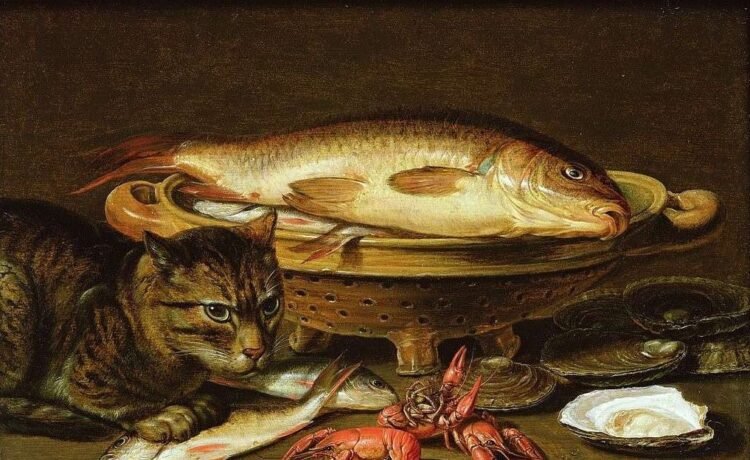
 By the fourteenth century carp had become part of the culinary trade in the Low Countries. During the early seventeenth century carp appear in Flemish and Dutch still life painting.
Antwerp-born Clara Peeters was prominent among the painters who shaped the traditions of ontbijtjes (breakfast pieces) with plain food and simple vessels, and banketjes (banquet pieces) with stylish cups and crockery. Her 1611 still life of a carp and cat is a fine example.
Ponds & Fishmongers
Carp appeared on London tables towards the end of the fourteenth century. Refugees from the Low Countries were running the fish farms. In 1381, locals attacked a Flemish lessee of fishponds in Southwark and wrecked his property. These merchants had become a target as they were associated with privilege.
Throughout the 1370s, Flemish settlers were accused of seeking unfair economic advantage over English-born workers and they became victims of xenophobic rioting at the time. It did not hamper the industry’s growth. By the mid-fourteenth century there were various plots known as “The Stews” on the southern bank of the River Thames created for the cultivation and fattening of carp. Operated by professionals, it heralded the start of commercial fish keeping.
 East Anglia has a long history of connections with the Low Countries. Not surprisingly, the first mention of an English carp pond goes back to 1462 on the Duke of Norfolk’s estate. By the late sixteenth century, carp had become the nation’s most popular freshwater fish. Dubravius’s book was translated in 1599 as A New Booke of Good Husbandry and sparked interest (mentioned by Robert Burton in The Anatomy of Melancholy).
John Taverner in his capacity as surveyor of the King’s woods was the first author to extol the virtues of rearing carp in a book on Certaine Experiments with Fishe and Fruite (1600). Carp was associated with the Crown. If any fish escaped from the Royal rearing ponds into local waterways, Henry VIII offered rewards to those who returned the “carpes to the King.”
The presence of carp was reported in Ireland soon after its arrival in England as monastic orders or members of the gentry introduced the non-native species to the country. It was food meant for the landowning nobility as distinct from the common Irish staple diet of grains, milk, and potatoes. Ponds stocked with carp signified wealth. At elaborate dinners, guests enjoyed carp alongside game and meats.
Although detailed records of consumption are scarce, they do point at intervention from the Low Countries. Peter de Latfewr was an Amsterdam-based merchant who, in 1626, supplied eight carp to Richard Boyle, Earl of Cork, for his fishponds at the Doneraile Estate on the banks of the Awbeg River, County Cork. Several years after its introduction, carp had bred sufficiently to allow Boyle to supply family and friends across Ireland with samples for their respective ponds, principally for food but also for ornamental purposes.
Gradually the fish reached middle class plates and palates. In 1653, Izaak Walton lauded carp as the “Queen of Rivers” in chapter nine (“Observations of the Carp”) of his famous treatise The Compleat Angler.
Cultivating carp became a commercial success. Professional fish farmers praised its hardiness and rate of fattening as compared to other freshwater species.
We Do Not Want You Here
Carp reached England and Ireland from Europe through human intervention as was its introduction to the United States during the mid-1800s. Newly arrived immigrants could scarcely believe that there was no carp in this vast continent.
Whilst in many European countries the fish was on the menu at weddings, birthdays, Christmas and New Year, in their new home settlers were deprived of a delicacy that tasted of a past they had left behind them.
Some settlers made attempts to start its culture. In 1831, imported carp was raised in New York City ponds or stocked in the Hudson River throughout the 1840s. Local entrepreneurs lacked the experience of fish culture and public demand completely outstripped supply.
There was some success elsewhere. Berlin-born fish farmer Julius Poppe succeeded in expanding a stock of five common carp imported in 1872 from Reinfield, Germany, into a thriving farm at Sonoma, California, within a period of five years.
The availability of carp remained limited and excluded to the rich. Celebrated as a delicacy, expensive hotels and restaurants in New York City served carp as a festive offering. The luncheon menu of April 16, 1902, at Manhattan’s Waldorf-Astoria hotel offered “Carp in Rhine Wine Sauce.”
 When in 1876 Pennsylvanian naturalist Spencer Fullerton Baird (1823-1887) took on the post of director of the newly formed Commission of Fish and Fisheries, he received countless requests for the importation of carp.
At the same time, he struggled with the challenge that enormous quantities of native species netted from the Illinois, Mississippi or Ohio rivers were shipped to markets of cities along the East Coast. Baird agreed to the introduction of carp into the nation’s lakes and rivers as a replacement of flagging stocks.
Carp would supplement traditional supplies and serve as an inexpensive source of protein for the benefit of the whole nation. The market was extensive and receptive; soon there was carp in abundance. Natives and newcomers snatched up carp from fish stalls in New York, Boston, Chicago, and elsewhere.
For urban fishing enthusiasts, there were plenty of common carp thriving in local outlets. New York City’s Reservoirs and Manhattan’s Central Park lakes (The Lake, Harlem Meer, or The Pond) made angling both a pastime and a means of (illegal) family food supply. The experiment seemed a success, but the love affair with carp would not last.
Carp tends to destroy vegetation in shallow wetlands and dominate distressed aquatic environments, crowding out other fish. In America, the species became a pest. Running a pond was no longer a workable enterprise as commercial anglers were hauling carp in from public waters that had been stocked intentionally or accidentally. Prices plunged. Fish farmers gave up the trade in carp.
The Asian carp added to the problem. Introduced in North American waterways to control algae blooms in aquaculture facilities, many of them escaped either through human mismanagement or natural events (flooding). Their numbers exploded, disrupting ecosystems especially in the Mississippi and Great Lakes region, endangering native species such as yellow perch, bluegill, or black and white crappie.
In the South hunger had been major issue since the collapse of the plantation cotton economy. As protein-rich carp was plentiful, many African American and other struggling families consumed it.
In the cities of the northeast, it became a staple for immigrants and poor minorities. Public perception connected hardship and low social status with carp which became a metaphor for poverty.
Many consumers rejected “poor man’s fish” as a cheap replacement of proper food driven forward by the federal government’s support for fish farming (much like the European introduction of the potato had once been an alternative for bread).
Dislike of carp coincided with growing unease about both the rate of mass immigration and the resistance against Black integration. The four-letter “carp” word expressed social and cultural disharmony.
In America at least, its association with Christmas was fading from memory.
Illustrations, from above: Ernst Nowak, “Cooking the Christmas Carp,” n.d.; A carp in Conrad Gessner, Historiae Animalium IV, 1558; English translation of Janus Dubravius’s Libellus de piscinis et piscium, 1599; Clara Peeters, “Still Life with Carp,” 1611 (Prado, Madrid); and Spencer F. Baird, head of the United States Commission of Fish and Fisheries.






Recent Comments