
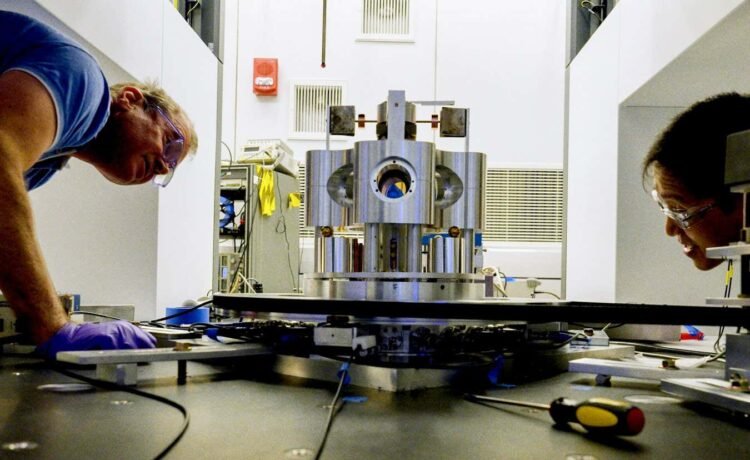

Stephan Schlamminger and his colleague, Vincent Lee, examine the torsion balance they used to measure the gravitational constant
R. Eskalis/NIST
For centuries, physicists have been trying to measure the strength of gravity, a number called “big G”. The measurements have never lined up with one another, hinting that either we don’t fully understand our experiments or perhaps we don’t fully understand gravity. The latest test doesn’t confirm either of these scenarios – but the extraordinary precision and care taken in the newest big G experiment may finally bring researchers closer to a consensus.
Gravity is much weaker than the other fundamental forces, which makes it extraordinarily hard to measure it precisely. “As kids, we were all mesmerised when we played with magnets by the way they attract each other. The same is true of gravity – if you have two coffee cups and you put them in each hand, there is still a force between them, but it’s so small you can’t feel it, so you’re not as mesmerised,” says Stephan Schlamminger at the US National Institute of Standards and Technology in Maryland. That weakness is also part of what makes it so difficult to measure the true strength of gravity.
The other part is that, unlike the other forces, it is impossible to shield an experiment from gravity. In 1798, physicist Henry Cavendish got around this by using a device called a torsion balance, which enabled him to measure gravity for the first time, albeit with low precision.
To imagine a torsion balance, picture a horizontal toothpick hanging from a thread at its centre. At each end of the toothpick is a small marble. If you move another object near one of the marbles, that object’s gravity will attract the marble, causing the toothpick to turn slightly. By measuring the amount that the toothpick turns, you can calculate the strength of gravity between the marble and the outside object without worrying about Earth’s gravity, which is counteracted by the thread.
The experiment that Schlamminger and his colleagues performed was a much more sophisticated version of this, with eight weights set on two precisely calibrated turntables, all suspended by ribbons about as thick as a human hair. This was a painstaking reproduction of an experiment first performed in France in 2007. The researchers took a decade to measure and reduce every possible source of uncertainty. “This is experimental physics at its best,” says Jens Gundlach at the University of Washington, who wasn’t involved with this work.
“The level of care that they have taken and all of the different effects that they have explored, this is a game-changer kind of experiment,” says Kasey Wagoner at North Carolina State University, who was also not involved with this work. The final value of big G was 6.67387×10⁻¹¹ metres3 per kilogram per second2. That’s a fraction of a per cent lower than the 2007 measurement, but it is enough to bring the measurement more in line with other tests that have been performed over the years.
“Big G is not just a measurement of gravity – it’s a measurement of how well you can measure gravity, and it transcends epochs of physics. We can compare our experiment to Cavendish’s experiment 230 years ago, and in 230 years they’ll be able to compare theirs to ours,” says Schlamminger. “In the end, I think it will be about which era of humanity can measure this best, with the most agreement between the measurements.”
By pinning down several sources of uncertainty that weren’t previously known, Schlamminger and his team have increased that agreement, says Gundlach. “The landscape looks better now, more trustworthy, more reliable,” he says.
They have also paved the way for future experiments to measure big G even more precisely, which will become increasingly important as cosmological measurements – many of which rely on knowledge of gravity’s strength – also grow in precision. “If there’s something funny going on here, it’ll have effects all the way from the scale of the lab to the scale of the universe,” says Wagoner. “What is a very small, minute difference in the lab, when you put that on cosmic scales, that difference gets blown up, and it could have really big implications.”
While most researchers agree that the more likely explanation for the remaining discrepancy is that we do not fully understand the sources of bias and uncertainty in all of the experiments, there is a chance that it is actually due to gravity behaving differently from how we thought. If that is the case, it would hint at potential exotic new physics. “There is a crack in our understanding of science, and we have to go into these cracks – there may be nothing there, but it would be foolish not to go,” says Schlamminger.
Topics:






Recent Comments