
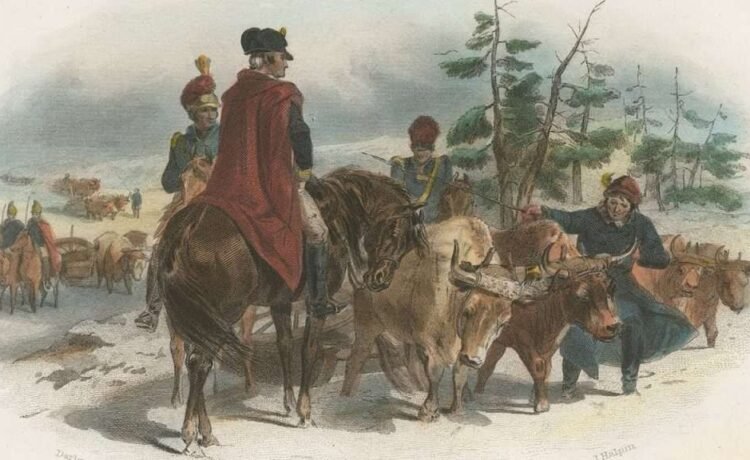
 Two hundred and fifty years ago, a 25-year-old bookseller from Boston was a guest in Stillwater, NY on Christmas Eve. His name was Henry Knox, and he was on an important expedition.
Sent by General George Washington, Knox was to retrieve artillery that had been taken from several forts captured by the fledgling American Army and bring them 300 miles to relieve the Siege of Boston in the winter of 1775.
Knox, well-read and possessing incredible confidence for someone with his level of experience, left Cambridge, MA in November and headed to Fort Ticonderoga where 59 pieces of artillery were selected to be part of his “Noble Train of Artillery,” a phrase penned by Knox himself in a letter to George Washington.
Knox arrived at Fort Ticonderoga on December 5th, 1775, and after overseeing the preparations for the first leg of the journey, which meant moving the cannon out of the fort (some from Fort Crown Point to the north) and up to the landing at the northern end of Lake George, he proceeded ahead of the gun-laden boats and made his way to Fort George at the lake’s southern end.
His younger brother William stayed behind with the bateau, “pettiauger” (a periauger, typically made from a hollowed log with sails) and scow as they made their way up a cold, though not frozen, Lake George.
After Henry arrived at Fort George, he was delayed while waiting for sleds, draft animals and snow. While there, he had time to write in his diary and catch up on correspondence with Gen. Philip Schuyler, Gen. George Washington and his wife Lucy.
In these letters he described weather conditions, anticipated timelines and logistics for the upcoming overland journey.
Washington had ordered Schuyler to assist Knox on this mission, and, since Schuyler was familiar with both the local landscape and many of the contractors in the area, he was not shy about informing Knox who he should, and should not, be working with.
Knox had contracted with George Palmer of Stillwater to “purchase or get made 40 good strong sleds… and likewise that you would procure oxen or horses as you shall judge most proper to drag them.” In the same letter, Knox goes on to promise Palmer that, “whatever expense you are at I shall pay you immediately.”
Palmer was a well-known Patriot, serving as a member of the Albany Committee of Safety, Protection and Correspondence. Though he clearly believed in the cause of independence, he may not have been above profiting handsomely from Knox’s naiveté.
When Schuyler became aware of this agreement he pumped the brakes, telling Knox that paying Palmer to build new sleds for this journey was an unnecessary expense since these sleds already existed in the region and presumably could be hired at a much lower cost than what Palmer was about to charge.
Knox followed Schuyler’s sound advice, though it was clear that Palmer was not happy about this reversal. A letter from Palmer to Knox written on Christmas Day 1775 expresses his disappointment in the cancellation of the contract and even warns Knox that there may be dangerous consequences in letting down all the people who stood ready to assist the artillery train.
If Knox responded to this thinly veiled threat, it has been lost to history.
Knox left Fort George ahead of the artillery to go to Schuyler’s mansion in Albany and work out the new plan for obtaining sleds. Though pages of his diary are missing during this time, it seems that he left on December 24th in the middle of a heavy snowstorm.
After noting that Judge “Dewer” helped him obtain a sleigh to get to Stillwater, he explains how difficult it was to make forward progress in the snow.
Stopping at Arch McNeals in Saratoga (now Schuylerville) to take in a meal, they left there at 3 pm, “it still snowing exceeding fast” and only made it to Stillwater before having to stop for the night.
He spent the night at Ensign’s Tavern and woke up on Christmas morning to over two feet of snow on the ground. While he had worried just a few days earlier that there would not be enough snow for the sleds, now there was too much snow for him to even make it to Schuyler’s house.
He noted that “we got a sleigh to go to Albany but the roads not being broken prevented our getting farther than New City [now Lansingburgh] about 9 miles above Albany – where we lodg’d.”
Knox eventually made it to Schuyler’s house in Albany on December 26th though the travel continued to be very difficult and Knox “almost perish’d with the cold.”
The first order of business was to send for George Palmer and see if an agreement could be reached regarding the much-needed sleds. A lengthy conversation took place between Palmer and Schuyler, but they remained at an impasse over the price Palmer demanded and he was eventually dismissed.
Schuyler then took matters into his own hands to obtain the sleds and draft animals, sending out his wagon master to make connections with local teamsters.
By New Year’s Eve, the wagon master had returned to Schuyler’s, with the names of the teamsters who were on their way to Fort George with sleds to begin loading the cannon.
Knox estimated that approximately 124 pairs of horses were employed to move the 60 tons of artillery. While it is often thought that oxen were used exclusively to pull the artillery train, from Fort George to Springfield, Massachusetts, it was primarily horses that were given this task.
With the matter of the sleds and draft animals settled, and the desired snow blanketing the ground, Knox and his noble train were finally on their way towards Boston.
Though difficulties still lay ahead for this expedition, they wouldn’t experience any more significant delays and by the end of January, they had arrived back in Cambridge.
In the coming weeks Washington’s army would successfully mount several cannons atop Dorchester Heights in a move that convinced the British Army it was time to leave the city of Boston, which they did on March 17, a date still known as “Evacuation Day” in that city.
Knox’s successful mission was a key victory in the American War for Independence. It showed the British that the American Army was capable of completing complicated expeditions, it showed Washington that Knox was someone he could rely on and it boosted the morale of the Patriots, who knew they were up against an army that bested them in numbers, experience, material and money. It was a feat worth celebrating.
And even now, 250 years later, we are continuing that celebration. This December, a bi-state commemoration is taking place in honor of Knox. Programs and processions are taking place all the way from Crown Point to Dorchester Heights.
On Friday, December 12, 2025, Lake George Battlefield Park will host a free commemoration of the 250th anniversary of Knox’s Noble Train, starting at 3 pm. The event features a reenactment of Knox’s arrival by boat, with military demonstrations, fife and drum music, and a horse-drawn cart transporting a replica cannon to Fort George. A historian’s talk will take place afterward.
In Saratoga County, several events are scheduled on December 13th and 14th, with Knox Fest at Fort Hardy Park, an 18th Century Candlelight Concert at the Arts Center on the Hudson in Mechanicville, and a ceremony at the Knox Trail Marker in Soldiers and Sailors Park in Waterford.
Also on December 14th, Schuyler Mansion State Historic Site invites the public to commemorate the 250th Anniversary.
These events are all free and open to the public and we encourage you to come experience this history in your backyard.
For more information on these events, and others across the region, visit knox250.com
Lauren Roberts is the Saratoga County historian, co-host of A New York Minute in History podcast with Devin Lander, and chairperson of the Saratoga County250th Commission celebrating the anniversary of the American Revolution and the Battles of Saratoga.
This essay is presented by the Saratoga County History Center. Follow them on Twitter and Facebook.




Recent Comments