
 Located on the River Scheldt (Schelde), Hoboken is a southern district of the city of Antwerp in Flanders. The name originates in the medieval Dutch phrase Hooghe Buechen (Hoge Beuken, or tall beech trees). Today there is a geriatric hospital in Hoboken named Hoge Beuken. The first historical records of the place date from the year 1135.
The New Jersey area of Hoboken on the western shore of the Hudson River was inhabited by Lenape indigenous people who called it Hopoghan Hackingh (Land of the Tobacco Pipe) for its green-veined rock from which they carved their pipes.
With the settlement of Flemish and Dutch colonists in the locality, the adopted name became Hoebuck, which stands for “high bluff” as it referred to the elevated terrain along the river (now known as Castle Point).
Immigrants from the Low Countries who settled in the area afterwards associated the sound of the name with Hoboken, Flanders. The pronunciation of hoge and “hoe” is similar; the singular beuk resembles “buck.” Hoge Beuken – Hoebuck – Hoboken: in popular etymology the words were linked.
There is another Flemish association. Jersey City’s (Cornelius) Van Vorst Park, a mile south of Hoboken, is renowned for its imposing beech trees. Cornelius descended from Hendrick Van Vorst’s pioneering family who, of either Dutch or Flemish descent, had settled in New Jersey.
 In 1847, the Weeping Beech was introduced from Flanders to Flushing, Queens. Originating at an estate in Beersel, a historic town near Brussels, this was the “mother seedling” from which all American weeping beeches are believed to have descended.
In 1966, the immigrant tree was designated New York City’s first living landmark before it died in 1998.
Hoboken was named officially in the nineteenth century. Dominated by German and Irish newcomers during the era of mass migration, in the twentieth century the city would become known around the globe for its Italian legacy.
Hoboken’s “vagabond shoes” encapsulates New York City’s multifaceted history of immigration.
Antwerp
Charles V, Holy Roman Emperor and Habsburg King of Spain, ruled over an Empire that included the Low Countries. Flanders was crucial to its economy. The port of Antwerp earned his Treasury some seven times more in revenue than the colonization of the Americas. Hence the ruler’s restrained attitude towards the emerging Reformation.
Booming economically, the city’s growth rate was without parallel. Traders from Europe and beyond vied for business in Antwerp. The presence of a community of Iberian crypto-Jews signaled a climate of inclusiveness.
Economic expansion demanded stable monetary institutions. The city opened its Bourse (stock market) in 1531, serving the “merchants of all nations.” Modern capitalism ca be said to have begun on the banks of the River Scheldt.
Inventor Simon Stevin was a student of physics and mathematics. As an author he championed the vernacular rather than Latin to communicate his research findings. In 1585, he published a study on decimals entitled De Thiende.
Robert Norton’s 1608 translation Disme: The Art of Tenths introduced decimalized calculations to English readers and inspired Thomas Jefferson when developing a currency for the United States. The ten cents coin became known as a dime.
The book was issued by Christophe Plantin, the printer who laid the foundation for Antwerp’s dominance in the trade. Completed in 1573, the “Polyglot Bible” was his most ambitious undertaking. As the work ran counter to the Council of Trent’s decree that the Latin Vulgate was the authentic version of Christian Scripture, its publication stirred emotion.
Antwerp was the location where religious controversy appeared in print. The names of English Bible translators – William Tyndale, George Joye, Miles Coverdale, and John Rogers – are linked to this city.
When Charles V was succeeded in 1560 by his devoutly Catholic son Philip II, the latter vowed to restore the Empire’s centralized structure and suppress the Reformation. Antwerp came under siege; Hoboken was flooded and raided.
In August 1585, the city fell to Spanish troops led by Alessandro Farnese, Duke of Parma. Protestants and secessionists had a brief spell to settle their affairs. At a stroke, the city lost its financial and artistic elite, and more than half of its citizens. Economic and cultural dominance shifted from Antwerp to Amsterdam.
By supplying a reservoir of talent, the first generation of Flemish refugees in the Dutch Republic (1585 to ca. 1615) was instrumental in forging a transition of experience and ability. No Amsterdam without Antwerp.
Flemish & Walloon Settlers
Between 1584 and 1585 Ghent, Bruges, and Antwerp fell to Spanish armies. The flow of refugees became a flood of people seeking refuge in Holland and Zeeland where they joined the Reformed Church or attended French-language Walloon services. Their input was the spark that set off an explosion of initiatives. The Dutch Republic would create a spectacular commercial and artistic domain with Amsterdam as its jewel.
The change was dramatic and intensified the pulse of life. It was a period of anxiety for some, and one of opportunity for others. Boosted by the decline of Antwerp’s population, that of Amsterdam trebled within a single generation. Immigration was an economic catalyst. The city opened its doors to merchants and skilled workers who created a dynamic labor market, fostering an environment that drove innovation.
Born in March 1556, Dirck van Os served as a captain of militia when Antwerp fell to Spanish troops. He was part of a thirteen-member delegation that, in August 1585, signed the treaty that confirmed the city’s surrender.
Having settled in Amsterdam, Van Os was a founding financier of the Dutch East India Company (VOC) and served as one of its first directors. When in 1607 London’s Muscovy Company sacked Henry Hudson for not finding a route to Asia, the VOC re-employed him to search for this elusive passage. Van Os signed his contract on behalf of the Company.
On September 3, 1609, Hudson sailed the Halve Maen (Half Moon) up the river that now bears his name. Following his report (published in 1611) of fertile lands rich in timber and fur, investors were keen to finance exploration of the area which provided the impetus for the establishment of a colony.
After years of private involvement, the States General created the West India Company (WIC) in 1621. It began settling New Netherland three years later. At the time, Amsterdam was dealing with a mass influx of Flemish and Walloon migrants.
The WIC recruited (pressured?) several dislocated refugee families to cross the Atlantic. Having landed in May 1623, they were some of the first settlers in the American colony.
The WIC’s governors ordered the construction of a fort on Manhattan Island in 1625, laying the foundations for New York City. A year later Peter Minuit (of Walloon descent), New Netherland’s third Director, bought the land from Native Americans.
New Amsterdam became the port through which all goods had to pass. America’s modern history started in Manhattan. The name Hoboken links the city to the origins of its first settlers.
Port of Entry
On October 2, 1609, Hudson anchored at Weehawken Cove, putting the Hoboken area on the map. Two decades later Michiel Reyniersz Pauw, a director of the WIC, was handed a land grant on condition that he would plant a New Jersey colony of about fifty persons within a time span of four years.
Using the Latinized name Pavonia for the territory, Pauw failed to carry out the task and returned his holding to the Company in 1633. It was entrusted to Hendrick Van Vorst, who leased part of the land to Aert Teunissen van Putten, a Dutch-born farmer who built a small brew-house on the premises. Van Putten is said to be North America’s first brewer.
In 1643, war erupted between settlers and indigenous people after New Netherland’s Director-General Willem Kieft had massacred many locals. Van Putten died during the hostilities. All Pavonia’s residents retreated to New Amsterdam until, in1658, Governor Peter Stuyvesant bought the land from the Indigenous inhabitants.
 When in 1664 English troops took hold of New Amsterdam, the domain came into possession of William Bayard, a Loyalist Tory. After the Revolutionary War, his confiscated property was sold at auction to Colonel John Stevens.
Developing the waterfront, Stevens opened a ferry service between Hoboken and Manhattan in October 1811. Before his death in 1838, Stevens founded the Hoboken Land & Improvement Company which laid out a system of streets, housing, and factories.
The settlement became a township in April 1849 and was incorporated as the City of Hoboken six years later.
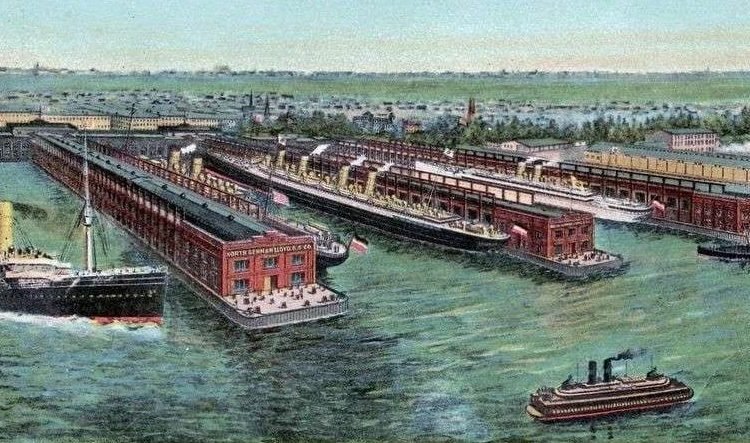
Following the 1891 Act that gave federal government direct control over immigration, Hoboken became the “port of entry” to the United States of America. Located opposite Lower Manhattan, multiple transatlantic shipping companies made the city their final call.
 The Fifth Street Pier was bought in 1890 by the Holland America Line (Pier 5 was in operation until the early 1960s). Over the next three decades, twenty million people entered America. Hoboken was not just a port of entry, but a destination too and an immigrant community.
Between 1890 and 1910 its population nearly doubled. German and Irish immigrants dominated (residents of German heritage referred to Hoboken as “Little Bremen”), but the number of Italians was increasing.
The first wave of Southern immigrants arrived between 1880 and 1900. Instead of moving to Manhattan’s “Little Italy,” many of them settled on the other side of the Hudson.
Most Hoboken Italians were unskilled laborers. They arrived from Puglia, Campania, or Molise, and settled in “downtown” Hoboken (south of Seventh Street), a densely populated area of tenement housing.
Within decades, they had moved upwards, working in construction, or running shops as barbers, bakers, or grocers. The ice cream cone is said to be a Hoboken Italian invention.
For some time, there was no awareness of an “Italian identity” as newcomers stuck to former regional customs and traditions, especially when it came to religion. Hoboken’s annual September feast of the Madonna dei Martiri (Virgin of the Martyrs) features the procession of a massive statue as well as the “Blessing of the Fleet” in the Hudson River. The celebration originated in the Adriatic port town of Molfetta, Puglia.
During the 1920s, the Italian community became Hoboken’s largest immigrant group. Although making up about ten percent of the city’s population, Italian Americans suffered discrimination lasting into the 1950s.
Their reluctance to become naturalized citizens, motivated by the dream of returning home one day, prevented them from obtaining senior public sector jobs. Many of them supported Benito Mussolini’s rise to power. A surge in “nostalgic nationalism” lasted until fascism became a threat to America.
After the war, men who loyally had served their country in action demanded participation in the running of their home city. The post-war battle for power resulted in the 1947 election of Fred M. DeSapio, Hoboken’s first Mayor of Italian origin, ending the socio-political dominance of Irish Americans. The Italian community enjoyed a boost in confidence and a renaissance of cultural expression.
If I Can Make It There …
Francis Albert Sinatra was born on December 12, 1915, the only child in an immigrant family living in a tenement at 415 Monroe Street, Hoboken. His mother “Dolly,” born Natalie Della Garavente in Genoa, was a midwife and ward leader. His Sicilian father Anthony Martin Sinatra was a boxer using the name of “Marty O’Brien” to get access to Irish-owned gymnasiums.
Hoboken’s gritty blue-collar spirit shaped Frank’s outlook and career. In 1935, he joined a trio of Italian Americans who had been childhood friends on Sixth Street, performing as “The Three Flashes.” As the “Hoboken Four” they made a name for themselves before falling out. Frank decided to go it alone.
In 1975, New York City was on the brink of bankruptcy, leading to massive layoffs, and a decline in essential public services. On July 13, 1977, a power failure plunged the city into a “Night of Terror,” triggering looting and vandalism. An atmosphere of gloom spread like a pandemic. And yet, chaos became the catalyst for an alternative culture.
Cheap accommodation allowed young artists and students to occupy crumbling sites in the Lower East Side. With defiant energy, they revitalized life amongst the rubble of “Fear City.” Republican Mayor John Lindsay’s initiative to boost creative activities through the foundation of a Film, Theatre & Broadcasting office, offering producers unrestricted shooting permits, released a fountain of creativity.
 Filmmakers explored a wealth of stories in the city’s mean streets, tenements, brothels, and porn shops. Martin Scorcese’s Taxi Driver highlighted this outpouring of urban tales.
New York City’s collective identity has an “immigrant DNA,” a global mix that fosters attitudes of adaptation and resilience, as well as ambition. Socio-cultural fusion (“melting pot”) of diverse backgrounds into a shared sense of belonging constitutes its cosmopolitan nature.
During his lengthy career, Sinatra embodied the immigrant spirit that Hoboken had instilled in him. He was “The Voice” and artistic soul of New York, a cultural symbol. Connected to his New Jersey roots, he celebrated the city’s diversity and challenged prejudice.
His iconic 1979 recording “Theme from New York, New York” became an anthem, synonymous with the city itself, bold and brassy. The song is a tribute to the tough mentality, diversity, and “sleepless” energy of the metropolis.
Illustrations, from above: Street signs showing Hoboken, a district of Antwerp (Flanders); The original Weeping Beech tree in the early 1960s (Landmarks Preservation Commission); Map from 1847 showing the routes of New York City ferries in Lower Manhattan, Jersey City, Hoboken, and Brooklyn; a postcard showing the North German Lloyd piers in Hoboken, 1909; and film poster for Martin Scorcese’s Taxi Driver, 1976 (Columbia Pictures).






Recent Comments