

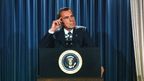
The president even urged Americans to lower their thermostats in homes, offices and factories by at least six degrees Fahrenheit. Anticipating a chilly response, Nixon tried to thaw the tension. “Incidentally, my doctor tells me that in a temperature of 66 to 68 degrees (18C to 20C), you’re really more healthy than when it’s 75 to 78 (23C to 26C), if that’s any comfort,” he said.
A month later, while signing year-long daylight saving into law, Nixon said that other measures required “inconvenience and sacrifice”. In contrast, he said that changing the time would “result in the conservation during the winter months of an estimated equivalent of 150,000 barrels of oil a day, will mean only a minimum of inconvenience and will involve equal participation by all”.
Prices at US fuel pumps rose 50% over the winter months. In his 2009 BBC radio series America: Empire of Liberty, Prof David Reynolds said: “Admittedly, at around 60 cents a gallon, the cost was hardly crippling by today’s standards. But to a country that assumed that cheap gas was an American birthright, the oil crisis was a real shock.” Reynolds noted that an opinion poll in December had detected signs of panic, with people said to be fearful that the country had run out of energy. “This was nonsense, of course,” he said. Still, while domestic production satisfied two-thirds of US needs, the other third came mostly from the Middle East, and “the price hike plus public panic created a crisis”.
The second dark age
Even before the shock of the oil crisis, the US had already been experiencing fuel shortages. Humphrys reported in May 1973 that “petrol in the most fuel-hungry country in the world is in short supply”. For added colour, the report contained part of an advertisement for the former US oil giant Amoco presented by Johnny Cash, who said: “It’s hard to believe that this great country of ours has an energy crisis, but it does.” The country star urged motorists to slow down to save on petrol. “You’ll get there, and there’ll be more gasoline for everyone,” he promised. In another Amoco advert, he talked of “a new pioneer spirit in America today, the spirit of conservation”.
Cash’s message of dialling down six degrees at home and slowing down on the highway was echoed by Nixon. What was not part of the Man in Black’s advertising sermon was year-round daylight saving time, a measure sure to be unpopular with many among his heartland audience. While time zones are a human invention, cows don’t know what time it is, so that extra hour of winter darkness in the morning was an extra challenge for farmers.
While Nixon was knee-deep in the Watergate scandal at the time, he might have learned from the UK’s experience a few years before, when the clocks were put forward as usual in spring 1968, and then not put back until autumn 1971. The lasting image was of children in fluorescent armbands trudging to school through the gloom. While some businesses involved in trading with continental Europe appreciated being in the same time zone, the measure was not welcomed by those who had to work outdoors. It was least popular in the far north of Scotland, where some people had to wait until 09:45 for their first glimpse of winter sun.





Recent Comments