
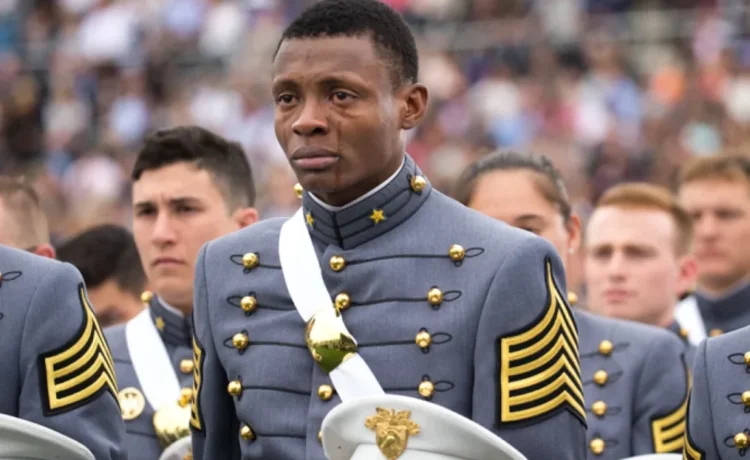
 In its first 133 years of existence (1802–1935), over 10,000 cadets graduated from the United States Military Academy at West Point, only three were African Americans.
West Point Academy was founded in 1802 with the passage of the Military Peace Establishment Act, signed into law by President Thomas Jefferson. It was designed to educate and train future Army officers. Jefferson claimed that West Point would be established under democratic ideals — a meritocracy that would admit cadets based on their character and abilities rather than their wealth and family connections. However, these democratic ideals only applied to white men.
Expressing his views on African Americans at West Point in his 1880 annual report, Superintendent of West Point Major General John D. Schofield wrote:
“To send to West Point for four years competition a young man who was born in slavery is to assume that half a generation is sufficient to raise a colored man to the social, moral, and intellectual level which the average white man has reached in several hundred years. As well might the common farm horse be entered in a four-mile race against the best blood inherited from a long line of English racers.”
It wasn’t until almost 70 years after its founding that the first African American cadet was admitted to West Point. James Webster Smith of South Carolina, a formerly enslaved man, entered in the Fall of 1870, one of only 12 Black men admitted between 1870 and 1899.
Each endured physical and emotional abuse and racist treatment from their white peers and professors throughout their time at the Academy. They were ostracized, barred from social activities with other cadets, and spoken to only when officially necessary, a practice known as silencing.
While white cadets were hazed by their fellow cadets as punishment for serious misconduct, Black cadets were hazed for being Black and for being at West Point.
 In the early hours of the morning on April 5, 1880, Cadet Johnson Chestnut Whittaker (1858-1931) was brutally beaten by white cadets while sleeping in his barracks. Three of them ambushed Whittaker, slashed his head and ears, burned his Bible, threatened his life, and then left him unconscious in his underwear, tied to the bed and bleeding profusely.
Born enslaved in South Carolina in 1858 on the Chestnut plantation of James Chestnut Jr., the owner of more than 400 enslaved people. Johnson Chestnut Whitaker’s middle name may indicate that he had raped Whittaker’s mother, a common practice at the tine.
Chestnut was member of the South Carolina House of Representatives (1840–52), the South Carolina Senate (1852–58, serving as its president 1856–58), and the US Senate from 1858 until being the first Senator to withdraw from the Senate after the election of Abraham Lincoln.
Famously, believing the South would successfully leave the United States without bloodshed, he boasted he would drink all of the blood spilled in the Civil War. Joining the enemy Confederate army, Chestnut gave the order to fire on Fort Sumter in 1861. He supported the conscription of white men into the Confederate army and oversaw the impressment of slaves for the war effort in South Carolina.
After the war, he returned to the practice of law and formed the Conservative Party of South Carolina. His wife Mary Chestnut is now widely known as the writer of a diary about the Civil War frequently cited by historians.
Johnsom Whittaker received a congressional appointment to the U.S. Military Academy in 1876. For most of his time at West Point, Whittaker was the only Black cadet and like other Black cadets endured social exclusion and racial terrorism perpetrated at the hands of white cadets and faculty alike.
Whittaker would later testify that he had “read and heard about the treatment that [Black] cadets received there, and expected to be ostracized.”
After Whittaker reported to West Point administrators that he had been attacked, the institution opened an investigation into him and declined to hold his white attackers accountable. Administrators instead claimed that Whittaker had staged the attack to get out of his final exams.
Initially, Whittaker was held by a court of inquiry, where he was defended by Troy, NY attorney Martin I. Townsend and an old friend, Richard Greener, the first African American to graduate from Harvard College and his former teacher.
 Although the court of inquiry found Whittaker guilty of lying about the attack, through Townsend and Greener’s efforts he was eventually granted a full court-martial, which was held in the city of New York.
The Army’s prosecutor, West Point Judge Advocate Major Asa Bird Gardiner (later a Sachem of Tammany Hall in New York and disgraced New York District Attorney), who repeatedly referred to Black people as an “inferior race” and said that “Negroes are noted for their ability to sham and feign.”
In January 1881, Brigadier General Nelson A. Miles affirmed Cadet Whittaker’s conviction and authorized him to be expelled from West Point, dishonorably discharged from the military, and held for continued imprisonment.
Whittaker’s case was ultimately forwarded to President Chester A. Arthur for approval, and, a year later, President Arthur issued an Executive Order overturning the conviction based on a finding that military prosecutors had relied on improperly admitted evidence.
By the time of President Arthur’s intervention, Whittaker had been incarcerated for nearly two years. After his conviction was overturned, West Point reinstated Cadet Whittaker’s expulsion, claiming he had failed an exam.
Johnson Whittaker went on to work in several professional fields and raise a family, including several generations of descendants who served in the U.S. military. His sons, Johnson Whittaker Jr. and Miller Whittaker both served as Army officers during the First World War. A grandson, Peter H. Whittaker, joined the all-black Tuskegee Airmen in World War II and a great-grandson, Ulysses W. Boykin III, (Mary Chestnut’s maiden name was Boykin) served as a first lieutenant in the Vietnam-era Army.
In 1995, more than 60 years after his death, Whittaker’s heirs accepted the commission he would have received upon graduating West Point. At the ceremony, President Bill Clinton remarked: “We cannot undo history. But today, finally, we can pay tribute to a great American and we can acknowledge a great injustice.”
Ultimately, due to various just and unjust circumstances, only three of the 12 cadets admitted during the first nearly 100 years of West Point Academy graduated: Henry Ossian Flipper of Georgia in 1877; and from Ohio, John Hanks Alexander in 1887, and Charles Young in 1889. Forty-seven years after Young graduated from West Point, Benjamin O. Davis Jr. became the fourth African American cadet to graduate in 1936.
Davis is best known as commander of the Tuskegee Airmen and had a long and distinguished career in the Air Force before retiring in 1970 at the rank of Lieutenant General. In 1998 he was advanced to General by President Clinton. General Benjamin O. Davis Jr. passed away on July 4, 2002, at the age of 89 and was buried at Arlington National Cemetery.
More recently, in September 2023, the conservative group Students for Fair Admissions filed a lawsuit challenging the use of race and ethnicity as admissions factors at West Point.
The case followed their success in Students for Fair Admissions v. Harvard, in which the Supreme Court ruled that Harvard’s admissions program violates the Equal Protection Clause of the Fourteenth Amendment. Chief Justice John Roberts authored the 6-3 majority opinion.
One of the most important political outcomes of the Civil War, the Fourteenth Amendment was ratified in 1868. It addresses citizenship, equal protection, and due process, and was passed to ensure that all persons born or naturalized in the United States receive the full rights of all other citizens and that no state can deny them these rights or equal protection under the law.
In December 2024, a federal judge ruled that West Point was exempt from the decision and could use race in their admission decisions, citing “military cohesion and other national security factors.”
Illustrations, from above: Cadet Alix Idrache sheds a tear of joy during the West Point’s Class of 2016 commencement (West Point Academy); undated portrait of Johnson Whittaker by an unknown artist, (New-York Historical Society); and Whittaker’s court of inquiry proceedings shown in “The West Point outrage – the Court of Inquiry in session” (Harper’s Weekly, May 1880).






Recent Comments