
Users who have noticed a dip in their social media performance metrics over the past year are not imagining things.
Social media management platform Buffer published a report last week that examined social media engagement rates across Buffer’s 191,000+ monthly users, incorporating tens of millions of posts sent via Buffer’s social media posting tool throughout 2025.
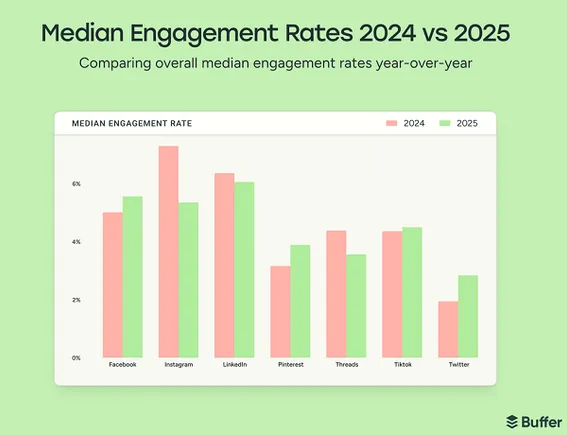
Based on Buffer’s data pool, Instagram, LinkedIn and Threads engagement rates declined throughout the last year, while Facebook, Pinterest and TikTok rates increased slightly and X posts saw significantly more engagement.
Engagement in this report was related primarily to likes, replies and shares in each app, bringing all of these interactions into a single metric.
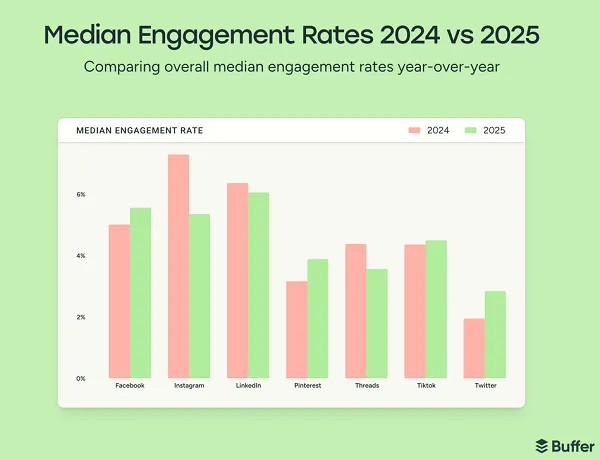
And based on this, TikTok engagement rates were essentially the same, comparing 2024’s data to 2025. LinkedIn, Threads and Instagram saw significant dips.
Why would that be? Well, increased competition due to more content being posted to an app is always a factor, and LinkedIn has seen more attention in recent years as business discussion has migrated from Twitter/X to the app. LinkedIn also changed its algorithm in July last year. Meanwhile, Threads is also seeing more competition for attention as its active user count continues to rise.
Maybe that has made it more difficult to gain traction. At the same time, Instagram has put more emphasis on Reels over all other content formats, which could be why feed post engagement is down.
In terms of increases, Buffer users saw a big rise in engagement per post on X, though it is also worth noting that the rise noted in this report is actually only a leap of 0.8% engagement (2.0% to 2.8%).
So X engagement per post was very low, and now it’s not as low, which is not as big of a shift as the chart above suggests. But X posts are seeing more action, while Pinterest and Facebook also saw average engagement increases.
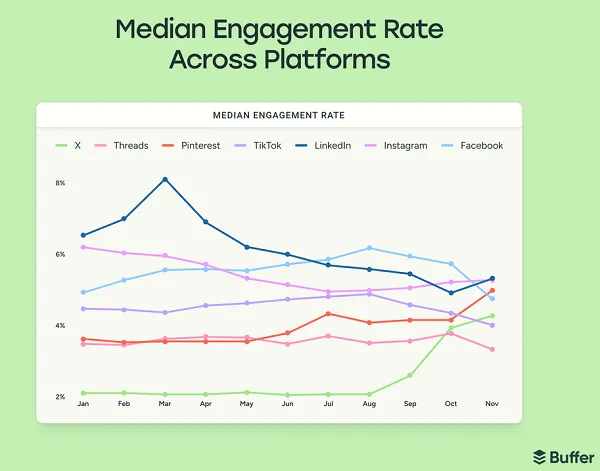
It’s interesting to note the changes, and to factor them into content benchmarking, but really, the actual increases and decreases here are fairly minor, and may not provide significant guide notes for social media planning.
The main factor that drives engagement is relevance to the target audience, and aligning content with what each audience group values and wants to see. If social media marketers can get this right, then they stand a strong chance of creating valuable, resonant content that will help to boost brand awareness, as well as ideally drive more sales-related activity.
Using platform insights tools and topical research functionalities will provide more data on this, while reading the comments on related posts could also uncover helpful insight to guide decision-making.
Which leads to what’s possibly the most valuable note of Buffer’s report: posts where creators or brands reply to comments earn more engagement than posts where they don’t.
According to Buffer’s data, when a creator or brand replies to post replies, average engagement rises:
- 42% on Threads
- 30% on LinkedIn
- 21% on Instagram
- 9% on Facebook
- 8% on X
- 5% on Bluesky
It could be important to planning to note that engaging with replies will help drive more reach and could improve brand awareness and overall engagement.
The report also said that:
- Reels get 36% more reach on Instagram than carousels, but carousels earn 12% more engagement.
- Carousel posts on LinkedIn see around 3x more engagement than video and image updates.
- The median engagement rate for non-paying accounts on X is very low (down to 0% in many instances)
Plan out content accordingly.





Recent Comments