
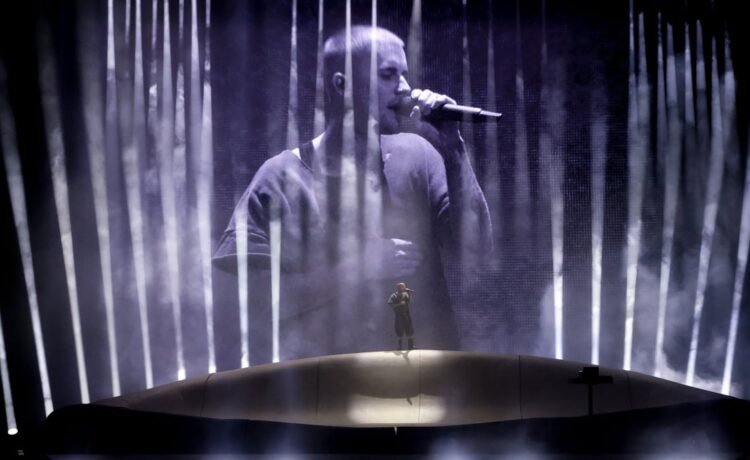
Justin Bieber did not spend his Coachella headlining set pretending the past was behind him. Instead, he opened a laptop, pulled up YouTube, and sang directly to it.
Midway through his 90-minute set on Saturday, the Day Two headliner began streaming old clips of himself performing snippets of songs like “Baby,” “Favorite Girl,” “Never Say Never,” and “Beauty and a Beat,” duetting with the floppy-haired, younger version of himself that first made him famous. “I feel like we gotta take you guys on a bit of a journey… How far back do you guys go?” Bieber asked the crowd. “Do you guys really go back, though? Like for real, for real?”
The most striking moment came when the 32-year-old pulled up the grainy 2007 YouTube video of 12-year-old Justin singing “So Sick” by Ne-Yo, one of the clips that helped get him discovered in the first place. That particular video was uploaded nearly 20 years ago, back when YouTube still felt like a place where anyone could stumble across a talented kid singing in a local competition, not an endless scroll optimized by algorithms, and before the internet regularly produced its own stars.
This Tweet is currently unavailable. It might be loading or has been removed.
It was a deeply meta moment: Bieber was singing along with YouTube while YouTube streamed his performance live to millions of viewers worldwide. He’d occasionally talk to the audience watching from home, looking into the camera like a friend FaceTiming from his living room, not from the Main Stage at Coachella.
But it also felt bigger than a nostalgia play. Bieber is one of the last true pop superstars whose mythology is inseparable from an earlier version of the internet, one where a kid uploading covers from his bedroom could still plausibly become one of the biggest artists on the planet. The internet still produces stars, but they are different now — more fragmented, more niche, more algorithmically siloed. Platforms produce creators, influencers, and a rotating cast of micro-celebrities, but few Justin Biebers.
Mashable Trend Report

Justin Bieber opens his Coachella set in a hoodie.
Credit: Kevin Mazur / Getty Images for Coachella
That is what made the performance feel unexpectedly emotional. Bieber was not just revisiting old clips; he was revisiting the child the internet turned into Justin Bieber. Many former child stars look back at old footage, and it feels a bit silly or even sad. Here, though, Bieber seemed genuinely at peace with it. He smiled at the videos. He harmonized with his younger self, treating him less like a brand asset and more like someone worth meeting again.
This Tweet is currently unavailable. It might be loading or has been removed.
This Tweet is currently unavailable. It might be loading or has been removed.
This Tweet is currently unavailable. It might be loading or has been removed.
This Tweet is currently unavailable. It might be loading or has been removed.
That intimacy was reinforced by the set’s understated nature. Most Coachella headliners are expected to deliver a giant spectacle: elaborate stage design, pyrotechnics, dancers, and some sort of viral visual moment engineered for social media. Bieber, dressed in a hoodie, mostly gave the crowd a laptop, a camera feed, a few guests (the Kid LAROI, Dijon, Tems, Wizkid, Mk.gee), and his voice.
For some viewers, that made the set feel underwhelming, especially in a festival slot that usually expects excess — Day One headliner Sabrina Carpenter rolled out five Dior costume changes and complex Hollywood-inspired sets on the same stage. There is also probably a fair conversation to be had about whether a female pop star delivering Bieber’s style of sparse, emotionally inward performance would have been criticized more harshly for doing too little. But part of what made his set so fascinating was its refusal to play by those expectations at all.
Instead of building some futuristic world around himself, he turned the stage into something closer to a bedroom computer circa 2009: YouTube tabs open, old videos surfacing one after another. His voice has arguably never sounded better, and the lack of elaborate staging made the set feel more confident, not less. Bieber didn’t need spectacle. The emotional reveal was the point.
Even the stranger, more meme-heavy moments of the set fit into that framework. Bieber recited along to his own “standing on business” paparazzi rant, pulled up unrelated viral clips like “Deez Nuts,” and turned the stage into something that looked less like a traditional concert and more like a browser window with too many tabs open. Call it his version of “gay guy music video night” — an intimate, almost devotional evening spent pulling up pop hits, deep cuts, and formative internet ephemera for 100,000 of his closest friends in the Indio desert.
This Tweet is currently unavailable. It might be loading or has been removed.
That is what celebrity looks like in 2026: less like a polished narrative and more like a living archive that anyone can revisit anytime, where each version of you exists fossilized in digital amber. Old interviews, paparazzi clips, memes, viral moments, performances, scandals, and forgotten uploads all live side by side online, waiting to resurface. What Bieber did at Coachella felt like walking through that archive on his own terms, choosing which versions of himself to revisit, which memories to reclaim.
In that sense, the set was not really about nostalgia at all. It was about what it means to live long enough online to have multiple versions of yourself floating around the internet at once. At Coachella, Bieber did something stranger and more moving than a greatest hits set: He logged into his own internet history, smiling at the screen as though he was finally making peace with the kid inside it.
Recent Comments