

 Consider the story of Mary Jemison. She was born in 1743 aboard a ship as her Scots-Irish family journeyed from Dublin, Ireland, to Pennsylvania. They settled on the frontier just north of Gettysburg. She and her five siblings enjoyed a happy childhood on the “little paradise” of the family farm.
One April morning, when Mary was fifteen, a party of six Shawnee and four French warriors attacked their isolated home. Her two older brothers escaped, but the raiders captured the rest of the family. They forced the prisoners to march westward. After two days, Mary was given a pair of moccasins to replace her shoes.
To her mother, this was a sign. She said, “My dear little Mary, I fear that the time has arrived when we must be parted forever.” She begged her daughter to think of her family, to remember her own name, and not to lose her ability to speak English.
Her foreboding came true — that night all the captives except Mary were murdered. The following day, Mary saw one of the Shawnee carrying her mother’s scalp.
After a week of walking, Mary and her captors arrived at the site of modern Pittsburgh. They turned her over to two women of the Seneca tribe. These women soon took her down the Ohio River by canoe to their village. They removed her garments, washed her, and gave her Indian-style clothes. She was adopted and “made welcome amongst them as a sister.”
Her new name was Dehgewanus, which meant “pretty girl.” They taught her the Seneca language and treated her with great kindness. She was alarmed when, after two years, they told her she was to marry a Lenape man named Sheninjee. But his “good nature, generosity, tenderness, and friendship towards me, soon gained my affection,” she related in her memoir. “Strange as it may seem, I loved him!”
Mary settled into Indian life. In 1762 she gave birth to a son, whom she named Thomas after her father. A short time later, she and two of her Seneca brothers made a 500-mile trek to the large Indigenous settlement of Genishua, near present-day Geneseo, New York. She soon learned that her husband had died of illness on a hunting trip.
She next married a Seneca warrior named Hiokatoo. They would live together for fifty years. “I received, according to Indian customs, all the kindness and attention that was my due as his wife. He uniformly treated me with tenderness, and never offered an insult.” They had six children together.
 During the Revolutionary War, the Seneca tried to stay neutral but finally sided with the British, who had promised to limit the incursion of Europeans into indigenous lands.
In 1779, George Washington sent a military force into Seneca territory to chastise the Iroquois for raiding the settlements of whites.
The soldiers on this Sullivan – Clinton Expedition were surprised to encounter Native villages with handsome frame houses and productive gardens and orchards. They advanced largely unopposed, destroying as they went.
Mary remembered, “They burnt our houses, killed what few cattle and horses they could find, destroyed our fruit trees.”
Mary escaped with her children to Gardow Flats along the Genesee River. When the war ended, she became friendly with European settlers who moved into the area. She had maintained her ability to speak English by reciting to herself prayers and passages of her catechism. She became known as “The White Woman of the Genesee.”
Although nothing barred her from returning to white society, she remained with her adopted people. She feared that her children, who were half-Indian, would not be accepted by European-Americans. She also understood that women had far more political power and more respect in Seneca culture than among whites.
(Historians have shown that this was very common. See for example the 1995 book Unredeemed Captive.)
Eventually, the tribal council awarded her a large tract of land. To secure her title, she tried to become a naturalized citizen. Her people were “subjects” of the United States, not citizens.
In 1817, she was made a citizen by a special act of the New York State Legislature (most Indigenous People were not considered citizens until 1924). Mary used her position, her land ownership, and her ability to converse in English to become a powerful negotiator and advocate for Native Americans.
In 1831 Mary was still living on a plot of land near the Genesee (within modern Letchworth State Park). She sold her farm that year and moved to the Buffalo Creek Reservation, where some of the Senecas remained — the rest had left for Canada. She died two years later at the age of ninety.
Mary was buried on the reservation, which was later subsumed into the city and suburbs of Buffalo, NY. In 1874, her descendants transferred her remains to her former home along the Genesee.
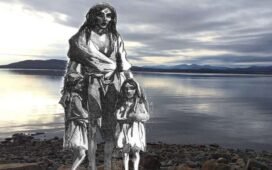
A monument in Letchworth Park commemorates her life. In 2010, members of the Seneca Nation regained sovereignty over nine acres of their former reservation and built the Seneca Buffalo Creek Casino in downtown Buffalo.
History is rarely clear and straightforward, often chaotic and paradoxical. Mary experienced love and kindness from her natural family and from her Native companions and spouses. She endured the cruelty of her captors and of the American soldiers who ravaged Native homes and stole their land.
Late in life, she concluded, “How brittle is the invisible thread on which all earthly comforts are suspended.”
Jack Kelly is a journalist, novelist, and historian. He grew up in a town in the canal corridor adjacent to Palmyra, Joseph Smith’s home. He lives in New York’s Hudson Valley. His Substack newsletter is called “Talking to America.”
Read more about the Indigenous History of New York.
Illustrations, from above: The Statue of Mary Jemison, by H.K. Bush-Brown, in Letchworth State Park in Castile, NY; and map of the lands of the Seneca, as defined by the Treaties of 1784 and 1794.



Recent Comments