
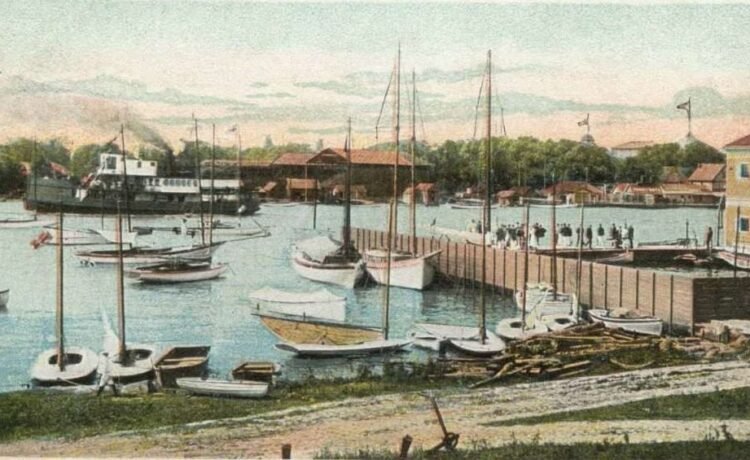
 As Rochester’s Democrat and Chronicle effused, presciently, in 1874: Charlotte, the Rochester NY neighborhood situated “at the mouth of the Genesee River, surrounded by scenery of unequaled beauty,” is “daily growing more important as a shipping port.”
The paper could scarcely have anticipated the impact of an international deal signed decades later, in 1905. “Car ferries” would be built, with related infrastructure, plus dredging of port channels to accommodate heavy loads, to directly link Rochester, with Cobourg in Ontario, Canada, to its north. The ferries would carry both freight-laden train cars and paying passengers.
 The first complete return trip for the ferry Ontario No. 1 took place in November 1907, for freight only. Soon, the ferry reached two round trips a day; but still, it just carried freight, and did not have a regular schedule. Passengers were first accepted in 1908, though, initially, they had to make do with having non-fixed departure times.
Once there were more passengers, Cobourg’s already-established appeal as a tourist destination for Americans was increased. Before those good-news events occurred however, there was a curious international, marine incident at Charlotte’s port, earlier in 1905.
An International Outrage
The fourth-of-July incident probably didn’t jeopardize the impending ferry deal with Canada too much, if at all. But, for much of that summer, it certainly outraged Canadian editorialists — and amused American ones.
Some said the Canadian government should submit an official complaint to U.S. Authorities. A member of Canadian Parliament agreed, and drafted, to the Minister of Marine, a formal request for an investigation of the matter.
 Here’s part of the Whig-Standard’s (Kingston, Ontario) reporting, three days after the event:
“Flag Outrage. Committed at Charlotte, N. Y., On Fourth.
“The schooner Acacia sailed into port [in Kingston] at eight o’clock this morning with a cargo of coal. Capt. William Simmons, a veteran sea dog, was in command, and was full of indignation at the outrage committed at Charlotte, N.Y., [when it was insisted that he] haul down the Union Jack, which he had run up on the afternoon of July 4, in honor of the day.
“Mr. Bump, the Collector… ordered Capt. Simmons to haul down [the Union Jack], saying it was an insult to the [American] national holiday. Simmons refused and threatened to shoot the collector if he boarded his vessel. Finally, Capt. Simmons lowered the flag when threatened with refusal of his clearance papers.”
Other accounts mention a “crowd” around the pier that threatened to “make trouble” (or fears that it might make trouble) if the flag wasn’t lowered. Some claim people threatened to come on board ship and personally haul down the flag.
Simmons, however, denied in an interview that he was moved by any threats, including about getting his clearance papers. He said he’d merely “stood by his principles for three hours,” and was induced by some sympathetic “real Americans” to lower his flag, “on promise that he would demand inquiry and get satisfaction.”
Whatever the facts, Canadian officials seemed to want the affair to just go away. The authorities always, somehow, had “not yet seen” the requisite paperwork or formal request, when asked about it. “It is said,” the Kingston paper reported, finally, in mid-September, that the two governments have “quietly settled” the matter. Thereafter, Capt. Simmons plied Lake Ontario for years, hoisting any flag he wished.
 Travel to Canada via Charlotte
Steamboat travel from Charlotte to Canadian destinations — and even a ship named Ontario — had long pre-dated the maiden voyage of that “leviathan ice-breaker” which would follow.
When the latter was launched, a Rochester paper reminisced about a “little side-wheel steamer” named Ontario, which used to travel to ports of call from, on the west, Lewiston, north of Niagara Falls, to, on the east on the Saint Lawrence River, Prescott, Ontario. It first sailed in April, 1817.
Cobourg, in the meantime, improved its own harbor and port facilities over the years, for handling passengers and freight. By 1840, it was advertised as a destination, together with Port Hope and Toronto, for “a new line of low-pressure steamers from Rochester.”
 Advertisements boasted that, if combined with coach and railroad services for land travel, passengers could “reach New York from Cobourg and Port Hope within 48 hours!”
Cobourg’s fortunes waxed and waned for some years afterwards. However, as industrialization increased in the northern U.S., there was increasing demand for iron ore mined in Ontario, while coal produced largely in Pennsylvania moved north. U.S. demand for iron and steel spiked further during its Civil War.
To meet growing demand for these products, wealthy American industrialists traveled to Ontario, to invest in mining and railroad interests, and some took routes passing through Charlotte.
Some also, apparently, stopped and smelled the roses (and saw the lovely beach) as they passed through Cobourg. Friends and family members started to accompany the moguls there. And some bought big houses or invested in building hotels.
 Thus was born what became known as the “American Summer Colony” in Cobourg. Pennsylvania historian Marsha Ann Tate describes the unique combination of American, seasonal residents who visited the colony, whether briefly or for complete summers.
Included were: “the wives of Ulysses S. Grant and Jefferson Davis; countless veterans of the Union and Confederate Armies; high-ranking federal and state government officials, including cabinet officers, U.S. Senators, and Supreme Court Justices; wealthy business people; actors and musicians; as well as working-class families” looking for a vacation. Dances, events and dinners, and even occasional marriages, involving these folks were regularly noted by local and Toronto papers.
Given its history, Pennsylvanians were much more prominent in the colony’s ranks than New Yorkers. Yet, evidence from society notices, hotel registrations, and so on, reveals that a significant sprinkling of New Yorkers also participated. Numerous arrivals from New York had family members in Cobourg, who they were likely visiting, as well.
All these visitors traveled by various means, especially lake steamers and rail connections around the lake. Once the train-car ferry was fully established, passengers had a new option of taking one-day, return trips to Cobourg from Charlotte. Sometimes, a whole group booked the ferry, and traveled together.
For example, a load of “Pittsburgh millionaires,” arrived one day, and were followed two days later by a church-group excursion of 600 people. The ferries could hold about 1,000 people a trip.
Arthur G. Yates’ Pivotal Role
It’s unclear if Rochester resident Arthur G. Yates ever vacationed in Cobourg, personally, or wanted to. But he was instrumental in establishing the train-car ferry that came to link those two communities. Yates was born December 18, 1843 in East Waverly, in Tioga County, NY.
 According to a long obituary in Rochester’s Democrat and Chronicle (1909), Yates moved to Rochester in 1865 to take a take a position in the Anthracite Coal Association.
He made his fortune in that industry, and expanded his business interests, as well, into railroads to transport the coal. He eventually became president of the Buffalo, Rochester, & Pittsburgh Railway Company, as well as “a director of a score of other companies.”
From early on, Yates was “was enthusiastic on the subject of making Charlotte one of the important ports of the Great Lakes.” While other industrialists still laughed at his vision, he advocated for building and operating a “ferry-boat capable of carrying a train of cars that would have Charlotte for a home port and some point in Canada as a destination.”
A developing Ontario, he realized, needed coal; and the existing alternatives for shipping were slow and inefficient: Either they shipped it via Niagara by train, which often faced bottlenecks; or they unloaded coal from trains onto ferries in Charlotte and had to re-load other trains after crossing the lake.
In 1905, Yates finally realized his vision, with the formal founding of the Ontario Car Ferry Company. It was a joint venture of his Buffalo, Rochester, and Pittsburgh Railway in the U.S., and the Grand Trunk Railway of Canada.
As mentioned, it launched its first ferry, the Ontario No. 1, in 1907; Yates lived to see it quickly become successful. An Ontario No. 2 ferry was launched in 1915. According to journalist Vince Versace, describing that era, ferry trips took about five hours each way; and it took about two hours to unload the boat.
Afterward
Versace estimates that each year, on average, the ferries carried about 12,800 railway cars of coal and 70,000 passengers. But business slowed after the Second World War. After four decades of service, “both ferries were scrapped by 1952.”
Before the ferries were discontinued, the “American Summer Colony” in Cobourg had already begun winding down, as circumstances changed for its seasonal and permanent members.
First came disruptions during the First World War, which caused labor and supply shortages. Then, as Marsha Ann Tate describes, “by the early 1930s, a number of the… summer residents had lost significant portions of their accumulated wealth due to a combination of the 1929 stock market crash, family disputes… tax burdens,” and other causes.
 “Many American families were forced to sell or abandon their ostentatious Cobourg summer homes,” some of which still stand; others have been destroyed by fire or torn down and replaced.
Nonetheless, the dream of a Rochester-based ferry to Canada — this time going to Toronto — was revived, almost a century after Yate’s train-ferry was founded:
The “fast” ferry (it clocked over 50 miles per hour) named Spirit of Ontario was launched on June 17, 2004, by its operator, Canadian American Transportation Systems.
That service, unfortunately, had financial problems and was suspended that same year. A subsidiary of the City of Rochester, the Rochester Ferry Company LLC, bought the ferry and tried its own hand in 2005; but that didn’t last long either.
Even so, for his own years, and for many years after, Arthur G. Yates provided powerful support for Charlotte through his investments in railroads, coal, and a modern new ferry.
Charlotte’s waterfront and port are, today, appreciated as leisure and recreational resources for the region.
Illustrations, from above: Postcard view of the Genesee River at Charlotte, 1905; Postcard showing Ontario No. 1 Rail Car Ferry, ca. 1909; William Simmons, Captain of the Acacia (Kingston Daily Standard, May 24 1920); The steamer Ontario in 1817 (drawn by Captain Van Cleve); Advertisement for three Lake Ontario steamers (Rochester Times Union, 1840); Cobourg Harbor, 1840; Arthur G. Yates from William F. Peck’s Semi-Centennial History of the City of Rochester, 1884; and Spirit of Ontario 1, part of The Breeze fast ferry service between Rochester and Toronto, at the Pier at the Port of Rochester, August 8, 2004 (photo by Ryan Tucker).
Read more about New York State’s maritime history.






Recent Comments