

As artificial intelligence (AI) threatens the white-collar job market and the cost of living continues to skyrocket, and while doomsday essays about white-collar job loss go viral—including those by Citrini Research and by Matt Shumer—a top global strategist has a stark warning for today’s youth: skip university and learn a trade.
Albert Edwards, a veteran macroeconomic analyst known for his contrarian views and his self-described “perma-bearish” outlook, is sounding the alarm on an economy that is systematically leaving young people behind. Specifically citing the mega-viral doomsday essay by Citrini Research, Edwards wrote in his global weekly strategy that he’s been making the exact same arguments from inside a global investment bank.
Once you factor in the “current clear benefits of surging AI-led productivity growth for investors,” along with lower unit labor costs, inflation and interest rates, he argued, “the blindingly obvious conclusion [is] that AI is already causing serious damage to aggregate job prospects, especially those of recent university graduates.”
“I can honestly say that if I was 18 now, there is no way I would go to university only to leave with huge debts and poor job prospects,” said Edwards. “Instead, I would become an electrician or similar trade.” Edwards even dabbled in the field when he was 22, rewiring his first house in 1983, which he claims to be a success save for losing the top of his left thumb when his interacted with a live connection. “To my knowledge, that house hasn’t burnt down yet.”
Edwards, who has previously talked to Fortune at length about what he describes as his radicalization as an analyst, stresses his views do not represent the house view at Societe Generale. He has long criticized capitalism, as evidenced in his 2023 analysis of corporate profit margins hitting an all-time high. In it, he wrote “we may be looking at the end of capitalism.” Three years later, he’s now predicting the end of perhaps the human side of capitalism. “The AI macro doomsday scenario is not for 2028,” he wrote. “It’s here right now!”
The brick wall
Edwards’ warning stems from this belief that 2028 will be too late for the AI doomsday scenario to play out because of the damage already visible in his analysis. Job cuts, initially concentrated in the tech sector, are now spreading to unexpected industries, including insurance, fund management, and logistics. But at the crux of Edwards’ analysis is the evidence he sees that the consumer is “running on fumes.”
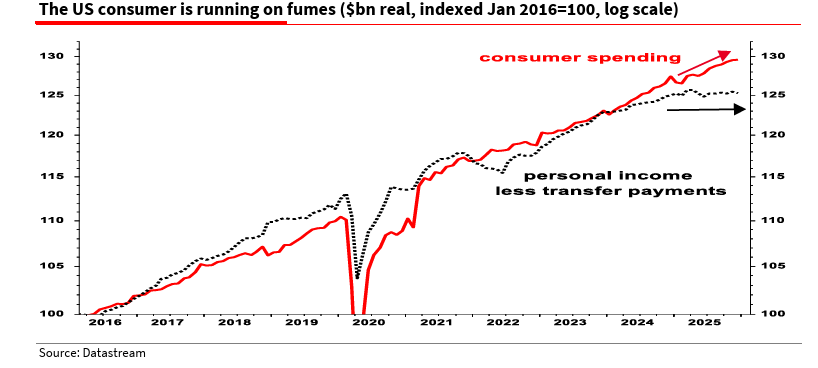
While aggregate consumer spending appears to be growing at a healthy rate of nearly 3%, he highlighted that the growth is fundamentally hollow, entirely unsupported by real personal disposable income, which has remained flat for the last six months. Instead, Americans are surviving by draining their savings.
The personal saving rate has collapsed to an “eye-wateringly low” 3.6%—a level not seen since the euphoria of the 2006 housing bubble. He believes the economy is barreling toward an AI-led consumer crunch, where job cuts cause weaker consumption, triggering a vicious cycle of further layoffs as companies try to maintain their high margins.
The Citrini Research report, for comparison, warned of a “deflationary spiral” and “ghost GDP.” This would be caused by AI as the white-collar workforce suffered a brutal recession from sudden and rapid displacement. In a services-heavy U.S. economy—where white-collar jobs account for roughly 50% of employment and 75% of discretionary consumer spending— the report argued that AI-driven productivity gains would accrue to capital, not labor, with profits reinvested in machines rather than people. In other words, a scenario very much resembling the stagnation in real income growth that Edwards says is already underway.
Edwards added that he believes the recent slump in the savings ratio is a short-term reaction to “real incomes hitting a brick wall.” The personal saving ratio will soon either stop falling—sending consumption growth to zero—or rise on a precautionary basis, causing overall consumption to decline, he added.
Marx for the digital age?
While sell-side research has been somewhat slow to respond to the Citrini note—which by some estimates, triggered a $300 billion selloff in 2026 markets so far—Evercore ISI’s Krishna Guha criticized it as “a high tech version of Marx’s thesis that capitalism would ultimately destroy itself by immiserating the petit bourgeois and working class until it had no consumers left, no additional profits to be earned on existing products produced, and no reason to grow.” Others, such as Marginal Revolution blogger and George Mason economist Tyler Cowen and Ritholtz Wealth Management CEO Josh Brown, have argued that it’s improbable that AI would represent the first time in hundreds of years of capitalism that new jobs would fail to be created by technological advancement.
Edwards previously told Fortune that much of his analysis is rooted in his sense that this is the first generation of Americans who do not feel they will be better off than their parents, creating a primal sense of betrayal. He argues that by being excessively greedy, corporations have “laid the seeds for their own destruction”. The lack of a true stake in modern capitalism takes the incentivization out of the economy for young people entirely. He pointed out that current economic conditions have created intense “intergenerational strife”. Young people are currently shut out of wealth concentration and face a nearly impenetrable housing market, heavily evidenced by the fact that the average age of a first-time homebuyer has now hit 40 years old.
Fortune recently interviewed Seth Lavine, a veteran venture capitalist, and Elizabeth MacBride, a veteran journalist, who co-authored Capital Evolution: The New American Economy, a book grappling with the same soul-searching over where things are headed. MacBride highlighted that neoliberal capitalism was born in an era that ignored behavioral psychology and relied on a purely economic view of human motivation while dismissing the reality that people are highly emotionally driven, and with neoliberalism largely discredited after the crisis of 2008, this period is a “messy middle.” As they learned in interviews for the book, business leaders including BlackRock CEO Larry Fink and JPMorgan CEO Jamie Dimon share concerns about what’s next, as do many normal, everyday middle-class Americans.
“Belief in the future is breaking down,” MacBride noted, pointing to alarming indicators such as dropping life expectancy and a suicide crisis among white men as stark evidence that the system is malfunctioning. Economic mobility has severely contracted: 50 years ago, an American born in the bottom wealth quartile had a 25% chance of reaching the top, but today that chance has plummeted to just 5%. “People do not feel like following the rules of the system is going to get them anywhere,” she added.
“This is probably the first generation [that] won’t be expected to outrun their parents,” Levine added. “So I mean, just by basic measures, we’re failing to provide for sort of economic mobility.”
Perhaps the reason the AI doomsday scenario has struck such a chord is the idea that, instead of potentially restoring the middle class in the 21st century, this technological advancement could go further in the direction of entrenching inequality, wiping out the white-collar careers that left a lucky few with precarious middle-class status. Could picking up a toolbox be safer than risking financial ruin for a vulnerable white-collar career? As Edwards previously told Fortune of modern capitalism’s dysfunctions, “You reap what you sow”.





Recent Comments