
 As Rick Cotton retires as the latest in a long line of executive directors of the Port Authority of New York and New Jersey, it’s worth thinking about the original, lurching journey to create the agency a century ago.
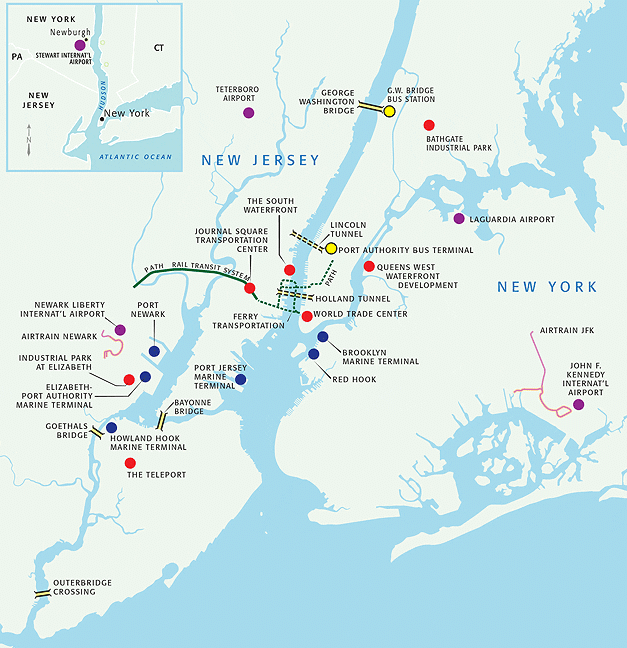
The Port Authority, which last year recorded gross operating revenues of almost $7 billion on assets of more than $63 billion, oversees many of New York City’s bridges, tunnels, marine terminals, and airports and a 1,500-square-mile port district. It was created in 1921 via a two-state compact ratified by Congress. That launch had not been assured, nor was getting there smooth.
 During World War One’s rushed ramp-up to U.S. participation, the port of New York served as the nation’s principal hub for embarking troops for Europe and vital concentration point for loading immense volumes of war materials.
The port was pivotal in the Allies’ victory, later welcoming the 2 million-man American Expeditionary Force (AEF) back home and assisting in shipping critical food relief to a devastated postwar Europe.
But the port’s infrastructure was scattered – owned and maintained in patchwork fashion, congested, and inefficient. As late as 1908, no bridges or tunnels spanned the Hudson River between New York and New Jersey; while passenger ship traffic landed in New York, freight often had to be barged from New Jersey.
As the first members of the AEF joined Europe’s front lines in Autumn 1917, President Woodrow Wilson tasked Secretary of War Newton Baker with untying this logistical knot.
“Port Board Named to Aid War Shipping,” blared the New York Times headline on November 4th, “Steps Will Be Taken at Once to Alleviate Congestion on All Sides of New York Harbor.”
The Port War Board’s creation was spurred by letters to Wilson from the governors of New York and New Jersey, who sought to weld together railroad and
steamship terminals into one system, and pledged support for “any plan which would make the Port of New York more serviceable to the Federal Government as a war utility.”
That solution? A formal bi-state authority.
The governor’s seat turned over twice during the fight to create a new port agency, but Albany’s support remained constant. After Democrat Al Smith was elected in 1918, the new governor worked to restart stalled negotiations with New Jersey and urged the state legislature to pass enabling legislation, saying in March 1920, “The matter of Port development is critical. It affects the housing problems; it affects the cost of living; it affects the cost of doing business within the Port of New York.”
But as has often been the case in mayor-governor relations through the decades, New York City’s chief executive had a different notion.
 John Francis Hylan (1868-1936), New York’s 96th mayor, was born in Hunter, Greene County, in the Catskills to an Irish immigrant father and Civil War veteran farming a 60-acre tract. As a boy, young John helped work the farm with his brothers; in his teens, he made $1.10 a day repairing winter damage to the nearby Stony Clove & Catskill Mountain Railroad.
At 19, he set off for the city, parlaying his Catskills experience into a job laying track on the Brooklyn Union Elevated Railroad. He spent nine years there, rising from stoker to engine hostler, and eventually to the exalted role of $3.50-a-day engineer.
From there, Hylan studied and practiced law, and in 1906 won appointment as a Brooklyn police magistrate and, nudging his way into various Democratic organizations, ascended to county judge.
In 1917, Hylan, seeking promotion to the state Supreme Court, began attacking the administration of Mayor John Purroy Mitchel for its support of private transit ownership.
But Hylan “overshot his mark,” as the Times put it, instead emerging from obscurity to gain Tammany Hall’s nod for mayor. Denouncing the “traction trusts” was a theme the former tracklayer would sound repeatedly before and after he defeated Mitchel by a wide plurality.
A bi-state port agreement and governing authority struck the first-term mayor as yet another example of shadowy “interests” controlling city resources. The stocky, mustachioed Hylan charged that a port agreement would disadvantage the city, which would have little say in how the port agency was run.
Speaking before the state Senate Judiciary Committee in Albany, Hylan accused port development promoters of working on behalf of the railroads and New Jersey, intent on “delivering New York harbor to the corporations.”
 The Governor and Mayor Hylan were on a collision course. Time magazine put it succinctly, “Now if there is a man whom Governor Alfred E. Smith despises, it is Red Mike.”
Al Smith was defeated for re-election in 1920 (he’d regain the governorship two years later), but his successor, Republican Nathan Miller, inherited the ports feud and Hylan’s intransigence, with the mayor filing a memorandum of dissent to the state legislature, delaying city Board of Estimate approvals, and threatening a lawsuit. Miller pushed ahead, telling legislators “no narrow or provincial view should be permitted to delay action.”
Governors usually get their way over mayors, and on April 30, 1921, at the marble colonnaded offices of Chamber of Commerce of New York State on Liberty Street, the ports treaty was signed by a variety of New York and New Jersey officials. Hylan stayed away.
The Port Authority was born, and Miller appointed Al Smith to its board, with the “Happy Warrior” serving until he was returned to the governorship after the 1922 election.
Hylan continued his opposition, going so far as to write President Warren G. Harding in June 1922, asking him, unsuccessfully, to veto a federal bill ratifying the authority’s comprehensive port development plan. He continued to rail against port development until, defeated for re-nomination by his successor, state senator Jimmy Walker, he left office at the end of 1925.
 Four years later, Hylan made an abortive attempt to regain City Hall, winning the nomination of the independent, anti-Tammany “Better Government Party” and calling Walker a tool of special interests. Wrote the New Yorker that March, “John F. Hylan… makes a nonstop flight of the imagination back into the City Hall. For all we know to the contrary, it is a solo hope.”
By October (two weeks before the Crash of 1929), Hylan had flipped to urging a united Democratic front behind Walker. A hyperbolic speaker never acclaimed for a facile mind, Hylan spent his last years back on the bench as judge of the Queens Children’s Court – appointed by his successor. Asked by a journalist why he’d appoint a rival, Walker was said to have joked, “The children now can be tried by their peers.”
As a legacy, however, Hylan’s lifelong focus on city ownership of its infrastructure, and his fights to keep subway, elevated, and streetcar fares in check, laid the foundation for today’s unified citywide public transit system.
In 1922 he proposed a 100-mile web of city-owned rapid transit lines to compete with his former employer, the privately owned Brooklyn Rapid Transit Company (later the Brooklyn–Manhattan Transit Corporation, or BMT), as well as the Interborough Rapid Transit Company (IRT).
A New York City Transit Commission drew up plans for what eventually became the Sixth Avenue and Eighth Avenue subways in Manhattan as well new underground lines linking Manhattan with the Bronx, Queens, and Brooklyn.
 These lines eventually became known as the Independent Subway System (IND) after the city purchased the BMT and IRT in 1940, creating a four-borough system.
The fifth borough, Staten Island, was originally part of Hylan’s plans, and an abandoned 150-foot tunnel beneath Owl’s Head Park in Bay Ridge, Brooklyn, known as The Hole or Hylan’s Holes, is all that remains of what was to have been a two-mile-long link to Staten Island beneath the tidal strait known as The Narrows.
More formally, the 14-mile Hylan Boulevard in Staten Island, the longest street in a single borough in the city, was renamed for him in 1923 and carries his name to this day.
Read more about transportation history in New York State.
Illustrations, from above: A map of Port Authority facilities, ca. 2015; World War One troops from training camps disembarking at Hoboken, New Jersey piers to board transports to Europe; John Hylan’s homestead in the Catskills, along with photos of his parents and two photos of himself as child and young man, from his autobiography; portrait of John F. Hylan during his time as Mayor; the 1921 signing of the Port Authority compact the Great Hall of the New York Chamber of Commerce; and a subway map showing the “Independent City Owned Rapid Transit Railroad” lines, 1938.





Recent Comments