
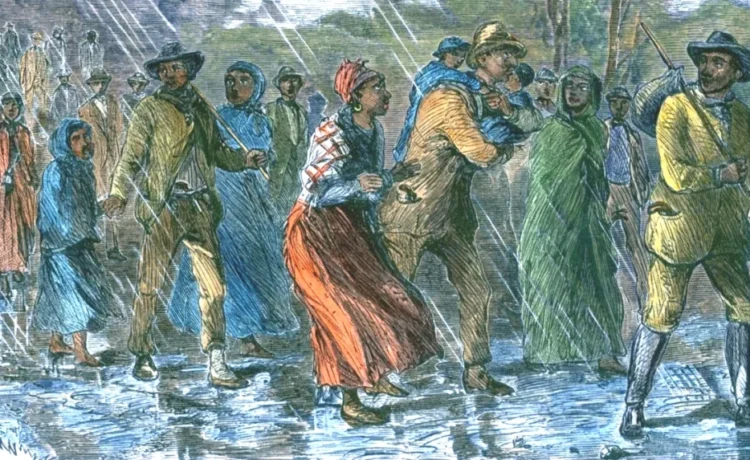
 Many New Yorkers before the Civil War contributed to the abolition of slavery, and the dangerous work of helping enslaved African-Americans flee their captors. Take Calvin Fairbank, a New York Methodist pastor born 1816, who spent 17 years in prison for his missions to help enslaved people escape.
Seth Concklin, a New Yorker whose name and sacrifice were more familiar in the 19th century, died tragically in 1851 while trying to help a mother and her three children escape from slavery.
Seth Concklin & Peter Still
Seth Concklin was born February 3, 1802, in what was then Sandy Hill (now Hudson Falls), in Washington County, NY. His parents may have been part of the “mysterious migration” of Black Americans into the area in 1800-1820.
Key sources about Concklin’s life weave together his tale with that of Peter Still (1801-1868), a long-enslaved older brother of well-known and remembered Philadelphia abolitionist William Still (1821–1902).
 As chairman of the city’s Anti-Slavery Office, William Still helped to coordinate, for people seeking freedom from slavery, their finding shelter, friendly contacts, food, clothing, transportation, and so on.
In 1850 Peter Still arrived at William Still’s and explained his situation. He also answered some additional, unexpected, questions, which concerned him: Why is he asking for so much personal information?
There was no need to worry. As William wrote later, he was in awe at this “wonderful development… that this Peter was one of my long absent brothers,” whom he could happily re-unite with his “Mother, 5 brothers, and 3 sisters situated comfortably in life.”
That’s right – Peter Still, then in his late 40s, learned William Still was a younger brother he never knew he had.
 Much of Peter’s story was recounted in Kate E.R. Pickard’s 1856 book The Kidnapped and the Ransomed, being the Personal Recollections of Peter Still and his Wife ‘Vina’ After Forty Years of Slavery.
Seth Concklin, who figures importantly in those recollections, was featured in the book’s Appendix, written by the abolitionist, Reverend William Henry Furness.
(In Emily Conkling’s reprint of that Appendix, published in 1892, Seth’s sister Emily Conkling revises the spelling’s of Seth’s last name to match hers.)
Slavery: A Still Family Recurring Tragedy
The Kidnapped and the Ransomed reveals poignantly how slavery tore families apart; yet, sometimes, improbably, after years, some families (or surviving members) did re-unite in freedom. Peter’s family experienced such scenarios several times.
First, Peter’s father, Levin, was able to save money and buy his own freedom in 1805. He then made arrangements, so his wife and four children could escape to join him.
At first, they were successful, and the family settled in free-state New Jersey…. Until, cruelly, slave-catchers kidnapped the runaways, mother and children, and returned them to the slaver who said they were his property.
 Peter’s mother, Cidney (later changed to Charity) would not give up, and planned another escape.
Fearing she could not make the difficult journey again while caring for four children she brought just her two daughters. She prayed she could come back someday later for her two sons. Peter Still had been one of those two sons; the other had died in captivity.
To avoid being discovered and kidnapped another time, Cidney had changed their names.
Some 40 years later Peter Still was obviously overjoyed to find his mother and sisters, plus younger siblings he’d never known. But he could not rest.
Like his father before him, Peter too had eventually found means to buy freedom; but he, likewise, had to leave behind a family in slavery. He had a wife and three children he hoped to help make it to freedom.
The next part of Peter’s story are offered by his long-long brother in William Still’s 1872 encyclopedic work about his years in his Philadelphia anti-slavery office and the struggles of Black Americans seeking freedom from what slaver John C. Calhoun (1782-1850) called “the peculiar institution.”
(Calhoun served as Vice President to the United States and owned dozens of slaves in South Carolina. He claimed that slavery was not a “necessary evil,” but a “positive good” which benefited slaves.)
Now known as The Underground Railroad Records, William Still’s original subtitle described his accounting as “A record of facts, authentic narratives, letters, &c., narrating the hardships, hair-breadth escapes, and death struggles of the slaves in their efforts for freedom, as related by themselves and others, or witnessed by the author.”
Concklin’s Daring Rescue Attempt
Peter Still hoped he could raise money in the North to purchase his family’s freedom. So, William and Peter shared Peter’s story but found limited success. Then appeared Seth Concklin who heard about, and was drawn to, Peter’s story.
Concklin had prior experience doing reconnaissance work with the network of anti-slavery activists resisting slavery by aiding the escape and concealment of freedom seekers.
 (Thomas Smallwood is credited with first using the term “Underground Railroad” in print in an August 10, 1842, issue of the Tocsin of Liberty newspaper published in Albany, NY, by Charles Turner Torrey. Smallwood used the phrase to describe his organized efforts to help enslaved people escape from Washington, DC, and Baltimore to Canada.)
According to historian Mary Ellen Snodgrass, Seth Concklin researched hiding places and also “noted gathering spots of bounty hunters and spies throughout Illinois and Indiana.”
But this would be different. “Seth,” wrote William Still, “seemed wholly insensible to fear… [and] he, in the spirit of the good Samaritan… volunteered his services, without pay or reward, to go and rescue the wife and three children of Peter Still” – directly from the plantation where they were being enslaved.
Peter was, at first, reluctant to accept Concklin’s offer of rescuing his family. Yet, he gave in when he saw no other prospect of success. William Still was hesitant, as well, as he an other organizers did not encourage such risky efforts. Out of necessity, he and many other activists represented themselves as helpers of people already on their journeys.
Nonetheless, the rescue project was agreed to, and Concklin wrote periodically to William Still about his efforts. From Indiana he wrote that he’d already “traveled over three thousand miles” in his efforts to plan safe routes and confirm trusted contacts:
“Two thousand and four hundred [miles] by steamboat, two hundred by railroad, one hundred by stage, four hundred on foot, forty-eight in a skiff.” At this point, “I have yet five hundred miles to go to the plantation, to commence operations.”
 If his plans worked out, he and his “passengers” would travel through Indiana on the Wabash River, and then work their way northeast to Canada, opposite Detroit, by April 1851. Concklin traveled under the name “Miller.”
They successfully reached Indiana, on schedule. However, on April 9, this news item was published in a local paper:
“RUNAWAY NEGROES CAUGHT.—At Vincennes, Indiana, on Saturday last, a white man and four negroes were arrested. The negroes belong to B. McKiernon, of South Florence, Alabama, and the man who was running them off calls himself John H. Miller. The prisoners were taken care of by the Marshall of Evansville [Indiana].”
When that Marshall, named John S. Gavitt, was later interviewed on behalf of Concklin’s friends, he said he acted on a writ for the arrest —consistent with the Fugitive Slave Act of 1850. Gavitt conceded however, that “I believe we’ve all done wrong.”
For what was probably Concklin’s last day alive, there was an eyewitness on board the steamer Paul Anderson, onto which the prisoners were loaded at Evansville.
A witness later said that during the trip a lot of “ranting Abolitionists” from the free state of Ohio were also on board, and tried pressuring the captain to release Concklin – but he refused. When the steamer made a scheduled stop at Smithland, Kentucky, Concklin escaped, “to the great joy of the worthy Ohioans.”
Speculative accounts, by that witness and others, vary on whether Seth Concklin’s subsequent death and injuries were accidental or from foul play. His injured body was found in the river, still in his chains.
In any case, for now, Peter Still’s family was still enslaved.
Seth Conklin’s Northern New York Past
Seth Conklin was called upon early to exhibit the compassion, resourcefulness, and experiences of family separation which drew him to eventually help out Peter Still.
Seth’s father Daniel was a mechanic who traveled for his work. He died in Georgia when Seth the oldest of his five children was only 15. Daniel left some property, but the agent entrusted with his accounts defrauded Daniel’s widow, and left the family penniless. Seth became the family’s breadwinner as a traveling peddler.
After a year or so Seth found steady work at a lumber yard. His mother Waitstill moved with three of her children to be near relatives in Canada while Seth’s employer “Mr. W.” put up Seth and his little sister Eveline with his own family.
Unfortunately, Mr. W. had a violent temper. In a final incident, he locked up Eveline, upstairs.
Seth’s escape is described in William Henry Furness’s Appendix:
“The boy and girl set out on foot for Canada… [sometimes] “a kind woman, a mother, would take them in, give them food and shelter, wash the little girl and comb her hair. From others they received harsh words, and… they trudged on.”
 At last, the exhausted brother and sister reached Sackets Harbor, NY, on Lake Ontario, during cold September weather.
Eveline was now ill, and Seth found an inn where she could have a proper rest, while he went out and hired “a man with a small sailboat (a smuggler) to take them across the Lake.”
A water route west of various peninsulas and islands could eventually take a sailboat to a land point near Kingston, Ontario.
On their first day out, they sailed into a storm, but safely reached shore past Pillar Point, and took refuge with some kind squatters in a cabin. Finally, they made it to Ontario; and, by land, completed the trip to Kingston, where their mother and siblings were living.
Seth returned to peddling for income for a year, until he discovered in the newspapers a highly unusual opportunity for the family. Furness records this anecdote:
Seth found “an advertisement of a house in Sackett’s Harbour, which had the reputation of being haunted, and in which the owner was willing that anyone should live, rent free, until the place should get a better name. Seth exclaimed: ‘I’ll go take that house, and we shall have nothing to pay.’”
His mother had no fear of ghosts, and consented. Seth went to secure the place, and, before returning to Kingston, found it to be “large and commodious, originally built for a hotel.”
Seth and his mom were delayed in Canada however. Reluctantly, they sent the other children ahead to move into the house and one of the children became ill.
The children were fortunate that an elderly neighbor was kind to them, visited regularly and brought hot soup. When Seth and the children’s mother arrived after ten days, the man said to Mrs. Concklin. “I was wondering… whether you were [the] ghost or a real woman.”
Once their family had “lived in the ‘haunted house’ one year… the owner considered the good character of the place established, and required them to pay rent,” which was beyond their means; so they moved again.
Detailing all Seth’s other uncommon adventures would require another article. But these highlights are pertinent to the present history:
Seth enlisted as a soldier, and gained experience, plus wages to send to his family, which he supplemented by cooking for his Company. When his mother died of illness within about a year, he obtained a discharge, with an intent to care for his siblings.
 While he explored options, he learned of New York’s staunchly abolitionist Shaker settlement at Watervliet, just north of Albany, and went there. Furness recounts:
He “was so much pleased with it that he took the little ones, now everywhere known as ‘Seth’s Family,’ and enrolled them and himself as members of that community…. Seth remained with the Shakers three years, the children for a longer period.”
Although, typically, members who quit the Shakers lost their membership, “Seth, in consideration of his worth and eccentricity, was allowed again and again to return into full communion with the Society… It impressed him very strongly in favor of the Shakers that they did not recognize the distinction of color.”
That observation contributed to Seth’s increasing abhorrence of slavery. His work in “the business of a miller” took him around Syracuse and in Rochester and other places, and he wrote letters about his views; and donated regularly to the abolitionist cause. Once, he nearly got tarred and feathered for circulating anti-slavery tracts in Syracuse.
Those interests led to his visiting St. Louis and spending time in Springfield, Illinois, in “aiding the transit of passengers on the Under-Ground Railroad.” Sometimes, he’d also give passengers financial assistance from his own pocket.
In character, Concklin managed next to get caught up in the Canadian Patriot War. Stan Evans, writing about that war in the New York Almanack, described it as an “ill-fated rebellion against the oligarchy that ruled colonial Canada.”
It was led by William Lyon MacKenzie, “a fiery, populist reformer and enemy of the elite,” and it was not condoned by the U.S. government.
 According to Concklin’s later sworn testimony he was imprisoned as an alleged spy on Navy Island on the Niagara River by Patriot forces up until they evacuated the island. He was confined “in a house… which was open to the fire of the British guns; and three of their shot passed the house whilst he was confined there.”
Regardless of whether Concklin was an official spy or not, he had a definite interest in Canada as a place of refuge for people escaping enslavement. After the press published accounts of his involvement it was said that “Concklin was, for a time, quite a lion in Buffalo” among the Patriot supporters.
Afterward, Concklin had some further exploits in the southern United States but returned north to be closer to family. Census records show Concklin was staying with his then-married sister Eveline in Philadelphia in 1850.
So, he was in the “City of Brotherly Love” when the news spread about the plight of Peter Still and his family.
Resolutions
Peter Still was heartbroken when his family were recaptured in 1851 despite Concklin’s efforts. He managed to have a letter forwarded to B. McKiernan, the man who held his family in slavery. He offered to pay for their release.
McKiernan replied after a time, in care of William Still. He said he went “to much expense and trouble” to recover the slaves — for which, in itself, he should be reimbursed $1,000; but “I will take $5,000 for the 4 of them.” In today’s dollars, that would exceed $160,000.
Peter spent nearly two years touring northern states, giving speaking events; and raised the full $5,000 by August 1854. Along the way, he’d received letters of support from Harriet Beecher Stowe, Horace Greeley, Gerrit Smith, and other prominent abolitionists.
This apparent success was bittersweet; for it continued the Still family’s horrific experiences for another generation.
Historian Spencer Crew summarized: “Vina, her daughter and two sons were allowed to leave per the agreement. However, one son [now had his own] young child who McKiernan refused to send with the family. He claimed the two-year-old boy was not part of the original agreement.”
The boy was left behind and “did not reunite with his family until after the Civil War.”
With regards to Seth Concklin: William Still honored his memory by devoting the first chapter, titled “Seth Concklin,” in his large Underground Railroad book to Seth’s story.
As Still explained in the book’s Preface: He gratefully acknowledged all who aided the cause of freedom through the end of slavery; yet, his book’s goal was to document and preserve, for free Black Americans themselves, their own heritage.
His book aimed to demonstrate how “through extraordinary determination and endeavor…. men and women [struggled] to obtain their freedom, education, and property.”
Concklin was not just any helper of the cause. “In the long list of names who have suffered and died in the cause of freedom,” William Still wrote, “not one, perhaps, could be found whose efforts to redeem a poor family of slaves were more Christlike than Seth Concklin’s, whose noble and daring spirit has been so long completely shrouded in mystery.”
Seth Concklin was certainly an exceptional abolitionist.
Read more about Black history in New York State.
Illustrations, from above: Freedom Seekers leave Maryland for Pennsylvania, ca. 1830, from William Still’s The Underground Railroad (1872) (colorized); engraving of William Still as a young man; Seth’s sister Emily Conkling from Life of Seth Conkling (1892); Peter and Charity Still (Charles L Blockson Afro-American Collection, Temple University); Tocsin of Liberty newspaper, March 16, 1842; “The Road to Liberty A Station on the Underground Railroad” (Schomburg Center, NYPL); The water route from Sackets Harbor to Kingston, Ontario; Stereocard of Watervliet Shaker Village, ca 1870 (Shaker Heritage Society); and an 1838 sketch of Navy Island (Brock University Collections).






Recent Comments