
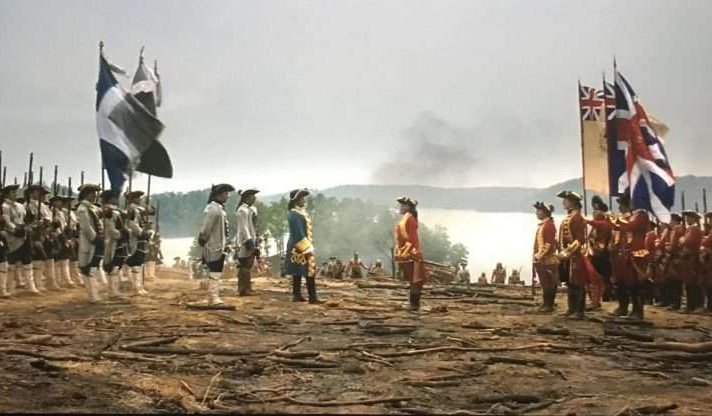
 The dramatic massacre at Fort William Henry on August 10, 1757 has been told in 18th century newspaper accounts, witness diaries, by historians, movie makers, and of course the famed novelist James Fenimore Cooper.
Another attack at Half-Way Brook a year later has been overshadowed by the carnage at Lake George. The events of July 28, 1758 were every bit as horrendous, bloody and gut-wrenching. That story has been largely overlooked.
The gruesome casualties sustained near Half-Way Brook by a wagon train making its way from Fort Edward to the southern end of Lake George in the summer of 1758 exceed those at Fort William Henry the year before.
The French and Indian War-time atrocities committed in 1758 took place at what today is a serene, babbling brook skirting Hovey Pond Park in Queensbury, NY. Major Robert Rogers called it “Bloody Brook.”
 Ian Steele in his Betrayals: Fort William Henry & the “Massacre” (Oxford University Press, 1990) has meticulously calculated the human cost of the British capitulation at the Siege of Fort William Henry in 1757.
His conclusion is that the “soldiers and civilians killed in the ‘massacre at Fort William Henry’ numbered at least 69 (2.8 percent), but could not possibly have exceeded 184 (7.5 percent) people.”
In Empires in the Mountains: French and Indian War Campaigns and Forts in the Lake Champlain, Lake George and Hudson River Corridor (Purple Mountain Press, 2010) Russell Bellico contends the number killed in the massacre could be higher because “by the end of 1757 over 300 soldiers who had survived the siege were still missing” and “this number does not include an unknown number of civilian losses.”
Even adding 300 more lives to Steele’s total, the percentage of killed at the Fort William Henry massacre would be about 20%. At Half-Way Brook, that percentage would be much higher.
Half-Way Brook in 1758
Military events started early at Half-Way Brook in 1758. A large contingent of Rogers’ Rangers and volunteers camped along the stream on March 10th. They were on their way to a stunning defeat at the hands of French partisans and their Indigenous allies along Trout Brook not far from Fort Carillon (now Fort Ticonderoga).
Although Robert Rogers would gain enduring fame for his faux escape by “sliding” down “Rogers’ Rock,” his “every man for himself” tactic left many of his rangers dead and scalped on the battlefield.
The following June, George Viscount Howe – “Lord Howe” – second in command of British Maj. Gen. James Abercromby’s 15,000 man army would also camp on the south bank of Half-Way Brook.
 Abercromby had been tasked with eliminating the French from Forts Carillion and St. Frederic (Crown Point). Howe’s 3,000 advance force lingered two days at the brook, then advanced to Lake George.
It would be Lord Howe’s last look at the creek. He would be killed in initial fighting at Ticonderoga. His body would later cross Half-Way Brook in a wagon escorted by Maj. Philip Schuyler on its way to burial in Albany.
Abercromby’s army would be soundly defeated on July 8, by Marquis de Montcalm and retreat back to the southern shore of Lake George.
Montcalm failed to follow up his stunning victory over Abercromby’s devastated army for good reasons, despite the urging of Canada’s governor, Pierre de Rigaud de Vaudreuil, marquis de Vaudreuil-Cavagnial.
Montcalm did not, however, let English soldiers off scot-free. The French army commander decided to launch several raids, using Canadian and Native American reinforcements, to keep his enemy off balance.
 This strategy kept the French forts on Lake Champlain safe for another year. Two of these raids would hit the military road between Fort Edward and Lake George near Half-Way Brook with devastating effect.
The First Ambush
Less than two weeks after Abercromby’s Fort Carillion debacle, some 500 Canadians and Indigenous allies under Captain Jacques-Francois Courtemanche ambushed a small Provincial column returning to Fort Edward after escorting a wagon train to Lake George. Courtmanche’s orders were “to annoy and intercept the English [supply] trains.”
On July 20, a “pritty [sic] warm” day, the French captain missed the convoy, but ended up butchering most of the returning column. One diarist reported that in the early morning hours, the French fired on the Provincials within two miles of Half-Way Brook.
Another account puts the English colonists within a thousand feet of the Half-Way Brook stockade when “the Indians shouted and fired on them and killed eight of them [in] the first shot.” Next, warriors flung their tomahawks at the two remaining soldiers, killing one as the other man made it to the stockade on the run.
Troops from Col. Ebenezer Nichol’s Massachusetts regiment stationed at the Half-Way Brook immediately responded to the musket fire by sallying out of the palisaded fort. It appears from several sources that Nichols had between 100 and 200 men at Half-Way Brook.
Desultory firing lasted about an hour before Nichol’s command was overwhelmed by the enemy’s advantage in numbers. The Bay State men fled back to their post.
The Native warriors decided to break off the attack, carrying their dead and wounded with them. Later, English bodies were found scalped with their throats cut.
Apparently, Courtemanche thought more mayhem was necessary. A later French report blamed “the impatience of the Indians [that] prevented this detachment [from] destroying a party of 300 English which had taken refuge in a stockade enclosure [at half-Way Brook] lately erected to serve as a depot on the Fort Edward road.”
English reports suggested a positive twist on the fighting by claiming that there was reason to believe a great number of the enemy had been killed by observing “the Poles cut and hew’d for Biers.”
Strewn around the battle site were quantities of peas, pork and corn meal as well as poles, packs and blankets left behind as the French and their allies made their escape to South Bay on Lake Champlain.
Complete casualty counts of this action are elusive, but the English lost approximately six officers, three non-commissioned officers and eight privates killed, two men wounded with seven to ten prisoners carried off to Canada.
One diarist credits the French organized enemy forces with killing 18 men and “some poor Women that were there.” Four more men were found scalped the day following Courtmanche’s raid.
French reports claimed 24 scalps were taken, perhaps as many as 40, along with ten prisoners. Between the men killed in the initial ambush of the returning column and the Provincials who went to their rescue from the stockade, the most conservative percentage of Provincials killed in this raid far exceeded the percentage of persons killed in the Fort William Henry massacre.
(Twenty-four scalps reported taken from an estimated force of 210 would yield a casualty rate of 11.4% verses Steele’s calculation of 2.8% to 7.4%, albeit the whole numbers at Fort William Henry were greater.)
The Second Raid
But the worst was yet to come at Half-Way Brook. Eight days later, a marauding force of some 400 to 500 Canadians and their Native Allies managed to hit the petite guerre jackpot.
 Led by Luc de La Corne (or La Corne Saint-Luc, 1711 – 1784), a “Colonial Captain” and one of Canada’s richest merchants, this raid would be a classic example of the type of guerilla warfare advocated by Governor Vaudreuil.
(In the small world of the 18th century, St. Luc would also command British General John Burgoyne’s Native Allies contingent during the 1777 campaign to capture Albany.)
St. Luc’s timing was perfect. On the morning of July 28, the French ambushed a British wagon train shortly after it left the Half-Way Brook stockade on its way to Abercromby’s army at Lake George. It was a convoy of 44 carts drawn mostly by two to three yoke of oxen each, carrying flour, pork, wine, rum and chocolate among other items for the army, including the commanding general’s sheet music.
The English supply train consisted of about 190 people which included teamsters, sutlers, a 40-man soldier escort and 30 women headed to the lake as nurses. St. Luc concealed his command in the thick bushes and swampy plains that bordered the brook and the military road in the area around what is now Route 9 and Quaker Road.
Several diarists claim the attack took place between Fort Edward and Half-Way Brook, but a Connecticut ranger who claimed to be on the scene on July 28 remembered that the attack took place as the wagons stretched from the Half-Way Brook blockhouse north, just up the hill to a familiar landmark known a Blind Rock.
An easy target for St. Luc to spring his ambush, Blind Rock was a significant meeting place, once considered a kind of southern boundary of New France. It is marked today by a New York State historic marker at the corner of Route 9 and Montray Road across from the Walmart in Queensbury.
As the supply carts creaked along at a leisurely, unsuspecting pace, St. Luc executed his ambush plan. Musket fire from both sides of the military road decimated the convoy’s escort guard. Teamsters were also hit. One woman jumped from a wagon, saving herself by running back down the road to the stockade.
Unidentified heroes emerged from the slaughter. A Connecticut Provincial captain later recorded in his journal that “one little child, a girl ran back in the path like a quail, a waggoner [sic] who cut his horse’s ropes and cleared him from ye wagon rode back ye path, took her by ye hand, catched [sic] her up before him and saved her.”
 Meanwhile, according to an 1822 reminiscence, after getting supplies at Lake George, Israel Putnam’s Connecticut ranger company had camped the previous night “at the flats near the southern spur of the French mountain.” (This location was probably where the Lake George outlet stores are today.)
Upon hearing musket fire to the south the next day, Putnam’s men rolled up their blankets and moved out to the sound of the guns about four miles away. But they were too late to fight the French. The rangers found about 150 slaughtered oxen, the “mangled remains of the soldiers, women and teamsters” and broken up carts.
The convoy’s contents had been plundered and for the most part destroyed. “A large number of boxes of chocolate which of heat of the summer sun, mingled with the pools and rivulets of blood forming a sickening and revolting spectacle,” one of Putnam’s men remembered years later.
Putnam’s command unsuccessfully pursued the raiders, then returned to the scene of the ambush where they found a Provincial company from Fort Edward digging a trench for the dead: “The corpses of twelve females were mingled with the dead bodies of the soldiery.”
The rangers continued to search the surrounding area where they found the body of a woman that had been “exposed to the most barbarous indignities and mutilations, and fastened in an upright position to a sapling which had been bent over for the purpose,” an image seared in one ranger’s mind for nearly 65 years.
Other women were found “killed in a barbarous manner striping them naked and cutting them after a cruel manner.” More mutilated bodies were later found — all of them scalped. A Massachusetts Provincial told his diary that the party of civilians and soldiers near Half-Way Brook had been “prodigiously and unhumanly [sic] butchered.”
St. Luc reported to Montcalm that his detachment took 111 scalps and 80 prisoners. He claimed to have killed all the oxen (240) and split open all the rum barrels. His casualties were one Iroquois (probably Mohawk) killed and three wounded.
A letter sent to the French War Department basically confirmed St. Luc’s earlier report, adding that 84 prisoners were taken which included “women or girls” as well as teamsters, sutlers, traders and children. The military commander of the convoy was a lieutenant who also was taken prisoner.
 Meanwhile, besides the human toll and the material loss of valuable provisions and alcohol so dear to a soldier’s heart, the Half-Way Brook raiders apparently disappointed Abercromby’s rank and file at the lake who were expecting a payday.
St. Luc’s command also made off a payroll thought to be worth some two thousand pounds sterling. A few days after the attack, the cash grabbed by the French was estimated to be 15,000 pounds sterling. Moreover, a Provincial colonel named Hart was under arrest for refusing to come to the convoy’s aid from Fort Edward.
Rescuers dispatched to the Half-Way Brook massacre site on July 28 found, according to a reminiscence of the event, an ox “regularly scalped.” The animal was still alive so it was driven to the British camp at Lake George.
By careful nursing, the wound healed. In the fall, the ox was driven to Col. Philipus Schuyler’s farm near Albany at Schuyler Flatts in what is now Menands (Philipus Schuyler was Philip Schuyler’s uncle.)
It was then shipped to England in 1759 where it became an instant “curiosity” and known as the “scalped ox.” A diarist also mentioned this story claiming, St. Luc’s men were “so wanton in their barbarities, that they scalped an ox.”
British Reaction
British reaction to the Half-Way Brook massacre was quick. As a result of the atttack, by August 1, the Half-Way Brook stockade garrison was increased to 800 men. In addition, Maj. Robert Rogers was immediately dispatched with 700 men, including Putnam’s ranger company and some regulars to intercept the raiders.
Rogers’ objective was to cut the French force off above South Bay on Lake Champlain by rowing north on Lake George, then hiking across the mountains to get in front of St. Luc. Rogers failed to catch the enemy, who made it safely back to Fort Carillion despite their excessive consumption of spirits.
Ordered to return to Fort Edward by Col. William Haviland, Rogers ran into another raiding party under the Canadian partisan Captain Joseph Marin. It was a standup fight near the decaying ruins of Fort Anne before the French side gave up the fight on August 8. French casualties were staggering.
 Rogers’ losses included the capture of the intrepid Israel Putnam who was nearly killed. Rogers, however, was happy to lead his men to Fort Edward and celebrate his victory after the two wagon train catastrophes near Half-Way Brook the previous month.
“Rogers’ defeat of Marin’s party effectively put an end to the French attempts to dislodge Abercromby’s army by incessant raiding,” according to artist/historian Gary Zaboly. The British army would decamp Lake George in the fall of 1758 to spend the winter at Fort Edward.
The following year, the Half-Way Brook post would be strengthened and enlarged to accommodate the increased garrison of 800 men. It would be named Fort Amherst in honor of the new British commander-in-chief, Jeffery Amherst and situated on the north side of Half-Way Brook. The post would be augmented with “redoubts, rifle pits, earthworks, and a palisade of hewn timbers.”
The bloodshed at Fort William Henry has dominated our perception of the brutal nature of 18th century wilderness warfare. But at the first Half-Way Brook ambush on July 20, 1758 90% of the English column was killed, while the relief force that sallied out from the Half-Way Brook stockade suffered at least a 13% loss in killed.
In the second attack by St. Luc on July 28, 74% to 77% of those in the English convoy were killed.
Read more about the Half-Way Brook fortifications.
Illustrations, from above: Still from the 1992 movie Last of the Mohicans showing the surrender of Fort William Henry; A recreation of the Siege of Fort William Henry in 1757; Abercromby’s flotilla launching up Lake George from Fort William Henry (diorama detail, Adirondack Experience – Lake George Battlefield Park Visitors Center); French and Indian Wars Forts in Hudson Champlain and Lake George corridor (Warfare History Network); Detail of posthumous portrait of Saint-Luc de La Corne by Henry Richard S. Bunnett, between 1885 and 1889 (McCord Stewart Museum, Montreal); Major Israel Putnam in colonial uniform, 1758; A blockhouse and palisaded enclosure similar to what the station at Half Way Brook in Queensbury might have looked like; and a painting depicting a fictionalized rescue of Israel Putnam in 1758 by Jean Leon Gerome Ferris, ca. 1905.






Recent Comments