
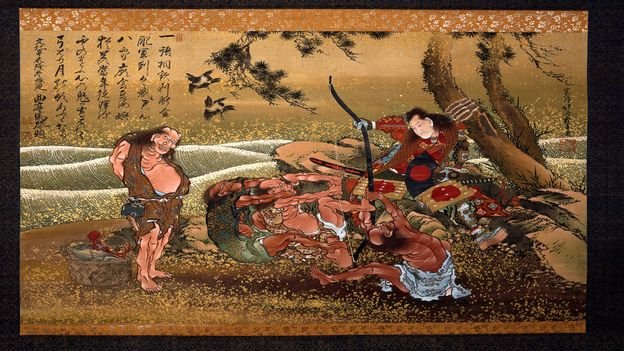
Their playbook for statecraft was based on Chinese philosophy, principally the ideas of Confucius. “In Neo-Confucian thought,” says Buckland, “you have to have a balance between military power and cultural skill.” The ramification was increasing investment in soft power in the incense-infused chambers of the court.

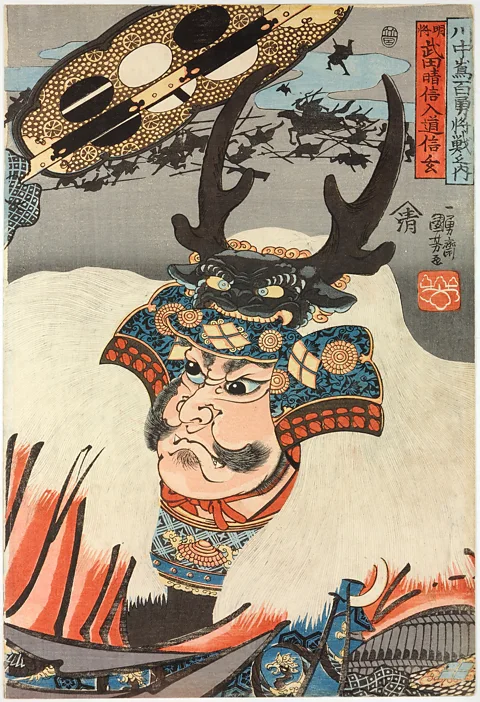 The Trustees of the British Museum
Alongside being adept in the art of war, the samurai became conversant with the refined arts of painting, poetry, music performance, theatre and tea ceremonies. A fan depicting orchids, painted in the 19th Century by a samurai artist, is one of the more beautiful and unexpected items in the exhibition.
Shōgun, the Disney/FX series whose second season is currently in production, provides a fictionalised account of one of the turning points in samurai history. In the 1500s, one clan leader, Tokugawa Ieyasu (represented by the fictional Yoshii Toranaga in the series), established a government that was so successful it lasted for 250 years.
This meant that there were no more major battles within Japan, and the samurai took on new roles. Rather than marshalling the battlefield, they now managed the state. “They’re the ministers, the lawmakers, the tax collectors,” says Buckland. They took on jobs that percolated throughout the court, “right down to being the guards in the castle gates”.




Recent Comments