
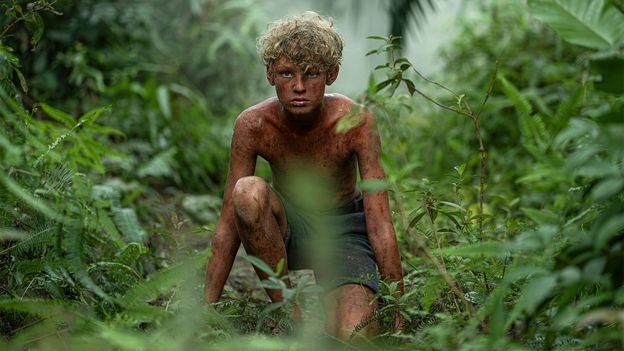

Adolescence writer Jack Thorne has adapted William Golding’s classic novel for his latest TV series about murderous male youth – but it’s a very different beast.
Jack Thorne has long been an acclaimed and prolific playwright and screenwriter, with credits including mega stage-hit Harry Potter and the Cursed Child. Nevertheless, last year’s Netflix phenomenon Adolescence, which he co-created with actor Stephen Graham, sent him into a different stratosphere, given how its tale of a 13-year-old killer cleaned up at the Emmys and sparked a global debate.
So you might say that Thorne choosing next to adapt William Golding’s classic novel Lord of the Flies was simultaneously good brand-building and tempting fate, given its superficial narrative similarities – another tale of boys behaving gruesomely. Yet in fact, Golding’s story of a school party gradually descending into violent anarchy and murderousness after their plane crashes on a desert island, is a very different beast – much more an allegory about the troubles of society full stop than those of male youth.
What Thorne’s bold, chilling four-parter pulls off so expertly is to make the narrative function on two levels – naturalistically, as a tense and immersive thriller, and philosophically, as a dark inquiry into the malignity of collective human behaviour.
His version of the story, which has had its international premiere at the Berlin Film Festival, retains the book’s period setting, with the boys speaking in an archaic, upper-crust British vernacular involving “long vacs” (holidays), “togs” (clothes) and “gnasher paste” (toothpaste). But otherwise, as takes on widely-studied classics go, this feels strikingly fresh and distinct.
Structurally, Thorne’s key innovation is to present each episode from a different point of view, lending it an intimacy of characterisation that is complemented by Marc Munden’s impactful direction. From disorientating fish-eye-lens camerawork to Terrence Malick-style cutaways to nature in action (ants swarming, beetles scuttling), Munden really envelops the viewer in island life. Meanwhile the over-saturated colour palette – blazing reds and oranges, horrifyingly garish greens – gives the whole thing the hallucinogenic quality of a nightmare, something bolstered by The White Lotus composer Cristobal Tapia de Veer’s rumbling, discordant score.





Recent Comments