
 It was October 1942, ten months after America’s entry into the Second World War (1941–1945). A cannon ball, said to be from the Battle of Lake George, was donated to a scrap metal drive in Fort Edward.
The Battle of Lake George was a series of three military engagements on September 8, 1755, near the waterway’s south end. The outcome was a British victory over the French and their Indigenous allies during the French & Indian War (1755–1763).
The iron cannon ball reportedly came from the collection of Orville H. Mott, a Fort Edward and Saratoga Springs physician, who passed away in 1912. Thirty years after Dr. Mott’s death, a former family member, Margaret Rogers, donated the artifact to a junk pile for the war effort.
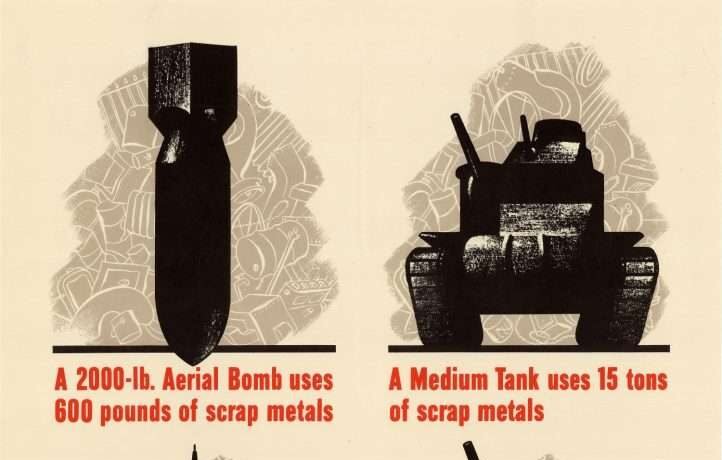
The 1942 scrap acquisitions were part of a nationwide campaign to support the American armed forces as they battled the Axis powers (Germany, Italy, and Japan).
Moreover, other recycling efforts sought rubber, paper, rags, cooking grease (to help make explosives), and other raw materials. Those collections also made non-combatants feel invested in the goal to defeat America’s enemy.
The “Salvage for Victory” metal drives targeted items like old pots and pans, dilapidated iron fences, junked car parts, broken signs, obsolete farm machinery, and even bygone artillery and cannon balls.
However, there were some patriotic Americans who felt that a few objects bound for recycling were historically significant and whenever possible, should be preserved for posterity.
The September 15, 1942 issue of the Glens Falls Times newspaper reported that some folks in Hudson Falls opposed scrapping a Civil War (1861–1865) cannon in their park. They felt that village citizens had already collected an enormous load of scrap metal.
Further, the historic artillery piece, exhibited for years in the village common, symbolized the sacrifices residents made in the Civil War. Yet, other villagers wholeheartedly supported sending the Civil War relic for repurposing. Debates like these were held in towns and cities all around the country.
Additionally, on September 18, 1942, the Glens Falls Times reported that a Civil War cannon in Crandall Park in Glens Falls was bound “for the nation’s scrap metal pile.”
So, across the land, old artillery tubes, cannon balls, shell casings, bayonets, swords, canteens, and other retired militaria ended up being melted and manufactured into modern weaponry. It was after all, a dire time for the United States.
Later in the hostilities, managers at national parks and other cultural sites created priority lists designating significant monuments made of metal and cannons that should not be scrapped unless the war turned for the worse.
Thus, some notable cannons and statues at heritage locations such as Saratoga, Gettysburg, and elsewhere were saved.
One can only wonder, what World War Two object was cast from the old cannon ball from the Battle of Lake George?
Read more about World War Two in New York State.
A version of this article first appeared on the Lake George Mirror, America’s oldest resort paper, covering Lake George and its surrounding environs. You can subscribe to the Mirror HERE.
Illustration: “Get In The Scrap,” one of the many government posters from the Second World War that promoted the scrap program to collect old and unused metal and other materials toward the effort to defeat the Axis powers (courtesy Franklin D. Roosevelt Presidential Library and Museum).





Recent Comments