
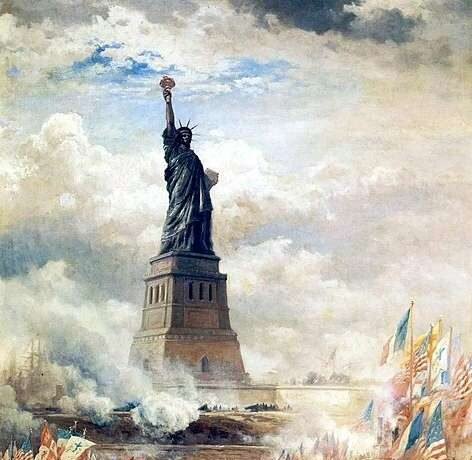
 From the very beginning it was agreed the Statue of Liberty would be a joint venture: France would create the actual copper sculpture; America would provide the stone pedestal on which it was to be mounted.
Strange as it may seem, however, neither government was involved. And neither government paid either a sou or a penny toward the monument’s funding.
Origin Story
Lady Liberty was said to be a gift to America from the French people. It was conceived and promoted by a private citizen: the French abolitionist and democratist Edouard de Laboulaye (1811-1883), who was certain that gifting such a tribute to liberty would strengthen support for democracy in then dictator-ruled France.
 The idea was enthusiastically adopted by French sculptor Frédéric-Auguste Bartholdi (1834-1904), who offered to design the statue. He also helped garner American interest by framing the proposed monument as a commemoration of the U.S. centennial of the Declaration of Independence, to be celebrated on July 4, 1876.
Then came the question of how to pay for it. Although France’s national government declined to contribute money, some 180 cities, towns and villages did. The descendants of French military officers who had fought a century earlier in the American Revolution (including relatives of the Marquis de Lafayette) also donated.
Even school children in the thousands scraped together what they could. But the cost of the project kept rising.
A lottery was held in which merchants donated prizes to be won. And finally, Bartholdi himself sold miniature versions of the statue with the buyer’s name engraved on it. The American centennial was years past.
But at long last, in 1880, the required two million francs (about 400,000 American dollars at the time) had been raised and work on the monument could move forward.
New York Location Almost Doomed
Despite Bartholdi’s public relations visits to the U.S. and particularly to Bedloe’s (now Liberty) Island where the statue was going to reside, the project in America
was controversial. There were factions that preferred the idea of a statue to Lafayette or George Washington.
 The New York Times thought the undertaking sheer folly and objected to spending money on it. Indeed, neither the federal government nor New York State agreed to contribute funding. The U.S. Congress couldn’t agree on a spending package and New York Governor Grover Cleveland even prohibited New York City from appropriating money from its own budget.
Small wonder, then, that fundraising on the American side of the ocean was sorely inadequate. While the statue was nearing completion, nowhere near the $250,000 needed for the pedestal was in the coffers and the stone platform was barely under construction.
What’s more, Boston and Philadelphia were happy to throw their hats in the ring. They each expressed interest in funding the statue provided it was moved to their municipalities.
Competition helped. Some of the money that trickled in no doubt came from wealthy donors. An art show loosened some wallets. Emma Lazarus was commissioned to write her now famous poem.
There was even a fund-raising rally on Wall Street. But the flow of contributions was slow.
Enter Joseph Pulitzer
Joseph Pulitzer was owner of the New York World newspaper and a Hungarian immigrant. So perhaps it was not surprising that he so energetically embraced the cause of the statue now that Lazarus’ poem had inextricably linked it to the plight of “homeless, tempest tossed” immigrants.
He vehemently encouraged his readers to donate and promised to print the name of each contributor, no matter how small the amount.
 “We must raise the money!” he instructed. “The World is the people’s paper, and now it appeals to the people… Let us not wait for the millionaires to give us this money. It is not a gift from the millionaires of France to the millionaires of America, but a gift of the whole people of France to the whole people of America.
His urging seemed to unlock hearts. Millions of individuals across the nation donated what they could. School children donated pennies. The sum of $1.35 came from a kindergarten class in Iowa.
In August 1885, just a month after the Statue itself had arrived in New York, Pulitzer’s paper announced that the needed balance of $100,000 had been collected from more than 120,000 people and the pedestal could be completed.
In somewhat of an irony, on October 28, 1886, former New York Governor Grover Cleveland — skunk at the party and now President of the U.S. – dedicated the Statue of Liberty handsomely erected on its stone platform.
Read more about the Statue of Liberty.
This essay was first published in Blackwell’s Almanac, the newsletter of the Roosevelt Island Historical Society. The Society was founded in 1977 to recover, maintain and disseminate the record of Roosevelt Island’s heritage from colonial times to the present. Visit their website at www.rihs.us.
Illustrations, from above: Edward Moran’s “Unveiling the Statue of Liberty Enlightening the World,” 1886 (Museum of the City of New York); The Statue of Liberty’s hand and torch on view in Madison Square, NYC (Museo Bartholdi Colmar); Albert Fernique’s “Assembling the Statue of Liberty,” Paris, 1883; and the September 11 attacks in New York City and the Statue of Liberty (National Park Service).




Recent Comments