
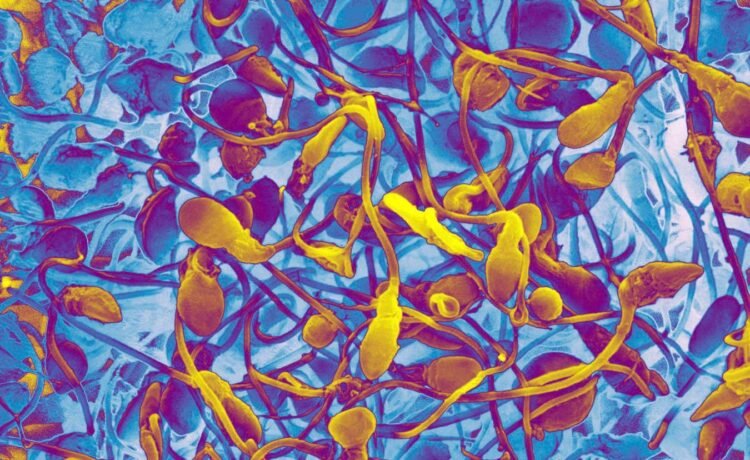

Coloured scanning electron micrograph of human sperm cells
PDC/SCIENCE PHOTO LIBRARY
Infertility isn’t something men like to talk about but it’s very common. Around 1 in 10 couples will have problems with conception, and in half of cases it is wholly or partly to do with sperm. In many cases, existing fertility treatments can’t help – but a US start-up called Paterna Biosciences thinks it can change this.
Paterna claims that it can take stem cells from the testes and turn them into sperm cells in the lab. What’s more, the company says this technique could enable almost all the men for whom fertility treatments currently fail to father children of their own.
But others in the field think it could be of very limited use for treating male infertility – unless it’s combined with CRISPR gene editing. That’s right, I’m talking about creating gene-edited children.
Let’s start at the beginning. There are a huge range of reasons why men may struggle to father a child. They may have a low sperm count, their sperm may not be good swimmers or may lack the ability to enter the egg, and so on. In these kinds of cases, injecting a sperm directly into an egg – intracytoplasmic sperm injection, or ICSI – as part of IVF treatment usually works.
Around 1 in 100 men don’t have any sperm at all in their semen. (This often-cited number is from an old paper, by the way, and could well be higher now, given the apparent decline in male fertility – but that’s another story.) This lack of sperm can be because some kind of obstruction is preventing the sperm from reaching the prostate. In these cases, it is usually possible to remove the obstruction or take sperm directly from testes.
But in most cases where there are no sperm in semen, it is because very few or none are being produced in the testes. That’s where Paterna Biosciences comes in. Paterna’s co-founder and head Alex Pastuszak says the company can take small pieces of tissue from testes and generate “high-single-digit to tens of thousands of sperm” from each piece.
Paterna’s team is able to do this, because they have identified the signals that tell sperm stem cells to start forming sperm, says Pastuszak. The process takes around a month in the lab.
The first question is whether this is true. Paterna has provided no evidence to back its claim yet. Pastuszak says this is about protecting intellectual property. “I’m not going to publish something that will go into the public domain until we have protection around that,” he told me.
We have been here before – a French biotech company called Kallistem made a similar claim in 2015 and did publish a paper in 2016. Other researchers were not convinced, and nothing has come of it.
Paterna says it has gone further, however. The company says the sperm it derived were able to fertilise human eggs, which developed into early embryos.
Independent researchers say Paterna has good scientists on its team and that it is possible they have done what they claim – but are reserving judgement until they see the evidence. “If they’ve done what they say, it’s an enormous breakthrough,” says Geert Hamer at the Amsterdam Reproduction & Development research institute in the Netherlands.
Potential genetic errors
Let’s assume for now that Paterna has done what it claims. The next question is whether this really can help men who don’t produce sperm. And the first issue here is whether it’s safe.
Sperm are formed from stem cells in the testes. When these stem cells divide in two, one cell remains a stem cell. The other divides to form four sperm via a process called meiosis, during which chromosomes swap bits of DNA.
“That’s a very dangerous situation,” says Miles Wilkinson at the University of California, San Diego, who studies sperm stem cells. When DNA is broken there is a risk of it not being put back together right, so it is really important meiosis isn’t disrupted – and if the lab conditions are not perfect, there could be a higher risk of this happening during Paterna’s procedure. That said, it is possible to remove cells from IVF embryos before implantation to test for any mutations that could come from meiosis gone awry.
Another risk is imprinting errors. During sperm development in mammals, a number of genes in sperm are turned off by the addition of chemical tags, known as imprinting. If this goes wrong, it causes serious developmental conditions. Imprinting errors are common in mouse sperm derived from stem cells made from body cells, says Hamer. But because Paterna is using existing stem cells from the testes, he thinks the risk is low.
Pastuszak says the lab-grown sperm appear normal. “We’ve shown that the sperm that we’re creating in vitro look molecularly exactly like the sperm that are made in the cysts [in the testes],” he says. “In some cases, actually better.”
The company is aiming to implant embryos fertilised with lab-grown sperm into women as early as next year. “Our first significant trial will probably be outside of the US, still under regulatory auspices, for sure,” says Pastuszak.
It’s not clear what evidence regulators would want before allowing the use of lab-grown sperm in IVF. In the past, it has to be said, fertility doctors just went ahead and tried methods like IVF and ICSI without knowing for sure they were safe.
Assuming Paterna’s technique is safe, the next big question is what proportion of infertile men it could help. A few men who do not produce sperm lack sperm stem cells altogether, and this certainly won’t work for them.
Others have sperm stem cells that fail to turn into sperm, and mutations are probably to blame in a lot of cases. “There’s been a long-standing thinking that a significant proportion of male infertility came from genetic mutations. That may be true,” says Pastuszak.
Outside experts doubt that Paterna’s technique will help in these cases. If a mutation is blocking meiosis in the testes, Hamer says, it’s also likely to block it in the lab. For this reason, he thinks the main group that could benefit are men who are infertile as a result of cancer treatments they received as boys, and who have frozen testicular samples taken before that treatment.
“If they’ve really achieved this, it would be great news for boys who become infertile due to chemotherapy,” says Hamer. But that’s a very small proportion of infertile men.
Another small group who could benefit, Wilkinson says, are men who do have a little sperm formation happening. At present, the only option for these men is a many-hours-long procedure called microdissection testicular sperm extraction (mTESE) that involves slicing a testis in half and hunting for any areas of sperm formation.
“If mTESE could be avoided, that would be great, as it is a highly invasive surgery to say the least,” says Wilkinson. “So in vitro spermatogenesis has an exciting niche here.”
The children of lab-grown sperm

Lab-grown sperm could help men father children, but it may require additional genetic techniques
Mayte Torres/Getty Images
But Pastuszak claims his team has been able to derive sperm in the lab from men who do not produce any sperm in their testes. “We’re seeing that most of these germ cells are maturation competent. The defect appears to be in the signalling from the support cells that provide the signals for those germ cells to mature [into sperm].”
Again, we have no evidence to back this up. I’m sceptical but I also really do hope he is right, because a lot more families might benefit if he is. “If somehow Paterna can make sperm from these men despite their having a mutation responsible for their spermatogenic defect, then this will obviously be huge,” says Wilkinson.
In this case, there’s yet another issue to consider – there would be a high chance of any male children born from lab-grown sperm inheriting the problematic mutation and being infertile, too. This is also a worry with ICSI. The latest ICSI study didn’t see those worries bear out, but it could be a more serious issue with lab-grown sperm.
Does Pastuszak think so too? “I would say maybe,” he says. Even if it is an issue, he says there are tests that can be done at various stages to screen out cells or embryos with harmful mutations.
What if Paterna is wrong and lab-grown sperm cannot be derived from most or all men with mutations causing their lack of sperm? Well, there is a potential solution – using CRISPR gene editing to correct the mutation causing infertility in the sperm stell cells, making it possible for them to turn into sperm and resulting in the birth of gene-edited children who lack the harmful mutation.
This is not nearly as easy as it sounds, because in most cases we don’t have a clear idea of what mutation might be to blame, just some rather tentative associations. “There’s really very little proof,” says Wilkinson.
Even so, in my view, in cases where we can pin down the exact mutation, the use of germline gene editing for this purpose would justified. In fact, it’s the only compelling case for its use that I know of. There are, of course, potential safety issues with CRISPR, but pre-implantation genetic testing could be used to check for any unintended changes.
Paterna is not ruling it out. “I’m not going to take that off the table, because I think science and technology are going to continue to advance, and the goal here is to help a lot of people,” says Pastuszak.
Topics:






Recent Comments