
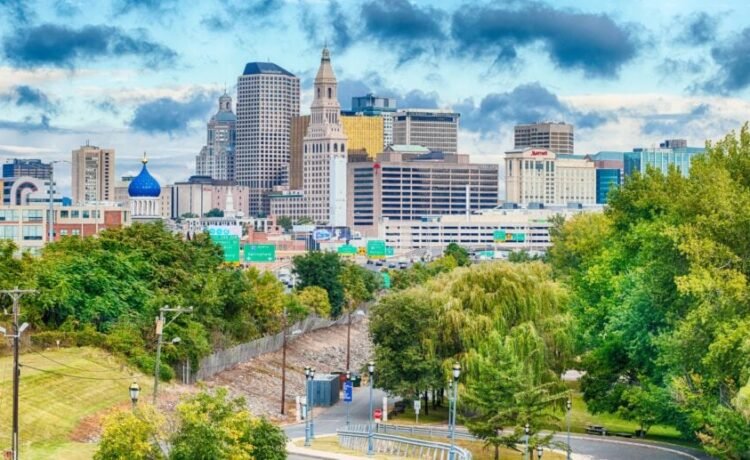
If Hartford, Connecticut, were a movie character, it would be Keyser Söze from The Usual Suspects. The once-unassuming city, known as the insurance capital of the world, has, for many years, masked a darker alter ego, only recently revealed: America’s most cutthroat real estate market.
In all fairness, even veteran real estate investors likely never knew their hometown would become Zillow’s hottest housing market of 2026, prompting bidding wars with all-cash offers like it was 2021 and driving prices up by 70% over the last six years.
So how did Hartford go from mild to wild? It’s a plot twist transformation that serves as a good case study for small investors chasing the latest rental hot spot and knowing when to turn or risk getting burned.
Why Hartford Earned Zillow’s Coveted Top Housing Market Spot
Hartford’s win wasn’t merely clickbait. The combination of expected home price growth this year, based on last year’s numbers, which saw 66% of houses sell for over list price and sit on the market for only a week, combined with low inventory—still 63% below pre-pandemic levels—earmarked Hartford for an intense year of price hikes and bidding wars.
Zillow senior economist Orphe Divounguy said that in Hartford, “buyers must compete to elbow their way to the front of the line, which creates hot conditions that elevate a market to the top of the list.”
Investors Flood In
Zillow also noted that many of its top markets were in the Northeast and California, close to large job centers, but where new housing construction has been slow. According to The Wall Street Journal, the pandemic was a game-changer for Hartford, which sits halfway between New York and Boston—a two-and-a-half-hour drive to both. As prices started to increase, investors from surrounding big cities began flooding in, looking for flips or rentals.
“Right now, houses don’t last more than a day on the market if they’re priced correctly,” Kristen Duchene, a Connecticut real estate agent and broker, told the Journal.
The key for investors looking at cities like Hartford is to try to see what’s around the corner. Its proximity to densely packed urban centers means it has always had the potential to be a rental hot spot. However, its housing market was decimated after the 2008 financial crash, with job growth in dire shape and homebuyers able to negotiate prices lower at will.
“There was no competition,” investor Eben Busa, who bought his first home in the area in 2017, told the Journal. “I would come in and say, ‘I want your grill,’ or ‘I want this wall repainted,’ and then I would still come in with an underbid.”
Stable Industries and Affordable Prices
Recovery hit Hartford’s leafy suburbs first, with stately older homes housing employees in the state’s main industries in insurance, healthcare, education, and aerospace. The older housing stock made it a haven for flippers. The lack of inventory meant that flippers who could find deals made tidy profits in record time when they listed their projects.
However, despite the increase in house prices, Hartford is still relatively affordable, with the average home in the city costing $189,744 and the average rent $1,529 as of January 2026, according to local newspaper The Bulletin, meaning that it is still possible to cash flow or at least break even.
The city’s low supply means those prices will surely increase. For now, with low prices and assuming the neighborhood is not treacherous, the numbers make sense.
Good and Bad Neighborhoods
That’s a big assumption, because just because a market is deemed to be “hot” doesn’t mean it’s a good investment, like many cities. Hartford has its good and bad areas.
Many investors fail to realize this as they rush in from pricey cities like New York and Boston to cash in on the hype around Hartford and its low prices. Last year, WalletHub ranked Hartford among the worst state capitals to live in, based on cost of living, affordability, education, economic well-being, and crime, among other factors.
Chip Lupo, WalletHub analyst, said in the report:
“A state’s capital city is more than just the seat of its government—it’s also often the center of its economic activity. Some state capitals boast incredible job markets, high average salaries, world-class universities, and an abundance of attractions. Unfortunately, others have populations that are struggling financially, failing public education systems, and poor public health systems. States should aim to make their capital city a shining example of the best they have to offer.”
In Hartford’s defense, a slate of new development projects and housing will have a major impact on the city’s complexion, which is why, with a still surprisingly reasonably priced housing market, Hartford is attracting the kind of buyer interest it is.
That’s reflected in Realtor.com‘s projected 17.1% median price growth for Hartford in 2026, with the listing site’s economists citing “chronically tight inventory” as the driver. The pricier areas of Hartford are pushing buyers to look elsewhere in the city, where they can get more bang for their buck, and driving price growth outward.
“People are saying, ‘OK—I can either continue to search in West Hartford and go for a small home, or I can get a larger home [elsewhere],” Alexa Kebalo, Connecticut Realtors president and a broker in the West Hartford office of ENRG Realty, told CT Insider. “I think a lot of people are realizing that you can have a dream list…but then you have a ‘what can I actually afford list’—the real list, in that your finances are what your finances are.”
Final Thoughts: Lessons From Hartford, Connecticut, for Investors Eyeing Cutthroat Markets
For investors looking to buy in similar “sleeper” markets like Hartford, recent data offers a few practical pointers.
First, the combination of low inventory and short days on market, highlighted by Zillow, means that financing and underwriting need to be in place before making any offers in Hartford. In this market, 2021 rules apply—no contingencies, over-asking-price offers, and all-cash buyers jump to the front of the line.
Secondly—of particular interest to buy-and-hold investors—rents are still rising year over year while the rest of the market cools, which augurs well for cash flow.
Finally, and this is a biggie: The limited concentration of older homes, especially in the city, means that single-family or small multifamily rentals are the prevalent type, favoring small landlords.
However, a large number of tenants (55%) are cost-burdened, and many of the city’s landlords were recently cited for violations of poor living standards. Much of the rental population is working-class and financially strapped, and the real estate is often in poor condition. This rental market is not easy to navigate if you want a stress-free life as a landlord.
Yes, the housing is relatively affordable and increasing in price, but you will need good property management, cash on the sidelines to handle repairs, and you will have to work for every penny of cash flow and equity. There is money to be made, but don’t believe the hype; it won’t come easy.






Recent Comments