
 Launched in July 1900, the transatlantic liner S.S. Vaderland (Flemish for fatherland) sailed the route between Antwerp and Hoboken on behalf of the Red Star Line. Catering for 340 first-class, 200 second-class, and over 600 third-class (formerly steerage) passengers, the liner was one of “mid tier” elegance rather than opulence and designed to compete with its rivals of the Cunard and White Star lines. She played a key role in the early history of mass emigration from Europe to the United States.
On May 25, 1912, the liner left Antwerp, arriving at Ellis Island for immigrant inspection on June 4th. On board was a talented twenty-year-old Polish woman keen to break free from traditional Jewish domestic constraints and find intellectual and sexual freedom in Manhattan.
Refusal & Removal
Every era creates its own political vocabulary reflecting current socio-cultural and ideological issues. Exclusion and deportation were keywords in American political discourse of the 1920s but attempts to “control” the influx of people go back to colonial days.
In 1639, Massachusetts law makers authorized towns to remove paupers. In 1683, New York handed local officials the legal right to send transient beggars to the “country from whence they came.”
 Waves of European immigrants during the late nineteenth century provoked a nativist backlash fueled by the fact that most newcomers originated from Southern and Eastern Europe.
Catholics (especially Irish, German and Italian) and Jews were viewed as inferior to the “old [Protestant] stock” of settlers. Concerns about criminality dominated the public debate. Perceived links between immigration and urban crime would shape federal law from the 1882 Immigration Act onward.
A process of tightening entry conditions culminated in the 1924 Johnson-Reed Act which capped new arrivals by banning most Asian immigrants and imposing nationality-based quotas. It created a Border Patrol to enforce limits on the number of Mexicans and other “illegal aliens” entering the country.
An entire bureaucratic apparatus was set up to track undocumented residents. It became a lucrative business challenge with railway companies competing for contracts to transport deportees and private property owners offering (unsuitable) accommodation to hold and guard them.
The Act curtailed the flow of arrivals, but immigrants were still blamed for driving up crime rates. The number of deportations rose significantly during the decade, escalating from 2,762 in 1920 to 16,631 in 1930.
There was a clear shift in policy from one that tried to restrict mass entry to a more active intervention of monitoring individuals already living in the country.
 Post-entry infractions allowed authorities to expel individuals for violating immigration law or breaching conditions of stay. The policy targeted two distinct groups for deportation.
Following the First World War the fear of social agitation led to the Palmer Raids in which officials used post-entry infringements as a justification to deport political leftists. This was the First Red Scare.
The other group was more vulnerable. LPC (Liable to Public Charge) was an immigration term for individuals likely to become dependent for subsistence.
Introduced in the 1882 Immigration Act and signed by Republican President Chester A. Arthur (the son of an Irish immigrant), the concept has been in operation ever since.
The updated Act of 1891 listed “classes of aliens” to be refused admission, including “idiots, insane persons, paupers or persons likely to be come a public charge.” Deportation gradually transformed from a process of last resource into a mechanism of social control.
Moral Turpitude
Legal provisions designed to uphold “healthy” moral standards focused strongly on single women. The law allowed for the arrest of any female who, within a five-year period following arrival, turned out to be a “public charge.”
While the early part of the decade was marked by the “sensational” removal of agitators, the “deportation machine” then became increasingly obsessed with removing women for financial dependency and/or moral infractions such as prostitution.
Federal officials gathered lists of foreign-born individuals in public hospitals, prisons, and alms-houses, creating a hostile environment for women who cared for their children alone. Deportations regularly split families, with mothers expelled and children left behind.
Immigration officials used poorly defined crimes of “moral turpitude” to deport women, specifically those suspected of prostitution, living out of wedlock, or any other diversion from traditional family orientated standards.
 So-called “White Slave” legislation was drawn up to target “immoral” behaviors or illicit relationships. An ill-defined charge, officers also sought out independent women who, like Emma Goldman, dared to criticize the political status-quo.
During the 1920s, attitudes toward lesbian women were a contradictory mix of increased visibility and punitive regulation. Within covert subcultures of Chicago or New York City, women adopted masculine fashion to signal lesbian identity.
The monocle, first worn by women in Paris, became a marker of gender affiliation; Le Monocle was a fashionable lesbian bar and club opened in the 1920s on Boulevard Edgar-Quinet, Montparnasse (it closed when the German forces occupied then city).
Such symbols may have been tolerated as “daring” and bohemian in alternative urban settings, but mainstream society ridiculed them as unnatural. Viewed as a psychological deviancy, social observers labeled lesbianism a depravity or mental illness.
Growing visibility triggered a reactionary response. The Great Depression and renewed political conservatism led to increased intolerance.
Lesbian venues became once more subject to surveillance and police raids. In this climate of suspicion and persecution, a lesbian immigrant woman with anarchist sympathies was bound to face a barrage of hostility.
Tearooms
Chaka Złoczower (Kotchever) was born in June 1891 in the Polish town of Mława (part of the Russian Empire) into a large Jewish working-class family. Little is known about her youth, but when she sailed from Antwerp to New York City through Ellis Island, she was a confident multi-lingual person.
 On arrival, she anglicized her first name to “Eve” and took “Adams” as her last name, a choice that some of her later adversaries considered provocative. As many Jewish immigrant women did at the time, she started as a factory worker in New York’s garment industry.
Amongst her early contacts was the Russian-born anarchist Emma Goldman. Given Poland’s socio-political turmoil of her younger days, it is probable that she herself held radical ideas on arrival.
Eve became a traveling salesperson of subversive periodicals such as Emma Goldman’s Mother Earth and Max Eastman’s The Liberator. By 1919, the year that Goldman faced deportation, Eve Adams was a suspect under surveillance by the “Radical Division” of J. Edgar Hoover’s Bureau of Investigation (later known as the FBI).
In 1921, Eve settled in Chicago with her lover, the Minnesota born painter Ruth Olsen Norlander (1889-1973). For about eight months, the couple ran a tea room named The Grey Cottage in East Chestnut Street, Towertown, frequented by a gay and lesbian clientele.
After the 1893 World’s Columbian Exhibition, artists, writers, and poets had settled in the district, attracting the opening of radical bookshops and bohemian clubs (including the legendary Dill Pickle Club).
At the time, the term “tearoom” had two distinct meanings: a social venue for unchaperoned women to meet and socialize; as well as a slang term used in gay subculture (referring to a public lavatory used for male sexual encounters).
Like it was for The Grey Cottage, some women-owned establishments provided a front – “tearoom” was a lesbian code for safe space at a time that same-sex activity was criminalized.
 By 1924 Eve had returned to Manhattan, living in a block (now demolished) at 38 Washington Square West. She ran a small tearoom named Eve’s Hangout in the basement of a row house at 129 MacDougal Street in Greenwich Village which became a destination for local activists, gay men, and lesbians.
Inevitably, the Hangout was watched by police; local crusaders who campaigned to “clean up” the area turned into informants. A Village alliance of social radicalism and moral “aberration” was intolerable to them.
There was more to come. In February 1925, Eve Adams (pen name Evelyn Addams) published a privately printed collection of nine short stories entitled Lesbian Love in a limited edition of 150 copies for circulation among friends.
It was America’s first ethnography of lesbians. The stories, reflecting personal encounters and relationships from the author’s past, predated the publication (and obscenity trial) of Radclyffe Hall’s Well of Loneliness by three years.
That is the historical significance of the book. The choice of title was audacious. The term “lesbian” at the time was associated with medical literature and used to pathologize women in same-sex liaisons.
It was this negative label of “perversion” that Adams embraced to give identity to a type of relationship that needed recognition.
Vice squad officer Margaret Leonard was instructed by the NYPD to visit Eve’s Hangout and gather undercover evidence against its owner. She claimed that Eve had made sexual advances.
The latter was arrested on June 17, 1926, at her tearoom being accused of indecency in print and disorderly conduct towards a female officer. According to police transcripts, she had ten copies of her book left, all of which were confiscated and destroyed.
 The only known surviving copy was traced back by Jonathan Ned Katz when preparing his biography of Eve Adams, an iconic study that saved her “daring life” from oblivion.
Katz added the complete text of Lesbian Love as an appendix to his book copy Lesbian Love was sold by the owner in 2024 at Bonham’s “Remarkable Women” auction.
Convicted to a sentence of one year for her “crime,” Eve was locked up in the women’s penitentiary on Welfare (now Roosevelt) Island. There she crossed paths with the notorious Mae West (1893-1980) who had been sentenced to ten days imprisonment for the alleged obscenity of her acclaimed Broadway play, Sex.
While West was treated as a celebrity and quickly released, Eve had to face deportation proceedings. The trumped-up charges were an excuse to punish Adams for her friendship with Emma Goldman. She was deported to Poland on December 7, 1927, and not allowed to return to America.
 Convoy 63
In 1930, Eve moved to Paris, where she worked under the name Eva Kotchever as a street bookseller along the Left Bank, offering “forbidden” writings by Henry Miller (including Tropic of Cancer), Anais Nin, and others, to American tourists.
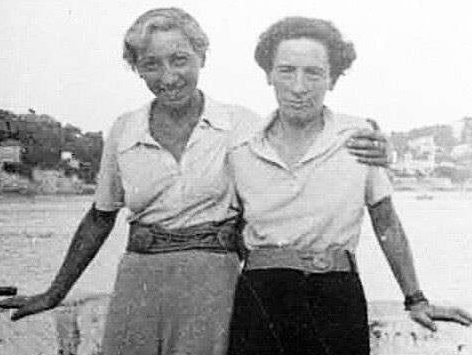
Three years later she met Hella Olstein Soldner, a Jewish singer who originated from Łódź, Poland. Eve was hired to take care of Hella’s house, but it was an open secret that the two were a couple.
In 1940, the Nazis marched into Paris and many of city’s Jewish residents fled to the “zone libre” of southern France. This territory was not occupied by German forces until November 1942.
Administered by the collaborationist Vichy regime under Marshal Philippe Pétain, the latter would participate in rounding up Jews (in razzias), often prioritizing the removal of foreign Jews.
Having settled in Nice on the Mediterranean coast, Eva and Hella were arrested at their home in December 1943. They were held briefly at Drancy, the main French transit camp near Paris, before being sent to Auschwitz on Convoy 63.
The train left on December 17, 1943, transporting 848 men, women, and children. Most of them were sent to the gas chambers upon arrival. There were few survivors.
 Adams and Olstein were not amongst them. It is not even known if the couple were together or separated during that fateful journey.
In 2021, the city of Paris named a street for her in the 18th arrondissement, Rue Eva Kotchever.
Read more about LGBTQ+ History in New York State.
Illustrations, from above: Postcard showing S.S. Vaderland on the River Scheldt leaving Antwerp for New York; Thomas Nast’s “Uncle Sam’s Thanksgiving Dinner” from Harpers Weekly, 1869 (colorized); I.W.W. New York City headquarters after a Palmer Raid, 1919; H. W. Lytle & John Dillon’s From Dance Hall to White Slavery: The World’s Greatest Tragedy (Chicago: Charles C. Thompson, 1912) from the collection of John Warren; Adams’ Polish passport, 1928 (Daniel Olstein Collection via OutHistory); Cover of what’s believed to be the only remaining copy of Lesbian Love; Eve Adams (right) and Hella Olstein (Daniel Olstein Collection); and the plaque for Eva Kotchever Street in Paris, 2021.






Recent Comments