
Many landlords are playing the long game. That’s the conclusion drawn from a survey by rental property management platform Avail (Part of Realtor.com), a partner of BiggerPockets, in their 2026 Independent Landlord Survey.
The report found that 1 in 5 landlords had a standing policy of not raising rents for tenants despite increasing operating costs. The reasoning behind the reluctance to raise rents is the fear of vacancies, repairs, and re-leasing. In other words, “don’t risk losing a stable tenant for the sake of a few dollars more in extra rental income.” But is it a wise strategy? Let’s figure it out.
Key Survey Insights
The survey revealed some fascinating insights:
- 74.4% of landlords saw property ownership costs rise this year.
- 18% of landlords maintain a strict policy of avoiding regular rent increases.
- 78.3% of landlords chose communication and payment plans over legal action.
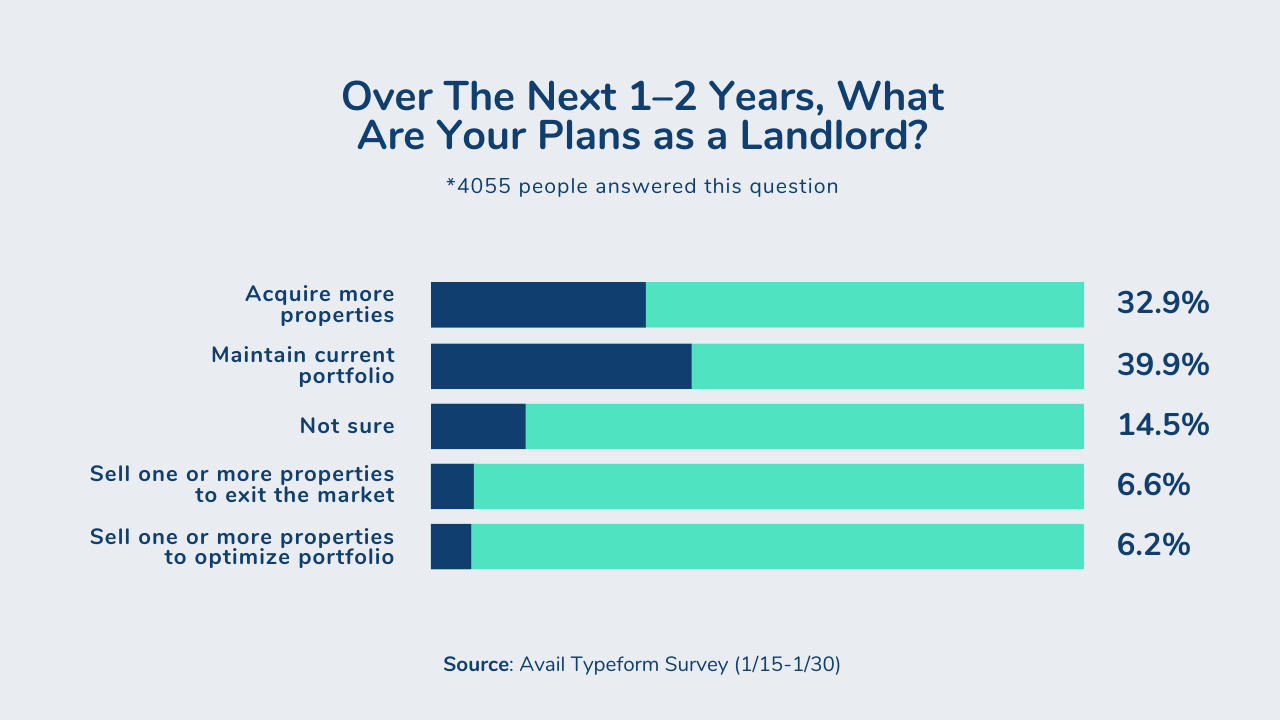
- Nearly 1 in 3 landlords intend to expand their portfolios over the next 24 months.
The Cost Squeeze
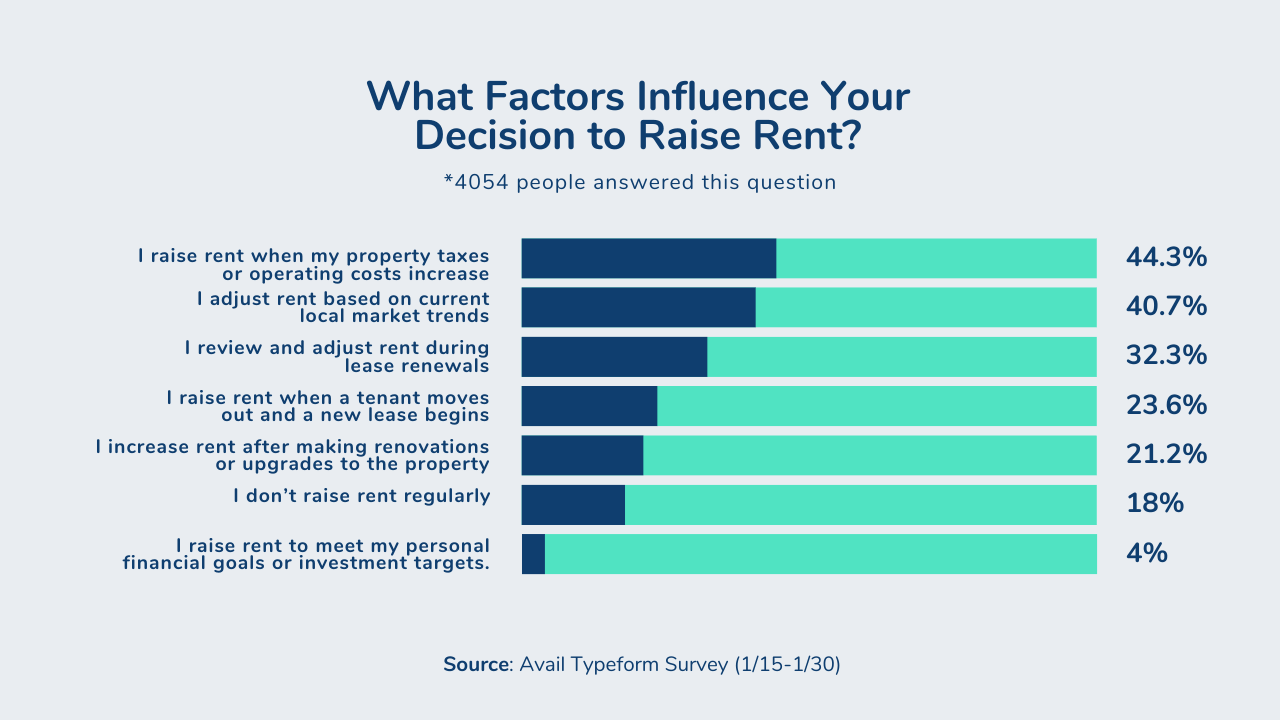
The rising costs of property taxes and insurance have been on every landlord’s mind, and Avail’s data shows that this was true for 74.4% of landlords surveyed. However, only 44.3% of landlords who raised rents cited taxes and insurance as their primary reasons.
Unlike large corporate landlords, who can absorb vacancies and have been accused of using algorithmic pricing to systematically raise rents, smaller landlords fear an empty apartment more.
Pro-Tip: Navigate the “Squeeze” with Precision
When taxes and insurance rise, your margins depend on operational efficiency. Use Avail’s Rental Property Accounting tools to track every expense against your rental income in real-time. By having a clear view of your cash flow, you can identify exactly where to cut costs, allowing you to keep your property viable without relying solely on aggressive rent hikes. Start tracking income and expenses here.
The Retention Argument
Real estate investor Soli Cayetano told Realtor.com:
“Tenants don’t care about your expenses—they care about value compared to other available options. Vacancy is way more expensive than being slightly under market. When a property sits empty for an extra month, you’re not just losing that month’s rent—you’re still paying the mortgage, utilities, and other carrying costs.”
Other factors—aside from taxes and insurance—influencing a landlord’s decision to raise rents, according to Avail, were:
- Current local market trends: 40.7%
- A lease renewal: 32.3%
- Start of a new tenancy: 23.6%
- New pricing following upgrades and renovations: 21.2%
- Personal financial goals or investment targets: 4%
These numbers align with the overall takeaway from Avail’s survey: Landlords are thinking long-term. Their data show that 32.9% of landlords plan to acquire additional property over the next two years, while only 6.6% intend to exit the market.
For expansion-minded landlords, stability is key. Maintaining steady revenue is essential for securing future loans and demonstrating competent stewardship of current portfolios. It also gives owners a certain peace of mind as they take on more risk/debt, and tenants.
The Math on Vacancy
For landlords, a vacant apartment versus an incremental rent increase comes down to the numbers.
- Current rent: $1,500 per month
- Proposed increase: $125 per month (to $1,625)
- Tenant leaves because of the increase.
- The unit sits vacant for one month.
The extra income from the increase, if the tenant stayed, would be:
$125 per month x 12 months = $1,500 in extra rent over one year.
However, if a tenant moves out, you lose one full month at $1,500 per year. Not only have you just lost that $1,500, but you have to incur the following costs (not including utilities):
- Turnover repairs and touch-ups
- Cleaning and trash removal
- Advertising and leasing time
- Application processing and screening costs
- The possible sacrifice of the first month’s rent to the property management company/agent who secured the new tenant
Let’s assume that you are leasing and renting the property yourself. The conservatively estimated cost of expenses could be:
- Cleaning: $150-$300
- Paint/touch-up repairs: $200-$800 (considerably more, depending on damage)
- Advertising/listing/photos: $50-$200 (and the cost of your own time)
- Application/screening/leasing admin/credit report: $50-$150 (and your own time)
To make the math easier, let’s use conservative additional turnover costs of $1,000. This makes the total cost of losing a tenant:
$1,500 + $1,000 = $2,500.00
To earn back the $2,500 in higher rent, you will need $2,500 ÷ $125 = 20 months.
Now, it’s not just one year of increases wiped out by a vacant apartment, but almost two years.
Pro-Tip: Take the Guesswork Out of Your ROI
Before you send a renewal notice, you need to know exactly where you stand. Use Avail’s Rent Price Analysis report to compare your unit against local comps. Get a professional report that helps you justify a modest increase to your tenants—or confirms that staying put is the smarter financial move. Get your rent report here.
A tacit understanding
Although it may not be formalized in writing or verbalized, there appears to be a tacit understanding between landlords and tenants: “I won’t move if you don’t raise the rent.” That’s because moving is equally as financially punishing for tenants as it is for landlords.
The Avail report shows that 36.1% of landlords have reported that tenants are staying longer in their rentals these days than in previous years, almost five times as many as in shorter-stay tenancies.
These cost-of-living crises and the difficulty of getting into the housing market are considered major contributing factors. High interest rates and property prices are forcing would-be buyers to stay on the sidelines as renters.
Making the Call
Knowing when to raise rents on tenants is not an exact science. In a high-demand area with rapidly rising rents, a landlord might feel quietly confident that they can risk a vacancy, given the quick turnover at a far higher rent. This is often the case when there is a significant gap between the rent you are charging and market rents. The argument is strengthened if a modest increase is needed to keep the unit financially viable.
On the flip side, Avail’s findings show that relationship-focused management is the key to holding the line with rock-solid tenants who have a spotless payment history. In those cases, the risk of vacancy and turnover costs can by far outweigh the upside of increased rent.
Final Thoughts
Landlording has many moving parts; it’s partly a psychological/relationship-based process. Knowing how to treat your tenants (Avail’s report shows that 78.3% respond to late rent with communication or payment plans, not legal action) goes a long way toward mitigating future issues before they arise. Tenant retention is a key aspect of maintaining and stabilizing a rental property.
However, being a landlord is also a business, and ultimately it comes down to the numbers. Once the risk of losing a tenant no longer outweighs the reward of keeping them at current rental prices, an increase is the only solution.
Pro-Tip: Optimize for Long-Term Stability
Successful landlording is about knowing when to hold and when to fold. Avail empowers you to maintain high retention through Credit-Building and easy digital payments, while giving you the market insights needed to know when your property’s value has outpaced its current rent. Use the full Avail suite to ensure that your business remains as stable as the properties you manage. Sign up for free to start.






Recent Comments